Alternatives to Animal Testing
During a government meeting about funding for research, former U.S. National Institutes of Health director Dr. Elias Zerhouni admitted to his colleagues that experimenting on animals to help humans has been a major failure:
“We have moved away from studying human disease in humans. … We all drank the Kool-Aid on that one, me included. … The problem is that [animal testing] hasn’t worked, and it’s time we stopped dancing around the problem. … We need to refocus and adapt new methodologies for use in humans to understand disease biology in humans.” —Dr. Elias Zerhouni
Today—because experiments on animals are cruel, time-consuming, and generally inapplicable to humans—the world’s most forward-thinking scientists are developing and using animal-free methods that are actually relevant to human health for studying diseases and testing products. These alternatives to animal testing include sophisticated tests using human cells and tissues (also known as in vitro methods), advanced computer-modeling techniques (often referred to as in silico models), and studies with human volunteers. These and other non-animal methods are not hindered by species differences that make applying animal test results to humans difficult or impossible, and they usually take less time to complete.
PETA and our affiliates fund the development of many of these alternatives to animal testing, vigorously promote their use to governments and companies around the world, and publish research on their superiority to traditional animal tests.
Here are just a few examples of the numerous state-of-the-art, non-animal methods available and their demonstrated benefits:
In Vitro Testing
- Researchers have created “organs-on-chips” that contain human cells grown in a state-of-the-art system to mimic the structure and function of human organs and organ systems. The chips can be used instead of animals in disease research, drug testing, and toxicity testing and have been shown to replicate human physiology, diseases, and drug responses more accurately than crude animal experiments do. Some companies, such as AlveoliX, MIMETAS, and Emulate, Inc., have already turned these chips into products that other researchers can use in place of animals.
- A variety of cell-based tests and tissue models can be used to assess the safety of drugs, chemicals, cosmetics, and consumer products. For example, MatTek Life Sciences’ EpiDerm™ Tissue Model is a 3-dimensional, human cell–derived model that can be used to replace rabbits in painful, prolonged experiments that have traditionally been used to evaluate chemicals for their ability to corrode or irritate the skin.
- The PETA International Science Consortium Ltd. helped fund the development of MatTek Life Sciences’ EpiAlveolar, a first-of-its-kind 3-dimensional model of the deepest part of the human lung. The model, composed of human cells, can be used to study the effects of inhaling different kinds of chemicals, pathogens, and (e-)cigarette smoke.
- Devices made by German-based manufacturer VITROCELL are used to expose human lung cells in a dish to chemicals in order to test the health effects of inhaled substances. Every day, humans inhale numerous chemicals—some intentionally (such as cigarette smoke) and some inadvertently (such as pesticides). Using the VITROCELL machines, human cells are exposed to the airborne chemical on one side while receiving nutrients from a blood-like liquid on the other—mimicking what actually occurs when a chemical enters a human lung. These devices, as well as EpiAlveolar, can replace the current method of confining rats to tiny tubes and forcing them to inhale toxic substances for hours before they are eventually killed.
- Researchers developed tests that use human blood cells to detect contaminants in drugs that cause a potentially dangerous fever response when they enter the body. The non-animal methods replace the crude methods of bleeding horseshoe crabs or restraining rabbits, injecting them with drugs or extracts from medical devices, and taking their temperature rectally to monitor if they develop a fever.
- Through research funded by the PETA International Science Consortium Ltd. and carried out at the Institute for Biochemistry, Biotechnology and Bioinformatics at the Technische Universität Braunschweig in Germany, scientists created fully human-derived antibodies capable of blocking the poisonous toxin that causes diphtheria. This method can end the practice of injecting horses repeatedly with the diphtheria toxin and draining huge amounts of their blood in order to collect the antibodies that their immune systems produce to fight the disease.

Computer (in Silico) Modeling
- Researchers have developed a wide range of sophisticated computer models that simulate human biology and the progression of developing diseases. Studies show that these models can accurately predict the ways that new drugs will react in the human body and replace the use of animals in exploratory research and many standard drug tests.
- Quantitative structure-activity relationships (QSARs) are computer-based techniques that can replace animal tests by making sophisticated estimates of a substance’s likelihood of being hazardous, based on its similarity to existing substances and our knowledge of human biology. Companies and governments are increasingly using QSAR tools to avoid testing chemicals on animals.
Research With Human Volunteers
- A method called “microdosing” can provide vital information on the safety of an experimental drug and how it is metabolized in humans prior to large-scale human trials. Volunteers are given an extremely small one-time drug dose, and sophisticated imaging techniques are used to monitor how the drug behaves in the body. Microdosing can replace certain tests on animals and help screen out drug compounds that won’t work in humans so that they are never tested in animals.
- Advanced brain imaging and recording techniques—such as functional magnetic resonance imaging (fMRI)—with human volunteers can be used to replace archaic experiments in which rats, cats, and monkeys have their brains damaged. These modern techniques allow the human brain to be safely studied down to the level of a single neuron (as in the case of intracranial electroencephalography), and researchers can even temporarily and reversibly induce brain disorders using transcranial magnetic stimulation.
Human-Patient Simulators
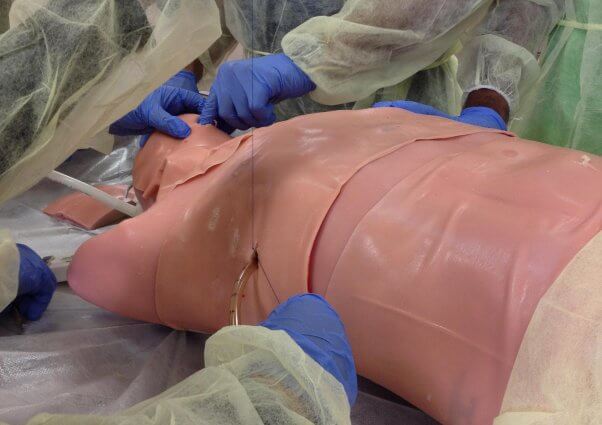
- Strikingly lifelike computerized human-patient simulators that breathe, bleed, convulse, talk, and even “die” have been shown to teach students physiology and pharmacology better than crude exercises that involve cutting up animals. The most high-tech simulators mimic illnesses and injuries and give the appropriate biological response to medical interventions and medication injections. All medical schools across the U.S., Canada, and India have completely replaced the use of animal laboratories in medical training with simulators as well as virtual reality systems, computer simulators, and supervised clinical experience.
- For more advanced medical training, systems like TraumaMan—which replicates a breathing, bleeding human torso and has realistic layers of skin and tissue, ribs, and internal organs—are widely used to teach emergency surgical procedures and have been shown in numerous studies to impart lifesaving skills better than courses that require students to cut into live pigs, goats, or dogs.
Although scientists have state-of-the-art, effective, non-animal methods available, experimenters continue to torture countless animals anyway. “Without Consent,” PETA’s interactive timeline, features almost 200 stories of twisted experiments from the past century, including ones in which dogs were forced to inhale cigarette smoke for months, mice were cut up while still conscious, and cats were deafened, paralyzed, and drowned. Visit “Without Consent” to learn about more harrowing animal experiments throughout history and how you can help create a better future for living, feeling beings.