Investigation Reveals Hell on Earth for Animals at California Dealer Warehouse
Investigation update and victory: Mitch Behm, owner of Global Captive Breeders, LLC (GCB), and David Delgado, GCB’s former manager, have pleaded guilty to numerous misdemeanor or felony counts of cruelty to animals, respectively, for their roles in the suffering and deaths of more than 16,000 animals. Behm and Delgado have both been barred from acquiring animals, and Delgado was sentenced to 180 days in the sheriff’s custody. Read more here.
For more than two months in late 2012, a PETA investigator worked undercover at GCB, a company that bred and sold reptiles and rats in Lake Elsinore, California. PETA’s investigator documented that some of the company’s workers, including its manager—and generally with the full knowledge of Behm—neglected thousands of animals, many of them to death, and cruelly killed countless more.
Based on PETA’s evidence, law-enforcement officials entered GCB on December 12, 2012, and mounted the largest rescue of neglected rats in U.S. history and the largest seizure of animals ever in California. All the animals—more than 600 reptiles and nearly 16,000 rats—were relinquished by Behm into the city’s custody.
Rats: Born to Die
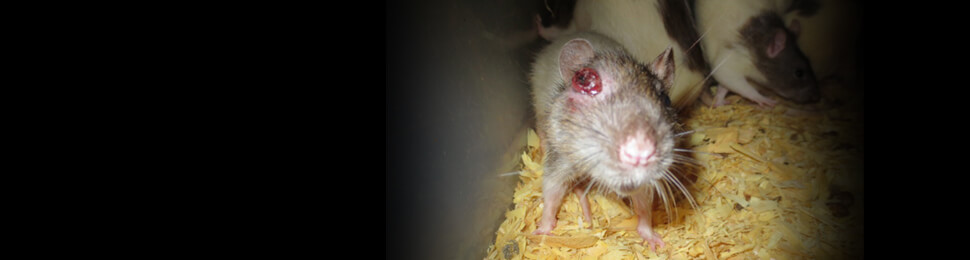
Most of the thousands of rats who were kept at GCB were what the pet trade industry refers to as “feeder” animals―bred and sold to be fed to snakes and other captive carnivorous reptiles kept as “pets.” Because of the facility’s chronic failure to provide animals with even their most minimal requirements, the rats were not just doomed to die terrifying, painful deaths inside GCB’s walls but also born into and kept in filth and misery throughout their entire lives.
- Rats—including those weakened by illness and suffering from injuries were routinely grabbed by the tail and slammed into metal posts, racks, tables, and walls when workers (including the facility’s manager) decided to kill them. Many didn’t die quickly―and were thrown into trash bins or into a reptile’s cage while still alive and convulsing. Some rats, including newborns, were frozen alive, despite the availability of a makeshift gas box in which the animals could have been killed with less suffering. Loose rats were shot with a BB gun, one rat was stomped on and maimed then whipped against a metal rack and finally killed, and several rats were bludgeoned with metal tongs and the handle of a BB gun.
- Tubs used for housing flooded frequently, drowning countless rats and leaving hundreds of others to struggle to keep their heads above water as the water rose. Exhausted, shivering, and terrified, many mother rats watched helplessly as their newborns drowned.
- Hundreds of rats were found dead in tubs, where they had been deprived of the most basic necessities—moderately clean air, dry bedding, drinking water, nutritious food, veterinary care, minimally humane handling, and adequate space to groom and engage in other normal and essential forms of behavior.
- During sorting and moving rats, the facility manager was among those who threw them up to 8 feet into hard plastic containers.
- Water valves in rat enclosures frequently malfunctioned, leaving the animals without water for extended periods of time, parched, their noses bloody from pushing at the bone-dry valves, dehydrated, and in many cases, dead.
Reptiles: Slowly Starved, Intentionally Ignored
Snakes, skinks, monitor lizards, and other reptiles at GCB were essentially left to die; they were so neglected that, in many cases, even their deaths went unnoticed by management―for days, leaving enclosures and rotting carcasses teeming with maggots. Some of them captured in the wild and stolen from their native homes, reptiles at GCB didn’t stand much of a chance of survival.
- Behm repeatedly told workers not to care for the facility’s reptiles because his revenue was coming from the rat-breeding operation and there was “no reason to spend time up front” (where the reptiles were housed) when the reptiles weren’t generating any revenue.
- Many reptiles were kept shelved in lightless, opaque drawers so small that they could not move, eat, or eliminate normally and were trapped with their own waste.
- Many reptiles were kept confined without access to water.
- Dozens of reptiles packed up for sale at a trade show were crammed into plastic deli cups and denied food, water, and other essentials for at least a week.
- Chronic deprivation was the norm at GCB—reptiles often languished for weeks before finally dying—hopeless, isolated, and robbed of all that was natural and important to them.
Warehoused in Filth, Mired in Misery
PETA’s investigator never saw GCB bring a veterinarian into the facility and was consistently turned down when he asked about providing veterinary care to any of the animals, even those who were clearly in critical condition and on death’s door.
PETA’s investigator brought obviously sick and injured animals’ suffering to the attention of Behm, the manager, and others but to no avail. Week after week, animals languished and died, including these:
- An emaciated, lethargic, pale, and shriveled albino boa constrictor—lying alongside maggots and reeking of rotting flesh for a month—whom the manager and a worker refused to help or even put out of his or her misery because Behm would have reportedly gotten angry. Instead, Behm told the manager to “wash” the snake in water; the snake was dead within a week.
- For about a week, a thin, listless baby black tree monitor who was cold to the touch was left to waste away slowly before finally dying. The manager said it would be “too expensive” to euthanize the lizard. Another worker said that the animal had “to languish … [u]ntil he” died.
- A Hogg Island boa constrictor was left to suffer with an untreated, grossly swollen nose for over a month after the manager saw the snake. A worker used a thumbtack that he got off a bulletin board to repeatedly jab the snake’s face and puncture the animal’s nose as the snake struggled and writhed. The worker then repeatedly squeezed the snake’s face, hard, until pus erupted from the wound. The snake’s nose swelled back up within a couple of days, and he continued to languish.
- A weak and debilitated blue tongue skink was left to drag his injured back leg and suffer for more than a week before dying. When PETA’s investigator told the manager that the skink needed care, the manager threw his hands in the air and exclaimed, “There is nothing I can do for him … if he dies, he dies. That’s better than him living here, I guess.”