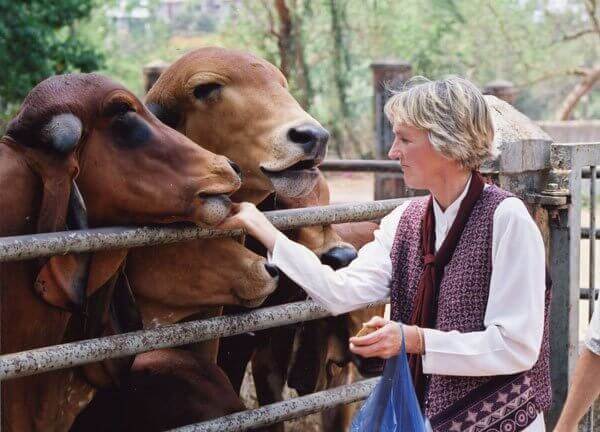
Honor Martin Luther King Jr.’s Legacy: Let Freedom Ring for ALL
Who among us wouldn’t agree that abuse and oppression are wrong? Racism is wrong. Sexism is wrong. Speciesism is wrong. But what are we doing about it? Dr. Martin Luther King Jr. asked, “What are you doing for others?” and gave a reminder that “[a] time comes when silence is betrayal.” By rallying for civil liberties and speaking out against inequality, he exemplified his own words, showing that “[t]he time is always right to do what is right.” Taking his statements and calls to action to heart, PETA speaks out against violence and oppression because every animal is someone.
Opposing injustice isn’t a matter of choosing a single issue and ignoring all others. It is acting on principle against all injustice. Picking which ugly “-isms” to stamp out, like plucking this grape and that from a bunch, will never be how social justice reform works. Ableism, homophobia, sexism, speciesism, racism, and transphobia are all linked by one common theme: a supremacist attitude.
Biases are born of ignorance. We discriminate against others who may not look exactly the same as “we” do but, if we are honest, clearly demonstrate that if you burn them, they scream just as we do; that they experience maternal love just as we do; and that they desire freedom just as we do.
It may be useful to look at acts of abuse committed today and imagine them through the more critical eyes of future generations or to put ourselves in the shoes of the oppressed, because if we believe what Dr. King famously said—that “[i]njustice anywhere is a threat to justice everywhere”—we must do exactly that.
Most people, when shown how their actions support cruelty and given options, will make compassionate choices. How else would PETA have all but obliterated cosmetics testing on animals, ignited an explosion of vegan options at grocery stores and restaurants, started a fur-free revolution, and forced SeaWorld to end its sordid orca-breeding program and to stop allowing trainers to stand on dolphins’ faces and backs? We wouldn’t have—not without the willingness of supporters and activists to challenge bigotry always and in all ways, even (or perhaps especially) when they were just witnesses and not victims.
“[T]here comes a time when one must take a position that is neither safe, nor politic, nor popular but he must take it because conscience tells him it is right,” Dr. King said.
Dr. King summoned up his courage and did and said what was right. We must do that, too, if we are to heed his call. Animal rights is not some poor cousin of other rights movements any more than women’s rights is a lower cause than others. All struggles to achieve social justice are equally important to support. “The ultimate tragedy is not the oppression and cruelty by the bad people but the silence over that by the good people,” said Dr. King. In his honor and for those who are oppressed, speak out against all forms of discrimination—often and with pride.
One of the most effective ways to do this is to speak up to usher in change. Reach out to your representatives and urge them to pass animal- and human-friendly legislation. You can start by asking your local, state, and national representatives to support PETA’s food justice campaign, an initiative to redirect subsidies from the meat, egg, and dairy industries toward incentives to grocers in food deserts to stock vegetables, fruits, and other healthy vegan foods. Follow our simple guide to letter-writing to start making your voice count:
Check out these clever, sexy, shocking, and downright provocative PETA ads to see what your TV has been keeping from you all these years!
Did you know Vogue’s new editor, Chloe Malle, has animal rights in her DNA? Find out how the fashion mogul is tied to animal liberation.
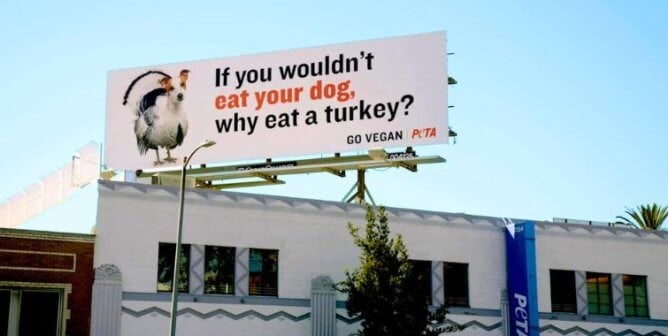
These PETA ads were initially rejected—so we took them to court. Dive into some of PETA’s free speech lawsuits and see how we kicked censorship to the curb.