PETA Investigations Reveal Taxpayer-Funded Torture at UNC Laboratory
The University of North Carolina (UNC) at Chapel Hill receives millions in taxpayer dollars, yet, as PETA revealed, it did not provide even the minimal standard of care to animals it used in federally funded research.
PETA conducted two undercover investigations of UNC–Chapel Hill’s animal laboratories, from February 2002 to January 2003 and from January through November 2003. During the second investigation, we hoped to find some improvement, but the university hadn’t changed its cruel practices, and animals continued to suffer.
In our first investigation, a PETA investigator who worked as an animal care technician found that chronic understaffing, incompetence, indifference, neglect, and outright cruelty caused rats and mice to be denied basic needs, including adequate space, food, water, and veterinary care. Some were even denied a humane death. Many of the animals were subjected to severe trauma, prolonged suffering, and agonizingly slow and grisly deaths.
A year after our first investigation began, a PETA undercover investigator went back inside UNC–Chapel Hill laboratories, hoping that UNC had cleaned up its act. But contrary to what UNC had assured the National Institutes of Health (NIH), the government agency that investigated our charges, we still found that animals were severely crowded, left without veterinary care, and killed inhumanely.
What the Investigator Witnessed
During our first investigation, PETA’s investigator documented—almost daily—the failure or refusal of researchers and their staff to meet basic animal care and use standards.
Animals at UNC were routinely denied veterinary care, including in the following instances:
- A researcher killed 23 mice in the presence of our investigator by breaking their necks with a metal cage-card holder. When our investigator later removed the mice from the dead-animal cooler, she found one still alive but paralyzed by a broken neck. Our investigator routinely found live animals in the dead-animal cooler.
- A researcher doused 8-day-old rat pups (“pinkies”) with ethyl alcohol and cut their heads off with scissors. He admitted that he was supposed to put the pups on ice for four minutes prior to cutting their heads off because “animal rights people” and the “committee” believe it is more humane. He said that when they write up their procedure reports, they say that they put the pups on ice, as required by the university’s Institutional Animal Care and Use Committee (IACUC) policy.
- Mice lost eyes as a result of grossly substandard skill in performing retro-orbital bleeding (sticking a glass pipette into the back of the animal’s eye to draw blood).
Many animals were denied euthanasia and left to suffer for days, including in the following instances:
- A mouse with a distended belly was recommended for euthanasia by a veterinary technician and a veterinarian who had the authority to euthanize on the spot. Repeated calls to the researcher’s office seeking permission to euthanize the animal went unanswered. As a result, the mouse suffered for six additional days.
- A rat suffered for 25 days with a discolored and enlarged abscess because it was thought that she was pregnant. She was put out of her misery only after the staff realized that she was not pregnant.
- Mice with implants breaking through their skin and rats with “huge sores” and “oozing scabs” around the devices implanted in their skulls were considered “normal.”
Extremely crowded cages—such as those in the following cases—were the norm:
- Newborn animals were often trampled and suffocated under the bodies of their cagemates or starved to death when they were unable to find or reach their mothers.
- “Overcrowded” cards placed on cages to protect animals from the dangers of severe crowding were routinely ignored by researchers and research technicians, who often threw the cards into the garbage without separating animals in the cages as required by policy.
Animals were deprived of food and water. Rats used in alcohol experiments at UNC’s Bowles Center for Alcohol Studies were given nothing to eat or drink but a liquid diet consisting of alcohol, sucrose water, and some nutrients for two weeks or more in order to force them to drink alcohol—which they would never do under normal circumstances. The rats were so hungry that they began eating their own feces and possibly their bedding. A researcher hypothesized that a rat whom our investigator found emaciated and foaming at the mouth had gotten drunk, eaten his bedding, and choked when it became wet and swelled in his trachea or esophagus.
PETA’s investigator complained to both supervisors and management about these abuses before finally alerting the IACUC, the university oversight committee that approves animal experiments and is ultimately responsible for the care and use of animals at UNC.
UNC animal care personnel covered their tracks by removing sick animals from the building in order to avoid trouble from and/or detection by the IACUC. Just days after the IACUC visited UNC’s animal laboratories, animals were left to suffer as “normal”—mice “raw and bloody from scratching” and “bleeding from the inner ear” were denied veterinary care and euthanasia, which had been recommended.
Government Report Proves PETA Right
PETA filed a complaint with NIH’s Office of Laboratory Animal Welfare (OLAW) detailing each violation of the NIH Guide for the Care and Use of Laboratory Animals. It took OLAW two years to issue its report on our complaint, but the government agreed with PETA that employees were improperly trained and caused animals pain and distress while taking blood, pumping their stomachs full of substances such as ethanol, and attempting to gas them or break their necks and that they committed many other violations. Click here to read NIH OLAW’s summary of its 30-page report about our first UNC investigation.
UNC told NIH that most of its problems with providing proper animal care were caused by the supervisor in that laboratory. UNC made a big display of hiring a new supervisor who, it claimed, would not allow the same things to happen that had happened during our first investigation.
The Abuse Continues
Our second investigator, hired to work in the same building and on some of the same experiments from January through November 2003, found that UNC had lied outright to NIH about cleaning up its act and discovered that conditions were just as hellish for the animals. Among other horrors, the investigator found the following:
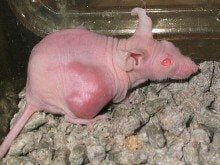
- Mice with large tumors that had ulcerated and burst
- Live animals who would have been thrown away along with the rest of the cage contents when the cages were cleaned if our investigator hadn’t intervened
- Seriously sick and injured animals left to die without any veterinary care
- Severe crowding, leading to cannibalism and suffocation
- A guillotine blade so dull that two fully conscious rats’ necks were hacked twice in order to sever their heads from their bodies
- Contradictory instructions given to animal-husbandry staff
- Amputation of animals’ toes—in direct defiance of government orders
When our investigator reported the toe amputations to the new supervisor, the supervisor said, “Stick to the script. … I just can’t be hearin’ this. You know that, right?” Once again, UNC had shown that it wouldn’t comply with the government’s extremely minimal care standards for using mice and rats in experiments. So PETA filed another formal, detailed complaint with NIH [link to pdf titled: UNC Law] insisting that it act immediately to investigate and close down UNC’s animal laboratories. Once again, NIH released a report corroborating PETA’s allegations.
That UNC thought it could get away with treating animals so cruelly shows an arrogance that permeates many universities that are given exorbitant amounts of our tax money and trusted to “do what’s right.”
What You Can Do
Together, we can overturn the arbitrary exclusion of mice, rats, and birds from the Animal Welfare Act (AWA). Excluding these species from the only federal law that offers any sort of protection for animals in laboratories causes suffering to millions of animals every year. Please write to your members of Congress and ask them to amend the AWA to include rats, mice, and birds. These animals are intelligent, social beings who deserve protection just as much as the dogs, rabbits, and hamsters, who are currently included in the AWA, do.
Please also consider making a donation to support PETA’s vital work to stop this cruelty.