
Join PETA's Community Animal Project

Help Animals in Your Town

Into the Van ... It's not easy to look, but you know they are there. Down that alley. Behind the trailer. Under the abandoned car. Every city, town, and country village has them—animals who aren't loved enough. The dog who sits at the end of a 5-foot chain, a rusting bowl—water long since spilled—to one side. His "house" is a metal drum that is stove-top hot in the summer and warm as tissue paper in frigid weather. His bed is a scrap of mildewed carpet. Toys? There are none. Affection? That ended with puppyhood.

Over the Fence ...Or the cat, exhausted by too many pregnancies and hungry because "cats can take care of themselves." Her eyes are encrusted from the respiratory illnesses she picks up from strays, but they are wary; strangers can be cruel and the streets are fraught with dangers. She has been chased by dogs and narrowly escaped death beneath the wheels of cars.

You know they are missing everything that makes their lives worth living, but someone "owns" them. What can be done?

Plenty!

PETA is reaching out to animals near our headquarters in Hampton Roads, Va., with a program called Community Animal Project (CAP). We realize that some people cannot afford to provide for their dogs and cats, some do not know how, and some just don't care.

Straw makes it comfy.So our caseworkers have gone out into the community, rolled up their sleeves, and set to work.

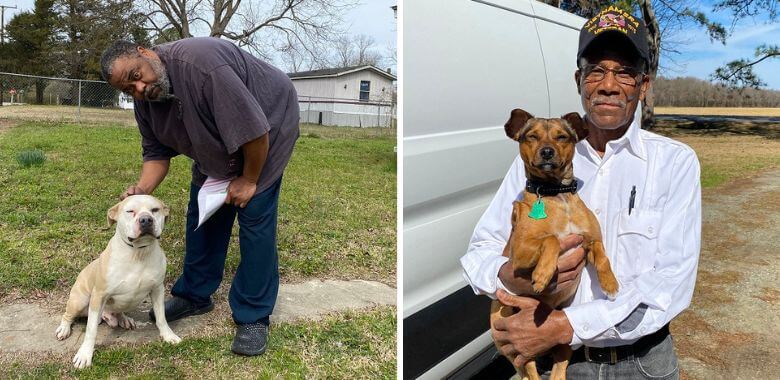
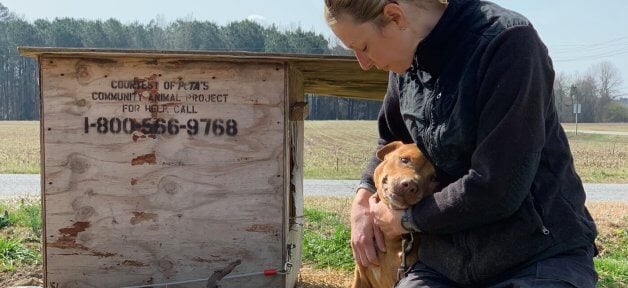
CAP staff and volunteers provide low-cost or free spaying and neutering and transport animals to veterinarians for de-worming and other badly needed treatments; they even bathe and groom dogs who have lived outside for years. They always explain why companion animals need to live in the house with their families and, if there's a willing ear, help people make that transition.

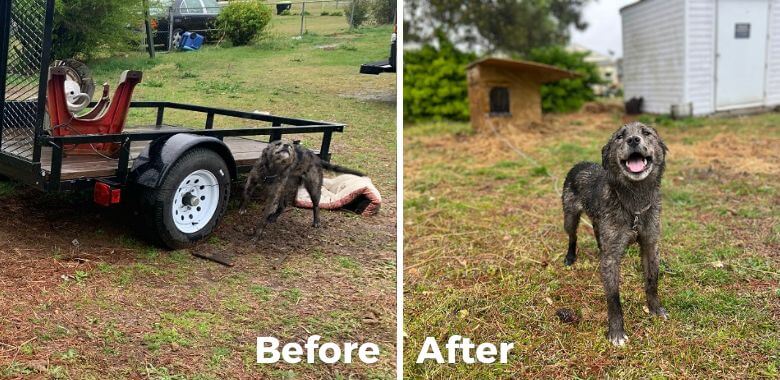
It doesn't always work. We may wonder why someone bothers to keep a dog at all when the lonely animal is chained out of sight behind the house 24 hours a day, but many people refuse to change, and often they are still within the law. When this happens, our caseworkers, determined to improve animals' lives, do everything they can to make the animals comfortable. They build, repair, and weatherproof doghouses, then fill them with fresh bedding. If the homeowner will allow it, our caseworkers sometimes have to build or repair fences so that chained dogs can have freedom within the yard. At other times, they provide a running line and a harness with a swivel so that the chained dog can exercise without getting tangled.

And they don't give up. Our caseworkers return to check on the animals and replace old bedding. They continue to educate—politely—and urge reluctant humans to be real companions to their animals.

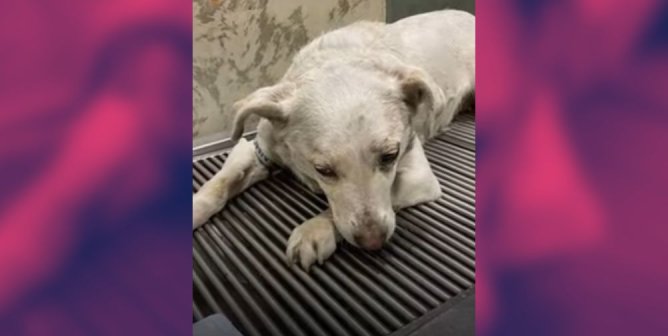
The reward for all this hard work is in the eyes of a dog sinking gratefully to sleep in the first comfortable, dry bed she's ever had. It's in the joyful leap of an old dog who knows that someone cares for him—at last.

You Can Help:

Start your own Community Animal Project. Write to PETA for a free how-to kit.

Never turn your back on an animal in need. A bowl of fresh water, a kind word or scratch behind the ears mean everything to a lonely dog or cat.

To help dogs in her town, Lois Winchester, 89, of Heppner, Ore., advertises for unwanted doghouses, repairs them, then fills them with straw and gives them to people whose dogs have no decent shelter.

How Julie-Ann Got Magic in Her Life

Actor-model Julie-Anne Younghans couldn't turn away from an abused dog in her town ... and Magic changed her life:

In September, I was paged by a man I had met on a movie set a few weeks before, who told me of a dog who was in very bad shape in south central Los Angeles.

Go and rescue the starving, stinky, dying, elephant-looking dog who needs to be put out of his misery, I was told.

I drove to south central L.A. the next morning to rescue Magic, the 8-year-old German shepherd mix from the hellish yard in which he had been chained all of his life. Magic stood sorrowfully in front of me, and I placed my hands on his bloody body to give him the comfort of knowing somebody was there to touch him without harming him.

His fragile, bald skeleton body trembled as he did his best to climb into my car. I then cried the entire way to the veterinarian.

In the weeks that came after, I watched this beaten-down, malnourished, flea-infested, ringworm infected, scabby, yet gorgeous, bright-eyed, perky-earred, tail-wagging, trusting soul go through an amazing transformation. Magic began to grow fuzz on his now clean skin, and he quickly gained weight, thanks to the food my vet shared with him as they buddied around the office.

At this very moment, Magic is lying here chewing on a snack next to his best pal, Mohammed, my black Lab. He is the kindest, gentlest, sweetest, most loving dog on the planet.

I later learned that his "owners" used slingshots on him, kicked him, starved him, and when he was lucky, ignored him. Once they dumped him in a parking lot and he sadly, but loyally, found his way back to the only "home" he had ever known.

Now he has a real home, with a family who loves him. But I'm the lucky one. Magic has taught me never to turn my back on an animal in need, and I'll always be grateful for his lesson of love.


People for the Ethical Treatment of Animals
501 Front St., Norfolk, VA 23510; 757-622-PETA