


• Mothers Against Dairy: 'Change School Meals'

    Written by Jeff Mackey

    PETA Executive Vice President Tracy Reiman, who's also the mother of a child in the California public school system, has written to the administrator of the U.S. Department of Agriculture's (USDA) Food and Nutrition Service asking that the service pull all beef and cow's milk from school lunches after mad cow disease was discovered in an animal at a California rendering plant.

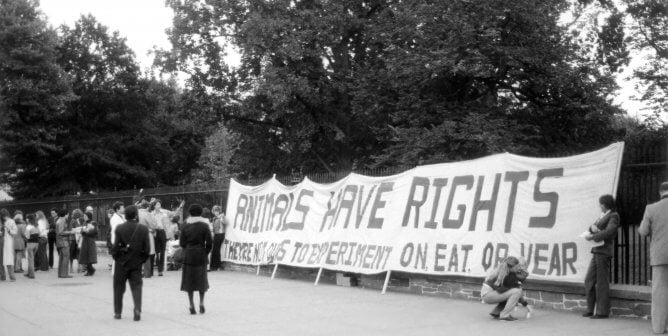
    A group of parents who are "DAM MAD" (Dads Against Meat and Mothers Against Dairy) also converged on the Sacramento headquarters of the California Department of Food and Agriculture to urge it to protect children by pulling meat and dairy products from school lunches.

    Playing Russian Roulette With Kids' Health

    What's truly mad is continuing to feed beef and cow's milk to students, especially because "spent" cows, whose milk supply is exhausted by the dairy industry, are the primary concern when it comes to mad cow disease and are likely to end up as the kind of cheap ground beef that is fed to schoolchildren.

    Given that the USDA has expanded its quarantine to a second dairy farm, that it still has not located the infected cow's mother or siblings (who may also have the disease), and that it doesn't even know what the California dairy industry is feeding its cows (because that's considered a "trade secret"), the USDA must stop risking our children's health and remove beef and cow's milk from school cafeterias right away.

    Protecting Factory Farms, Not Consumers

    Tracy's letter and the demonstration by the DAM MAD parents coincided with another PETA appeal to the USDA urging Secretary Tom Vilsack to correct misleading statements that he made regarding the detection of the disease—also known as bovine spongiform encephalopathy (BSE)—that created a false and dangerous sense of security by erroneously claiming that the nation's human and animal food supply is safe.

    In the letter to Vilsack, PETA points out that there is no way to know how many other animals are infected with mad cow disease because only a tiny fraction—about 0.1 percent of the nearly 34 million cows who are slaughtered every year—are tested for BSE. It's also likely that milk from the cow who tested positive entered the food chain, and contrary to the USDA's assurances about the safety of milk, studies have already shown that another form of the disease can be spread from mother to baby through milk.

    How to Help Stop the Threat of Mad Cow Disease

    Worried that tainted milk or meat may be on your child's lunch tray? Don't wait for the USDA to act. Protect your kids (and yourself) by packing healthy and humane vegan lunches—and keep it up at breakfast, dinner, and snacktime, too!

  • Top 10 Reasons Cows Are Mad

    Written by Michelle Kretzer

    With the discovery of mad cow disease in a cow from a California dairy farm and in potentially more cows as the U.S. Department of Agriculture searches for her former herdmates, PETA presents the top 10 reasons why cows are so darn mad:

    1. How Many Kids and Counting?
      Unless you're Michelle Duggar, you probably have no inclination to crank out one baby after another. Neither do cows used for their milk, but they are kept almost constantly pregnant so that they will continue to produce more milk.
    2. Crying Over Stolen Milk
      Mother cows know the meaning of "mother's love" too, and they often wail, sometimes for days, when their babies are taken away so that people can steal the milk that nature intended for their calves.
    3. A Scene Out of a Saw Movie
      Farmers use one of several "Jigsaw"-inspired instruments—such as guillotine dehorners, caustic chemicals, searing-hot irons, and saws—to remove cows' horns and calves' sensitive horn tissue.

    4. A barbaric device known as a "keystone" or "guillotine" dehorner

    5. Castration Without So Much as an Aspirin
      Guys, you wouldn't like it. Male calves don't either.
    6. Baby Bullies
      Veal is supposedly "tender" flesh, but there is nothing tender about how it is produced. Male calves, who are useless to the dairy industry because they don't produce milk, are often forced to live alone inside frighteningly tiny, dark crates for months, kept virtually immobilized so that their muscles can't develop, and deprived of sufficient iron, leaving their flesh the desired pale color.
    7. A Bunch of Bull Crap
      Forcing cows to stand ankle-deep in feces on filthy lots is … you know the appropriate word.
    8. Debbie Downer
      Downed cows are no longer allowed into the food supply, but what happens to them is a serious downer. They are sometimes simply left to die from their illness or injuries or from dehydration.
    9. There's no D.A.R.E. Program for Cows
      Farmers genetically manipulate and sometimes drug cows in order to force them to produce up to four and a half times as much milk as they naturally would for their calves.
    10. The Road Trip From Hell
      Anyone who has ever been crammed shoulder to shoulder in a coupe for an extended road trip knows how miserable it is, and that's even with bathroom breaks, food, water, and temperature controls. And while the trip may end at an annoying relative's house, at least it doesn't end at the slaughterhouse.
    11. This Is the Thanks They Get
      After years of birthin' babies and pumping out thousands of gallons of milk, do cows used for their milk get a comfy retirement? Heck, no! They get sent to slaughter, where, in the words of one slaughterhouse worker, they "die piece by piece." A longtime slaughterhouse worker said he frequently cut the legs off completely conscious cows who blinked and made noises as their bodies were hacked apart.

    Don't Get Mad—Get Vegan. Grab a free vegetarian/vegan starter kit and make for fewer mad cows in the world.

  • Where Are Mad Cow's Offspring, Mother, and Siblings?

    Written by Michelle Kretzer

    After happening upon a case of mad cow disease at a California rendering plant during its testing of less than 0.5 percent of cows, the U.S Department of Agriculture (USDA) is now searching for the infected animal's offspring, where her mother ended up, and her mother's other offspring, as all of them could potentially be infected, too. If an infected cow is slaughtered, the tainted meat could cause a degenerative brain disorder known as variant Creutzfeldt-Jakob disease (vCJD) in anyone who ingests it. The disease, which is always fatal, causes sponge-like holes in the brain.

    Also of concern in this case is the fact that milk from the infected cow may have been sold for human consumption. The USDA claims that vCJD cannot be contracted by consuming the milk of infected animals, but as a Mother Jones article points out, the sheep form of the disease, scrapie, has indeed been shown to pass from mother to offspring through milk.


    Groks
    | cc by 2.0

    The Consumers Union, which publishes Consumer Reports, posits that because the number of cows the USDA tests is so low—less than half of 1 percent of the nearly 34 million slaughtered annually—many cases could be and likely are going undetected. Jean Halloran, Consumers Union director of food policy initiatives, stated:

    The fact we found one in 40,000 could actually be interpreted as worrisome. Does that mean if we tested 80,000 we'd find two? ... Our testing program is so small it can't give us even a ball-park idea of whether we have a problem here or not.

    If the lack of adequate testing makes you think the USDA may be playing Russian roulette with our health, consider that we do the same thing every time we bite into a piece of meat that increases our risk of cancer, heart disease, diabetes, and strokes. And then order a slew of free vegetarian/vegan starter kits for the people you love who still eat meat.

  • PETA Takes On California's Mad Cow Scare

    Written by Michelle Kretzer

    As a result of the latest case of mad cow disease on a dairy farm, PETA is placing a billboard near the Hanford, California, testing facility that found the disease. The billboard is a parody of the ludicrous "real milk comes from cows" ads that the California Milk Processor Board pushes.

    No one who eats meat is safe from mad cow disease. Since the U.S. Department of Agriculture tests only a tiny fraction of all the cows killed for food for mad cow disease—including cows from dairy farms who are ground up for hamburger—there's no telling how many animals may be infected. The only way to avoid slurping down a cup of cruelty or a dish of disease is to dump dairy products and meat.

    And that won't make cows mad.

  • It's a Mad, Mad, Mad, Mad Cow

    Written by Heather Faraid Drennan

    Maybe being able to see the Hollywood sign from my living room makes everything remind me of a bad horror movie, but seeing the headline "New Strain of 'Mad Cow' Disease" is enough to make anyone (especially meat-eaters) shriek like a celluloid scream queen. That's right—bovine spongiform encephalopathy (BSE) has struck again!

    Mad cow disease first captured the world's attention when it appeared on the scene in the United Kingdom, and it has since been found in cows in Canada, the U.S., and now Japan—although the latest stricken animals are believed to have come from Australia. One cow who tested positive was only 23 months old, the youngest ever found with BSE, and officials believe that this may be a new strain of the disease that can't always be detected with Japan's current monitoring system.

    Since the prions that cause BSE can be found in all parts of an affected animal's flesh, staying away from meat is really the only sure-fire way to avoid mad cow disease.

  • 'Contagion': Just a Movie or …

    Written by PETA

    Audiences are flocking to see the new thriller Contagion for its exciting action scenes and big-name celebrities, but the film's storyline is more true to life than many people may realize.

    As the recent swine and bird flu outbreaks have amply illustrated, deadly diseases that originate on factory farms easily spread to humans. Just last month, three children in Pennsylvania were diagnosed with a new strain of swine flu that the state's Department of Health believes they may have contracted from animals at an agricultural fair. And the World Health Organization is concerned about a true pandemic this winter. 

    Filthy conditions on severely crowded factory farms are the perfect breeding ground for deadly contagious diseases. Considering that factory farms breed swine flu, avian flu, MRSA, mad cow disease, and E. coli, not to mention cruelty to animals, isn't it time that we ditch diseased dinners in favor of healthy platters of plants?

    PETA will be distributing leaflets about the dangers of factory farming at theaters showing Contagion across the country. To get involved, contact our Action Team.


    Written by Michelle Sherrow


  • Diary of a Mad Cow

    Written by PETA

    "Shoot, shovel, and shut up" might sound like a bad bumper sticker, but it's actually how former Canadian Premier Ralph Klein did business. He recommended to cattle farmers that if they suspect a cow has mad cow disease, they should kill the cow, dispose of the body, and not report the incident. It's impossible to say how many cases of mad cow disease have gone unreported, but this week in Alberta, a new case was discovered in a cow used by the dairy industry.

    Before we go all South Park and start blaming Canada for everything, consider this: Mad cow disease incubates in cows for so long that most cows show no symptoms before they are sent to slaughter. The cow in Alberta was over 6-years-old—older than most cows who are killed for their flesh. Cases of mad cow disease have been reported all across North America and around the world—but those are just the cases that were caught. Cue Twilight Zone music.

    ILRI/cc by 2.0


    The only way to totally avoid entering the mad cow zone is to keep cows and other animals off your plate.

    Written by Michelle Sherrow

  • 25,000 Pounds of Bison Heads Recalled

    Written by PETA

    Jairo S. Feris Delgado / CC by 3.0
    bison

    By now, most of us have pretty much forgotten what mad cow disease is—all we remember is that it's scary and that we don't want to catch it. Well, the recent recall of 25,000 pounds of bison heads because of the risk of mad cow disease just might have people scrambling for their medical dictionaries.

    Here's a little refresher course: Mad cow disease essentially eats holes in the brain and is always fatal. In humans, it initially causes memory loss and erratic behavior. Over a period of months, victims gradually lose all ability to care for themselves or communicate, and eventually, they die. The disease has been traced to farmers' cost-cutting practice of mixing bits of dead animals' neural tissue into the feed of cattle, who are naturally herbivorous. If cattle eat the brains of cattle who already have mad cow disease, or of sheep suffering from a similar disease called "scrapie," the cattle can develop the disease. If humans eat flesh (and possibly milk) from infected animals, they can develop the human version of the disease, called "new variant Creutzfeldt-Jakob disease." The disease is caused by misshapen proteins called "prions." Prions are virtually indestructible—they aren't destroyed by cooking, disinfecting, or freezing.

    According to the U.S. Department of Agriculture (USDA), the tonsils must be removed from cows and other ruminants who are slaughtered in order to prevent the spread of mad cow disease, something that a bison slaughterhouse in North Dakota failed to do, which prompted the recall.

    It can take eight years for an infected cow to begin showing symptoms of mad cow disease, but most cattle in the U.S. are killed by age 5, before many would be displaying symptoms. Only a very tiny fraction of the cows who are slaughtered are tested, which means that the only way to ensure that you'll never get mad cow disease is to go vegan.

    Written by Logan Scherer

  • Oprah's Best Animal-Friendly Episodes

    Written by PETA

    athensboy / CC
    Oprah

    It's official: Oprah will end her show in 2011. Feel that collective surge of sadness? We sure do. Oprah's groundbreaking program has transcended the talk-show format and has paved the way for social and political change. In honor of PETA's 2008 Person of the Year and her show's long run, we're revisiting Oprah's best animal-friendly episodes:

    • Oprah's week-long move from Chicago to Amarillo was the move followed 'round the world. She captivated millions with her court appearance to defend her 1995 episode that revealed the horrors of a beef industry rampant with mad cow disease.
    • Inspired by guest Kathy Freston's book Quantum Wellness, Oprah went vegan for three weeks and marveled, "I never imagined meatless meals could be so satisfying."
    • Oprah dedicated an entire episode to exposing the stifling, crippling conditions of chickens, cows, and pigs on factory farms as Californians prepared to vote on Proposition 2. The measure passed by a large majority—in part thanks to her revealing show.
    • After Oprah saw a billboard off the Kennedy Expressway that read, "Oprah: Do a show on puppy mills. The dogs need you," she immediately jumped at the opportunity to save lives. Just a few minutes of her horrifying exposé were enough to convince viewers that adopting from an animal shelter is the only way to go.
    • My food envy was raging when Chef Tal Ronnen cooked his "Chicken" Scallopini and other delectable vegan meals on a recent episode of the show.
    • When Charla Nash decided to show her face to the public for the first time earlier this month, it's no surprise that she chose to do it on Oprah's show.

    The media mogul may be bidding farewell to her legendary talk show, but with the upcoming launch of her new cable network, we're sure that we'll be seeing a lot more of her for a long time to come.

    Written by Logan Scherer

  • PETA U.K. Introduces Dumbed-Down Ad for the Masses

    Written by PETA

    Yesterday, the U.K.'s Advertising Standards Authority ruled against a PETA U.K. ad that the watch group feels the public is too dense to understand. The decision was sparked by a sole complainant who thought that people might be confused by this billboard:


    Meat Kills


    Personally, I think it's pretty straightforward, but moving on: How about this one, which PETA U.K. unveiled yesterday?


    Meat Create Disease


    Hans-Gerhard Wagner of the U.N.'s Food and Agriculture Organization has acknowledged that factory farms create an "opportunity for emerging disease." The meat, egg, and dairy industries keep diseased animals in crowded, filthy conditions and feed them a steady diet of drugs to keep them alive. It shouldn't come as a shock that factory farms provide the ideal conditions for drug-resistant "superbugs" to develop.

    Forgo the surgical masks, folks. The safest, easiest way to prevent animal-borne disease epidemics is to go vegan.

    Written by Karin Bennett

REPORT CRUELTY

If you have a general question for PETA and would like a response, please e-mail Info@peta.org. If you need to report cruelty to an animal, please click here. If you are reporting an animal in imminent danger and know where to find the animal and if the abuse is taking place right now, please call your local police department. If the police are unresponsive, please call PETA immediately at 757-622-7382 and press 2. 

PETA Tweets

Follow PETA on Twitter!

Chicken Photo: © Rommel Manuel