Written by Michelle Kretzer
Following PETA's release last week of disturbing whistleblower reports of 27 animal deaths during the filming of The Hobbit: An Unexpected Journey, we have asked authorities in New Zealand, where The Hobbit was filmed, to investigate and pursue appropriate criminal charges if warranted.
The five whistleblowers, all wranglers who worked on the film set, allege the following:
Reportedly, the AHA monitors who were supposed to be ensuring the animals' safety were overly friendly with the head trainer—who was himself distracted by other projects—and the AHA was absent for many of the animal sequences. Allegedly, three horses died before the AHA investigated and recommended improvements in housing. The wranglers also report that they voiced their concerns to the unit production manager but were ignored.
In September, PETA contacted the AHA about reported problems on The Hobbit set, but we've yet to receive a response. PETA wrote to director Peter Jackson to find out what, if anything, he knew about the animals' deaths during production. The man who brought us the superb computer-generated imagery (CGI) that won him our Proggy (for "progress") Award for King Kong has the ability to make the animals and other interesting creatures in his movies 100 percent CGI, and PETA calls on him to do so again.
In the age of Oscar-winning digital effects, there is no reason why a single animal should suffer for a film. Join PETA in urging Jackson to continue to use cutting-edge CGI and give his assurance that no animal will ever suffer again for one of his movies.
Written by Jeff Mackey
On the heels of a Los Angeles Times report about whistleblowers' allegations that oversight failures may have led to animal injuries and deaths during film and TV productions, PETA was joined by Hollywood animal advocates Bob Barker and Sam Simon for a news conference calling for immediate action to protect animals.
PETA was flooded with complaints from whistleblowers after we released leaked information earlier this year about the deaths of horses on the set of HBO's Luck. The complaints that we've received include an incident in which a horse and rider were allegedly swept downstream in a scene from the upcoming film The Lone Ranger and the deaths of three horses on the set of The Hobbit. Many of the alleged incidents reportedly involved pressure from industry figures to put animals at risk in a wide range of movie and TV productions, including some that are still being filmed.
During the news conference at PETA's Bob Barker Building in Los Angeles, legendary The Price Is Right host Barker and The Simpsons co-creator Simon backed PETA's appeal for the American Humane Association (AHA)—the organization assigned to monitor the use of animals on TV and film sets—to launch an immediate investigation into the allegations. To ensure that the AHA's ratings have any meaning, PETA presented a series of recommendations for an overhaul of the monitoring system, including the following:
Producers, directors, and writers must also do their part. They must make sure that animal trainers with U.S. Department of Agriculture violations are not employed, that scenes aren't written that would endanger horses and wild animals, and that computer-generated imagery, animatronics, and other technology are used to replace animals. Animals should never have to die for our entertainment.
You can help horses, great apes, and other animals used in the entertainment industry by contacting the AHA right now. Use the form below to urge the AHA to swiftly implement a plan to protect all animal "actors."
PETA has sent an urgent letter to the board of directors of the American Humane Association (AHA) detailing reported allegations of incidents—some of them fatal—and lack of proper oversight involving animals on more than a dozen recent or current film and television productions purportedly monitored for animal safety by the AHA, as related to PETA by whistleblowers. PETA is asking the AHA to investigate the allegations and, if they prove to be valid, to fix any problems that allowed them to occur.
The AHA is the organization—known for its "No Animals Were Harmed" statement seen in film credits—tasked by Hollywood with monitoring the use of animals on TV and film sets. But it is not clear that this statement means what it seems to say. The deaths of horses on the set of HBO's Luck made it clear that AHA involvement didn't mean that animals were safe. After PETA took that matter public, the series was canceled—and PETA was contacted with reports about several other productions where animals allegedly died or were injured or put at risk. If the reports are substantiated, some of the problems could have been averted. Some of the assertions allege that AHA's management ignored problems or even helped set up the filming of sequences that were potentially dangerous for animals.
The productions about which concerns were conveyed to PETA include Moonrise Kingdom, Boardwalk Empire, The Hobbit, Failure to Launch, Abraham Lincoln: Vampire Hunter, The Lone Ranger, and others. PETA was informed that the AHA ratings of some films do not reflect what occurred on set, that "Acceptable" ratings have been given when not all animal action was monitored, and that ratings were changed when the AHA feared information about problems on the set would be leaked. Some of the reported incidents allegedly resulted in injuries to animals and even their deaths.
Whether or not the whistleblowers' claims are verified or if the AHA institutes reforms, AHA ratings are based only on the short period of time when animals are on the set—they don't reveal anything about how the animals were trained or the conditions in which they live.
There is no reason to use animals as "actors" when animation, blue screen, computer-generated imagery, and other advanced technologies can produce realistic substitutes. If you see a movie that uses animals in an improper way or portrays animals disrespectfullly, walk out, and tell the theater manager that you'd like a refund and why. For television shows or commercials, express your objections to network representatives or the advertised company.
Written by PETA
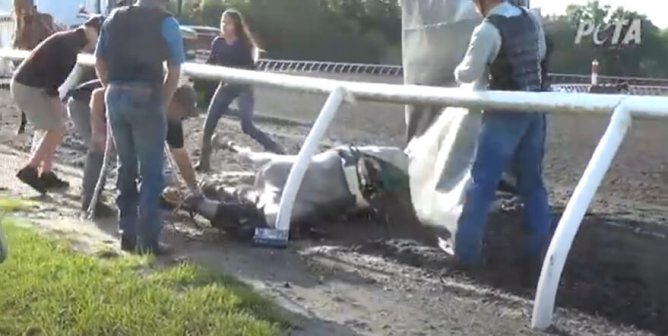
PETA members converged on the Hollywood premiere of the new movie Zookeeper to remember Tweet, a giraffe who collapsed and died on set during the movie's production.
An elephant used in the film may also have been abused. Animal Defenders International took video footage of elephants as they were beaten and shocked by trainers at Have Trunk Will Travel, the company that provided the elephant for the movie.
Moviegoers may be surprised to learn that the presence of American Humane Association (AHA) representatives on a movie set is no guarantee that animals were not exploited, hurt, or even killed during production. AHA representatives only monitor what occurs during filming, not what happens during off-set training sessions, where abuse is most likely to occur.
Please don't reward the producers of Zookeeper—which, incidentally, is receiving scathing reviews—for exploiting animals. Don't buy a ticket.
Written by Jennifer O'Connor
You may remember that there were hearings last month in support of a bill that would have banned the use of cruel bullhooks in the entire state of California. And no bullhooks means less pain and suffering for elephants in circuses or on the sets of commercials or movies, so it is a super important piece of legislation. It was supported not only by PETA, but essentially the entire animal protection community. The only animal advocacy group who sided with the circus industry in opposing the bullhook ban was the American Humane Association (AHA). I wonder if AHA is more concerned about protecting the film industry, and the huge contributions they receive to monitor films, than the animals they are supposed to protect. . . .
Anyway, here’s the letter we sent the AHA’s board of directors asking them wtf is up. The bill is still in committee and can still be called up for a vote, so for the elephants’ sake, here’s hoping the AHA come to their senses and get behind it . . .
If you have a general question for PETA and would like a response, please e-mail Info@peta.org. If you need to report cruelty to an animal, please click here. If you are reporting an animal in imminent danger and know where to find the animal and if the abuse is taking place right now, please call your local police department. If the police are unresponsive, please call PETA immediately at 757-622-7382 and press 2.
Follow PETA on Twitter!