UMass Chan Laboratories Sewing Living Mice Together? Meet the ‘Butcher’
Two living mice are sliced open along opposite sides, then stitched together at their joints and skin. Two surgically joined beings, now sharing a circulatory system, are forced to eat, sleep, and move as a single unit.
PETA has learned that experimenters at the University of Massachusetts Chan Medical School (UMass Chan) are subjecting pairs of mice to a procedure called parabiosis. And at least one person authorized to do it is neither a physician nor a veterinary surgeon.
Insiders call him “the Butcher.”
E Pluribus Unum
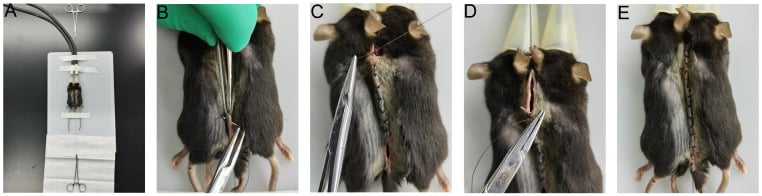
At UMass Chan, experimenters shave the areas of each mouse that will be joined, from elbow to knee. They’re placed back-to-back and sliced along their sides. The skin is detached, their corresponding knees and elbows are stitched together, and their skin is joined. As they heal, blood vessels form between them, allowing the mice to share their circulation.
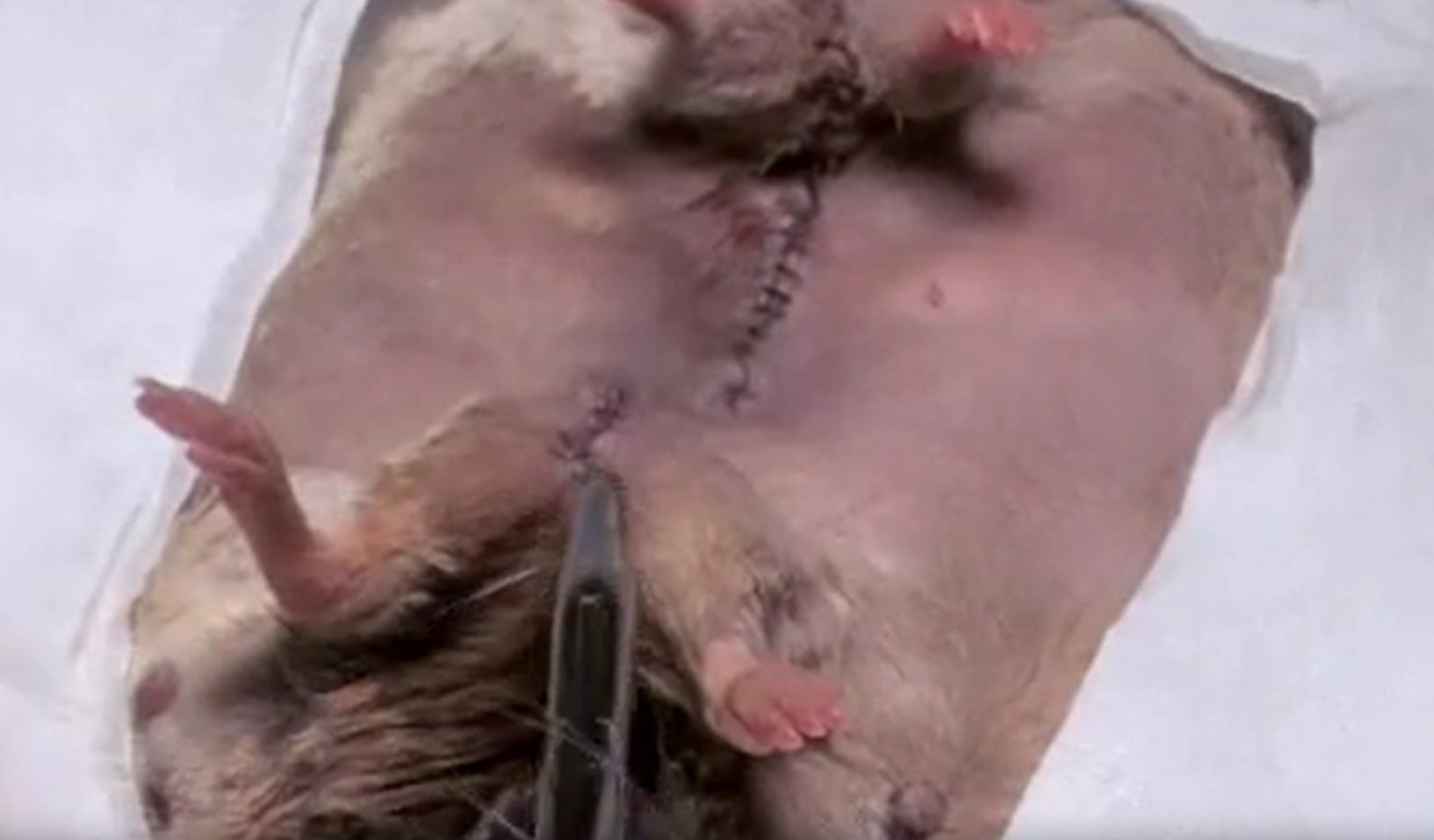
The animals may stay attached in this torturous manner for weeks, even years.
The Butcher of UMass Chan
Mark Kelly is a laboratory technician at UMass Chan. He is not a doctor. He is not a veterinarian.
But insiders tell PETA he is the experimenters’ go-to guy they call on when they want all manner of torment inflicted on an animal.
Kelly can crush the sciatic nerve or create deep wounds. He can cut into or block major arteries and veins. He can cut off and restore blood flow to the kidneys, limbs, and heart. He can remove adrenal glands, narrow the aorta to strain the heart, and surgically connect arteries to veins.
Small wonder he’s called “the Butcher.”
A Bridge Too Far
Parabiosis has been around since the 1860s and was initially used to study circulation and transplantation. Experimenters now use it in cancer, obesity, and aging experiments, among others. But it’s among the most controversial surgical procedures in animal experimentation, even by the permissive standards of the field.
The harm doesn’t end with the surgery. The mice remain physically joined. They cannot get away from each other. Every movement requires accommodation by the other animal.
Parabiosis surgery is so controversial that a German court recently upheld a ban on a parabiosis procedure that an experimenter planned to carry out on mice. The court concluded that the experiment would cause at minimum severe harm and that this was not adequately justified.
So Why at UMass Chan?
The honest answer is that we don’t know. Publicly available records do not indicate why or how often mice are being sewn together, how long they remain attached, or what the experiments are intended to accomplish.
What we do know is that parabiosis appears in UMass Chan publications and protocols and is currently on their website as a core procedure.
What we also know is that a controversial surgery that a German court found would cause “at least severe harm” is allowed to be performed by a man who is not a doctor or a veterinarian at UMass Chan, an institution with a long and gruesome history of animal welfare violations. That’s enough to raise serious questions.
What You Can Do
Please TAKE ACTION today and urge UMass to get out of the cruel and pointless animal tormenting business and switch to human-relevant, non-animal research methods.