Part Love Story, Part Investigation: The Book That’s Rocking the Animal Testing World
When journalist Melanie D. G. Kaplan adopted a timid beagle named Hamilton—“Hammy” for short—she had no idea how profoundly he would change her life. Hammy, underweight and with quiet brown eyes, had spent his early years in a desolate cage at the massive Virginia breeding facility—later obtained and operated by Envigo—that sold dogs to laboratories. Like thousands of others, they treated him as little more than a number, tattooed in his ear and destined for painful experiments.
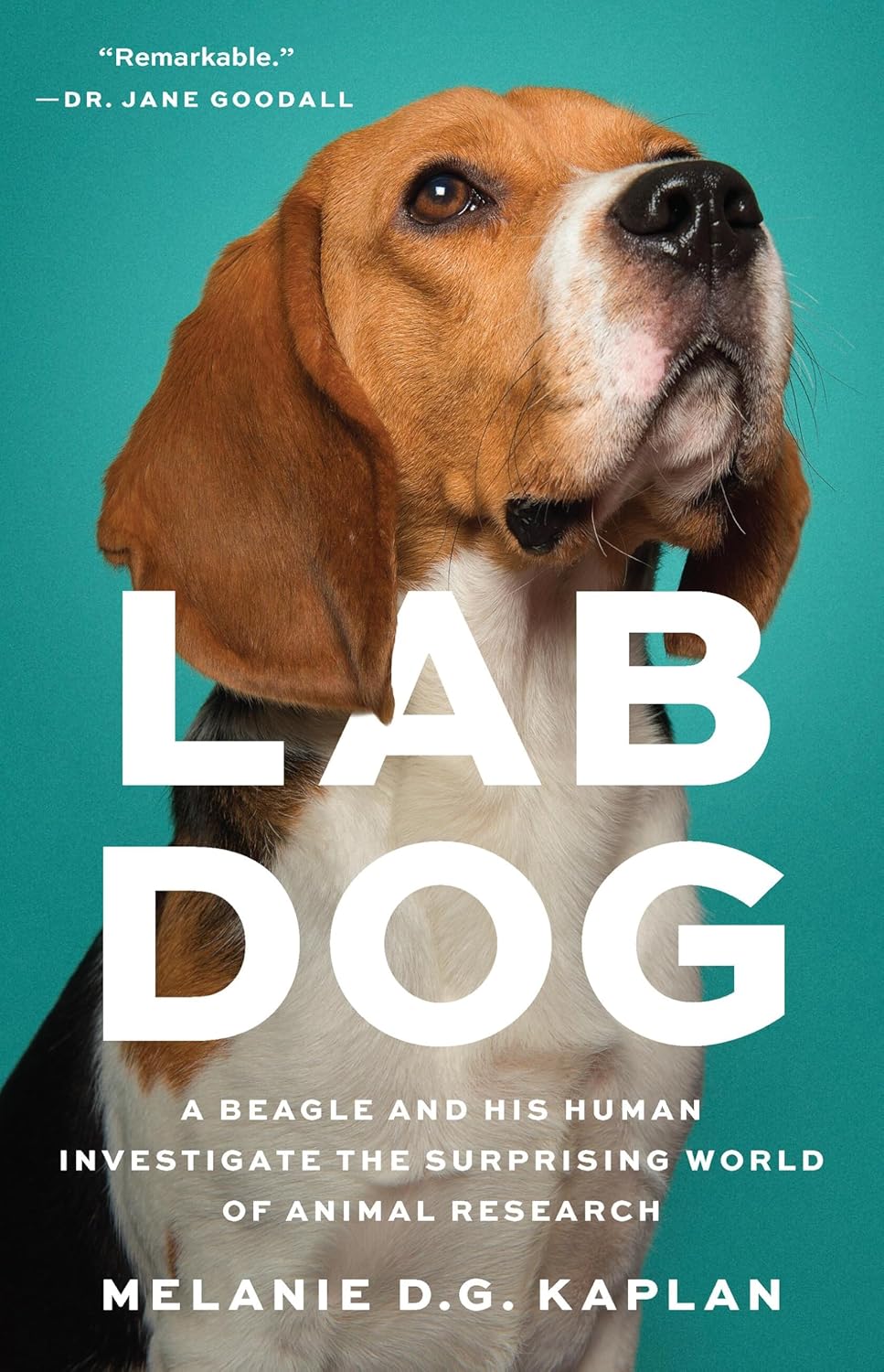
Kaplan’s new book, Lab Dog: A Beagle and His Human Investigate the Surprising World of Animal Research (out October 14), is part memoir, part investigation into the hidden world of animal testing. She explores the cruelty of breeding operations, the callousness of laboratory life, and the resilience of dogs who somehow learn to trust again. To provide expert insight, Kaplan spoke with several PETA employees, drawing on their decades of experience documenting the suffering animals endure in laboratories.
PETA Pulls Back the Curtain on Laboratories That Test on Animals
Hammy’s story is not unique. For decades, PETA investigations have exposed how the experimentation industry tortures dogs—from the facilities that breed them in extreme confinement and deprivation to laboratories where vivisectors pump dogs full of toxic chemicals, drill into their skulls, infect them with deadly diseases, and dispose of them once they’re no longer of use.
Hammy’s birthplace was one of the most notorious suppliers of dogs to labs. PETA’s undercover investigation there revealed beagles crammed into filthy cages, denied veterinary care, and left to suffer with untreated illnesses. The public outcry that followed led to a federal raid, dozens of legal violations, and a court-approved rescue of nearly 4,000 dogs. Under pressure, Envigo’s parent company shut the facility down—ending one of the darkest chapters in the business of breeding dogs to sell to experimenters.
Cruelty runs rampant across this industry. PETA found that researchers tormented dogs in gruesome experiments at Colorado contract laboratory Red Beast Enterprises Inc.—also known as High Quality Research—and routinely subjected dogs to agonizing “debarking” mutilations without pain relief. One beagle, Temple, was deemed “too wiggly” to experiment on, so PETA swooped in and rescued her! Sweet Temple is now thriving—and wiggling—in a loving home.
Kaplan also highlights PETA’s victory at Texas A&M University, where relentless campaigning ended the school’s cruel muscular dystrophy experiments on dogs.
Why Beagles?
Laboratories don’t use beagles in experiments because they are genetically similar to humans (they aren’t). They use them because they are small, gentle, and easy to exploit. Their trusting nature makes their suffering all the more cruel.
As Kaplan writes, “We humans are the ones who breed and confine and experiment on dogs. … How did I not see until now that I was culpable too? That as a human, I was responsible for some of the harms inflicted on Hammy?”
Though we have caused immense suffering, we also hold the power—and responsibility—to demand change.
Hope for Every Hammy
Every year, tens of thousands of dogs are bred, sold, and experimented on in the U.S. in useless experiments that fail to produce cures for human diseases. Most don’t make it out alive.
Join PETA in calling on the dean of Colorado State University’s College of Veterinary Medicine and Biomedical Sciences to reconsider allowing faculty to conduct experiments at High Quality Research, where dogs still suffer today.
Correction (October 14, 2025): An earlier version of this review misstated that Hamilton (“Hammy”), the beagle featured in Lab Dog: A Beagle and His Human Investigate the Surprising World of Animal Research, had his vocal cords cut. The book notes that while many laboratory dogs endure this cruel procedure, Kaplan writes that she had “no reason to think Hammy’s vocal cords were cut. His bark, once he was confident enough to share it, had always been robust” (p. 258). The article has been updated to reflect this.
As an Amazon Associate, PETA earns from qualifying purchases. If you buy something after clicking the Amazon links on this page, a percentage of the qualifying purchase will be donated to PETA and help us protect more animals from exploitation.