$10,000 PETA Reward Seeks Tips on Repackaged, Mislabeled Meat
For Immediate Release:
October 1, 2026
Contact:
Nicole Perreira 202-483-7382
PETA is putting up $10,000 for meat-industry insiders who expose companies repackaging, relabeling, or otherwise misrepresenting meat, in a new nationwide push for information that leads to enforcement action by federal or state authorities. After allegations surfaced that a company that built its brand on “humane” claims repackaged factory-farmed meat as its own, PETA is seeking insiders with firsthand knowledge of similar practices that could leave consumers paying a premium for meat from the very facilities they sought to avoid.
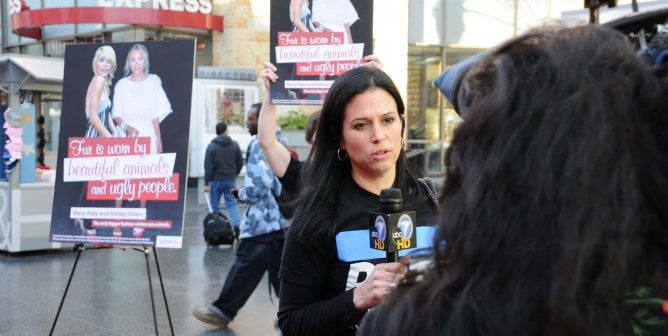
To reach workers with firsthand knowledge, PETA will take eye-catching messages straight to meat-industry areas across the country—including Harrisonburg, Virginia; Sioux Center and Sioux City, Iowa; Decatur, Alabama; Sanger, California; and the Modesto, California, region—urging industry insiders to report “meat fraud.” The areas are all home to operations associated with leading brands that market meat using “humane” or similar animal-welfare claims.
The nationwide offer follows documentation PETA obtained earlier this year showing that Virginia-based chicken company Shenandoah Valley Organic, which does business as Farmer Focus—and markets its products as “animal welfare certified” and “traceable”—purchased more than 50,000 pounds of chicken from a massive non-organic producer, George’s Inc., and, according to a whistleblower, repackaged and resold it as its own. PETA has filed a formal complaint with the Federal Trade Commission over the whistleblower’s allegations.
Public records obtained by PETA also revealed that the U.S. Department of Agriculture has repeatedly warned George’s for incidents including workers violently abusing live birds, birds drowning in hot water, thousands dying of heat stroke on trucks, and a bird “buried up to the neck” in feces.
“Animals endure terror and pain in the meat industry regardless of what reassuring words appear on a label, and deceptive meat marketing can leave consumers paying a premium for promises that simply aren’t true,” says PETA Vice President Daniel Paden. “PETA is offering $10,000 for credible evidence that helps authorities hold companies accountable for misleading consumers about where meat comes from and the suffering behind it.”
PETA notes that even if meat comes from a facility that meets the requirements of “Certified Humane” or a similar program, those labels don’t prevent animals from suffering. An insider told PETA that at Farmer Focus’s own Virginia slaughterhouse, chickens suffered broken and bruised wings, drowned in an overfilled stunning bath, or were fully conscious when struck in the face, neck, and wings by an automatic kill blade. Some birds reportedly remained conscious after these failed throat cuts and were still alert when a machine tore their heads from their bodies.
Anyone with information about meat being repackaged, relabeled, or otherwise misrepresented can email PETA at [email protected].
PETA—whose motto reads, in part, that “animals are not ours to eat”—points out that Every Animal Is Someone and offers free vegan starter kits for those looking to make the switch. For more information, please visit PETA.org or follow PETA on X, Facebook, or Instagram.