


Protests, Pressure, Partnership … PROGRESS!
A terrified rabbit quivers as gloved hands apply a caustic chemical to her eye. Searing pain seizes her. For decades, crude and cruel experiments like this were the foundation of the US Environmental Protection Agency’s (EPA) chemical testing program. But that is changing, and PETA’s relentless scientific, legal, and advocacy work can take a bow.
Advancing Science by Leaps and Bounds
The EPA has committed to ending its reliance on toxicity tests on mammals! This is major progress that PETA has pushed hard for – and it will save thousands of rabbits, rats, mice, and other animals from being burned with chemicals, dosed with toxins, given cancer, and killed. This change can’t come soon enough, and we’re working hard to turn this commitment into reality.
PETA scientists are shattering the old paradigm of using living beings as disposable test tubes. They coauthored award-winning papers showing that non-animal approaches outperform tests on rabbits such as the one above, helping the EPA to make non-animal eye-irritation methods its preferred option. They also helped the agency to design a new way to test for skin irritation that prioritizes animal-free methods, which means that chemicals once smeared onto rabbits’ shaved, raw skin can now be evaluated without harming a single animal.

As for cancer tests, rats and mice are forced to ingest or inhale substances daily for up to two years before they are killed and dissected. PETA scientists broke through the inertia, partnering with EPA researchers to develop a way to assess cancer risk without new tests on animals. This approach has already spared 1,600 animals and created a blueprint that will save countless more! And that’s just for starters.
From Suing the EPA to Standing Beside It
How did the world’s largest critic of animal experimenters become partners with federal agencies in ending tests on animals? At first, the EPA balked at giving PETA a seat at the table – it didn’t believe an animal rights group had a place in chemical-testing discussions. But from the earliest times, we didn’t take “no” for an answer – instead, we took our giant “Gorey rabbit” on the campaign trail. We followed then-presidential candidate Al Gore everywhere, exposing the EPA’s cruel tests to national media. We brought legal pressure, too, and we helped amend legislation that compels the agency to replace the use of vertebrate animals whenever possible.
A New Path Opened Up
But in the past decade, the EPA began seeing PETA scientists as a valuable resource. That led to coauthored papers, training for regulators, and, together, developing and evaluating state-of-the-art, animal-free test methods. PETA began siding with the EPA, defending the agency against lawsuits from vested interest groups trying to force it to increase unreliable animal tests that run counter to modern science. So when EPA Administrator Lee Zeldin announced the agency’s commitment, PETA’s Managing Director of Regulatory Toxicology Dr. Amy Clippinger didn’t just have a seat at the table – she had a spot at the podium.
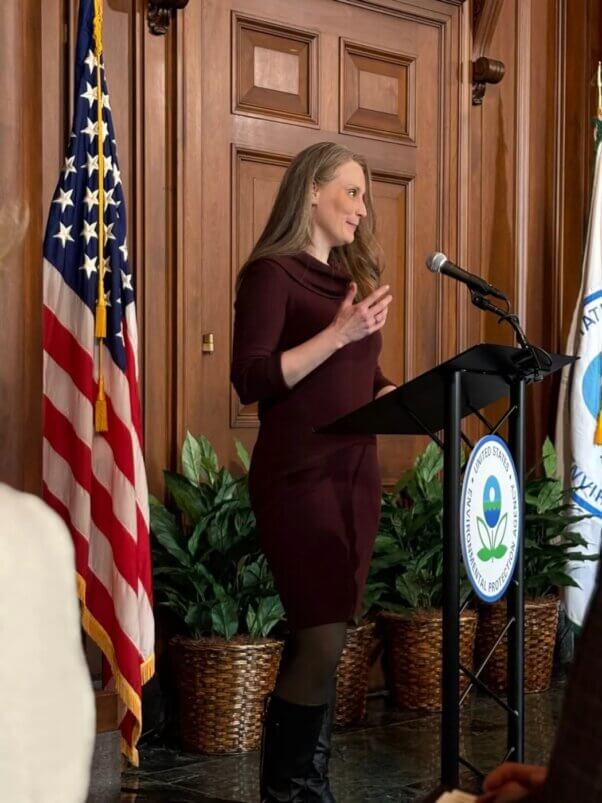
“The EPA is a leader in advancing reliable and human-relevant non-animal testing, an urgent priority given the tens of thousands of animals used each year in toxicity tests for the agency. PETA scientists are proud to have contributed to this progress through collaborative research and training initiatives, and we look forward to continuing our work with the agency to accelerate the adoption of the best available science to protect people, animals, and the environment.”
—PETA Managing Director of Regulatory Toxicology Dr. Amy Clippinger
This Is What Momentum Looks Like
Government agencies worldwide are embracing what PETA has championed for years: Obsolete animal tests should be left behind in favor of reliable and human-relevant non-animal tests. The Centers for Disease Control and Prevention announced it will phase out all experiments on monkeys – a seismic shift that PETA fought for. The National Institutes of Health is ending funding calls for animals-only experiments, and the Food and Drug Administration (FDA) is leaning into superior, human-relevant methods in response to relentless PETA pressure. Following extensive input by PETA scientists and entities, the European Commission is developing a plan to phase out animals in chemical safety assessments, and Health Canada and Environment and Climate Change Canada have released a national strategy to move away from chemical tests on animals.
We will keep our sleeves rolled up until we knock out all experiments on animals, everywhere!

What You Can Do
Keep science moving forward! The FDA may now require that companies test menstrual products, such as tampons, pads, and cups, on animals – even when state-of-the-art, animal-free methods are available. Speak out against this!

