Executive Summary of PETA’s White Paper on the Failure of Cage-Free Housing Systems to Reduce Overall Hen Suffering
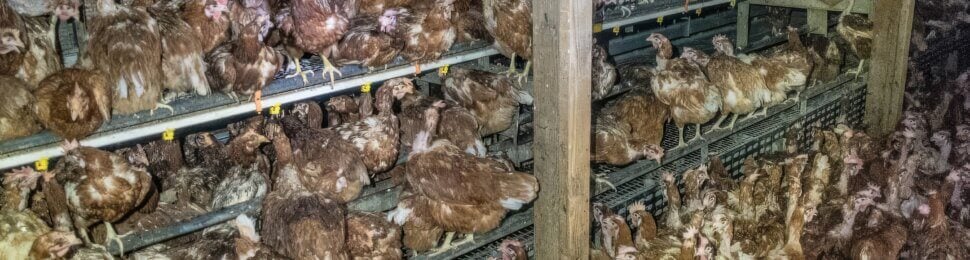
The time has come to acknowledge that the well-intentioned move to compel the egg industry to switch from traditional battery cages to alternative cage-free housing systems has failed to achieve more than minimal improvements in hen welfare and, in some cases, can create distinct or worse welfare problems than the caged systems they replaced. This transition and the marketing of cage-free options have left consumers with a false impression of “happy” hens who can perform a full range of natural behaviors. Despite marketing claims, stocking density, poor building design, and flock size in industrial cage-free systems limit high-quality expression of a full range of natural behaviors, such as the ability to stretch and preen wings, roost, scratch, peck, forage, dust-bathe, socialize, and more. Cage-free certifications and labels mislead consumers into believing that cage-free hens behave like hens in their natural environments. The egg industry encourages and profits from this fiction, which is perpetuated through deceptive humane labeling, promoted in studies that respond to industry concerns to increase productivity and profit, and legitimized by animal welfare organizations that secure corporate cage-free commitments.
Cage-free housing cannot achieve good animal welfare because it exists within a larger industrial system that exploits hens and causes them great suffering at every stage of their lives. It simply removes battery cages but transforms the same factory farm shed into one large cage. Cage-free environments involve most of the same abuses found in conventional housing, such as permanently damaging the sensitive tips of hens’ beaks by searing or burning them off with a blade or infrared light and inducing molting to maximize a hen’s egg production. It similarly depends on the cruelties of industrial hatchery and genetic selection to maximize production and exploit hens’ bodies to their biological limits and beyond.
In artificially lit and severely crowded non-cage housing, where space allowances can prevent the average hen from turning around freely and spreading her wings or traveling to another section of a barn without bumping into or infringing on the space of another hen, pecking is the one natural behavior that remains after the pecking order has fallen to pieces.
Cage-free confinement also introduces welfare problems that are worse than in caged systems, such as increased immunosuppression and chronic respiratory infections and skin lesions caused by ammonia-saturated air, wet loose litter, and higher levels of pathogenic particulate matter. This dust is disturbed by mass movement, dustbathing, and pecking on open flooring, increasing the risk of barn fires in addition to widespread contagion and, consequently, the mass killing of infected flocks due to heatstroke and suffocation from the standard industry practice of ventilation shutdown (VSD/ VSD+). Uncaged hens are vulnerable to higher rates of injurious, severe, and cannibalistic feather, toe, and cloacal pecking, leading to chronic pain, infection, loss of the ability to regulate body heat, cannibalism, and even death.
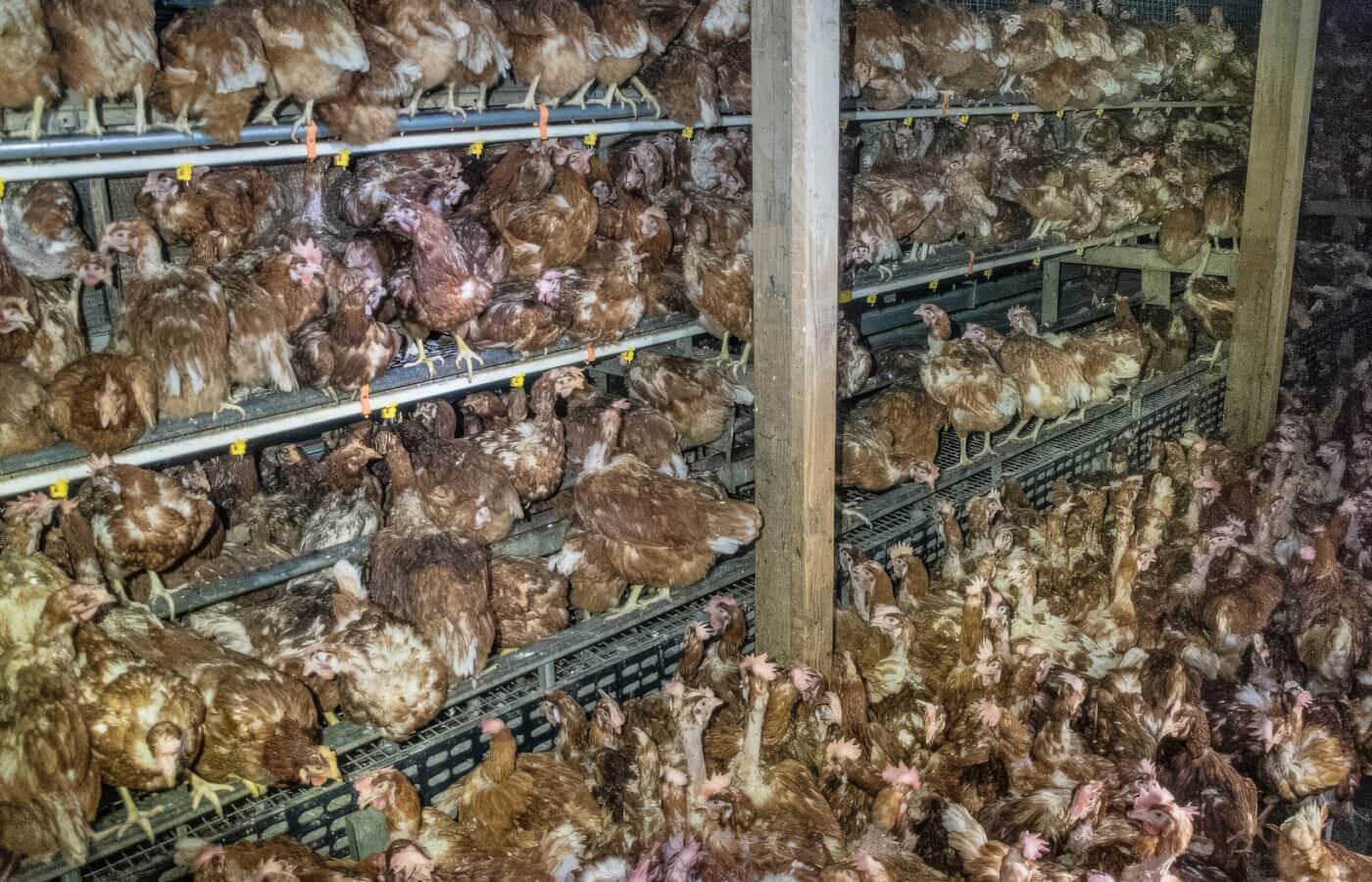
In flocks numbering in the tens of thousands, each hen is provided with only between 1 and 1.5 square feet of floor space. This confinement, combined with large flock sizes, breeds aggression and resource competition. Hens’ natural behavioral synchronization leads to piling and suffocation. Debilitating keel-bone fractures and breaks often occur when hens fall or are pushed or jostled by other hens from perches and nest boxes. Competition for next boxes causes piling and even death from suffocation due to smothering. As a result of resource competition, hens in cage-free systems lay a portion of their roughly 300 eggs per year on the floor. These hens will never brood or experience motherhood. When a new generation of hens is hatched in mechanized incubators, they are born without the presence of their mothers, which deprives the chicks of learning vocalizations that would help them manage fear and stress responses throughout their lives. These motherless chicks are once again traumatized by being separated from the chicks they imprinted on at a hatchery when they are roughly loaded and transported to egg factories. This dystopian cycle of chronic stress, frustration, pain, suffering, aggression, and death by cannibalism, disease, and slaughter repeats with each generation of chicks born into the egg industry, whether destined for a battery cage or a cage-free facility.
Confining hens to battery cages was always ethically untenable, but so was the alternative presented by cage-free campaigns; neither option should be supported or promoted. Instead, anyone who believes hens’ suffering is unacceptable should commit to supporting efforts to eliminate their exploitation for eggs in the first place.
Read PETA’s White Paper
Crack open the truth about “cage-free” eggs. PETA’s white paper details how hens are confined in overcrowded sheds, subjected to painful mutilations, and pushed to their physical limits in systems that prioritize profit over welfare. To understand the full scope of suffering—and why “cage-free” housing fails to deliver meaningful change for hens—read the complete report now.

From recycled plastics to next-generation vegan leather, these car interiors leave animals out of the equation.
PETA Latino went inside this Mexican zoo and documented severe distress, filth, and apparent signs of neglect.

A biotech pioneer that’s helping replace tests on animals just earned top honors from PETA scientists.