
Endangered Monkey Bound for Laboratory Dies During Transport; PETA Demands Investigation
For Immediate Release:
January 12, 2026
Contact:
Tasgola Bruner 202-483-7382
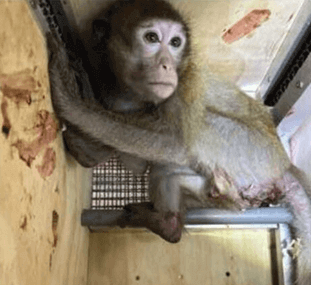
In a letter sent today, PETA calls on the Inspector General of the U.S. Department of Agriculture (USDA) to investigate how an endangered juvenile long-tailed macaque was found dead upon arrival at a Connecticut laboratory, despite the transport carrier, JKL Secure Freight, reporting that the animals were “active and alert” during the trip. PETA also asks why the agency closed the case without enforcement despite the contradictory records.
Records obtained by PETA show the monkey was transported on February 7, 2023, by Nevada-based JKL Secure Freight from BCUS LLC, an Immokalee, Florida primate facility. The intake notes at the Connecticut laboratory describe the animal as cold to the touch and unresponsive when the shipping crates were opened, indicating death occurred well before arrival. Yet JKL reported the animals were in good condition up to an hour before delivery.
The USDA conducted a focused inspection of JKL but quickly closed the matter without citing any violations of the Animal Welfare Act or providing an explanation.
“When a monkey arrives dead in a transport truck, and the carrier’s own records don’t match what the receiving laboratory documented, that should trigger serious regulatory action, not a quiet dismissal,” said PETA primate scientist Dr. Lisa Jones-Engel. “PETA calls for an independent investigation before this pattern puts more animals, and the public, at risk.”
JKL has a history of transportation violations, including falsified veterinary documentation and unsafe transport conditions—failures of animal welfare laws that also pose a health hazard to humans. Primates, particularly those imported from Asia and Africa, are known to carry tuberculosis, hepatitis A, malaria, and other zoonotic pathogens.
Just two weeks after this monkey’s unexplained death, monkeys were found infected with tuberculosis at a Michigan laboratory. Those monkeys, like the female juvenile who died, originated from Mauritius.
In nature, macaques live in large, tight-knit groups, travel several miles each day exploring diverse habitats, and cuddle together in their favorite “sleeping trees” at night. Monkeys imported to U.S. laboratories are bred on squalid factory farms or abducted from their forest homes, pushing some species toward extinction.
PETA—whose motto reads, in part, that “animals are not ours to experiment on or abuse in any other way”—points out that Every Animal Is Someone and offers free Empathy Kits for people who need a lesson in kindness. For more information, please visit PETA.org or follow PETA on X, Facebook, or Instagram.