Stating the Obvious to Massachusetts Legislators: Baby Monkeys Need Their Mothers
Members of the Massachusetts State Legislature just heard from numerous experts supporting a landmark bill that seeks to prevent experimenters from ripping baby monkeys from their mothers for the first year of their lives in dramatic, emotional testimonies brought about by the efforts of PETA and Massachusetts-based Speak Up for Animals.
The legislation (H.1948/S.1167) was introduced in the Massachusetts legislature by Senator Joan B. Lovely (D-2nd Essex) and Representative Sean Reid (D-11th Essex). No vote on the measure was immediately scheduled.
PETA applauds all members of the Joint Committee on the Judiciary for holding today’s important hearing and Speak Up for Animals for its diligent efforts in bringing forward this crucial bill.
Baby monkeys need their mothers. It’s a fact that should seem obvious enough to anyone drawing breath. Because some experimenters still tear infant monkeys from their mothers, experts, animal protectionists, and activists weighed in on the tremendous long-term physical and psychological damage caused by maternal separation, a patently vile practice that also undermines any supposedly scientific exploration.
Comments came from a former laboratory worker, a veterinarian, a Harvard Medical School alum, Massachusetts residents and PETA representatives and animal advocates of all stripes. In all, 11 supporters of the bill addressed the committee, led by Dr. Katherine Roe, PETA’s Chief Scientist of Laboratory Investigations.
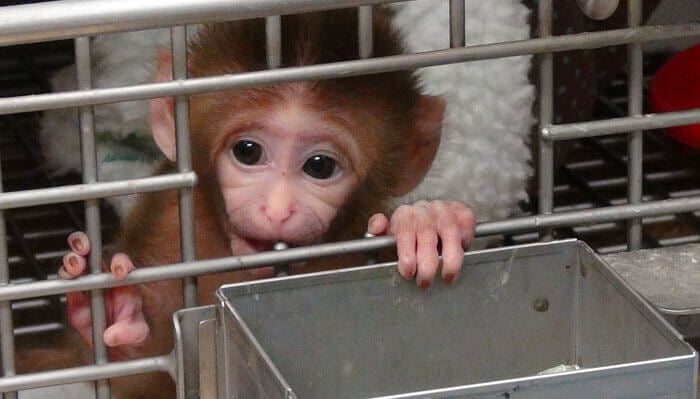
“What happens to nonhuman primates in laboratories is too gut-wrenching to put into words,” Roe said. “We know from decades of research that when infant monkeys are taken away from their mothers for experimentation, the negative effects are 10 times worse.”
Deb Newman, founder of Speak up for Animals, took direct aim at the ghastly maternal separation experiments of Harvard’s Margaret Livingstone as “pointless” and “depraved.”
“If you believe you can’t object to such research on ethical grounds, then you must object to its lack of scientific or medical justification,” Newman said.
Madeline Krasno worked for two years at the Harlow Primate Lab at the University of Wisconsin-Madison, and she delivered a first-hand account of the misery caused by removing baby monkeys from their mothers.
“When you work in an environment where life is treated as disposable, you either start to believe it, or you disassociate to survive,” Krasno said. “I’ve been living with PTSD ever since.”
Dr. Marge Peppercorn, a Harvard Medical School alum and pediatrician, argued vehemently that compassion and sound science are not mutually exclusive.
“I am not anti-science. I am not anti-research,” Peppercorn said. “I believe in research. The fact is that I know of no positive effects or positive knowledge that has come from any studies that I’ve read about that have taken different monkeys from their mothers at a young age.”
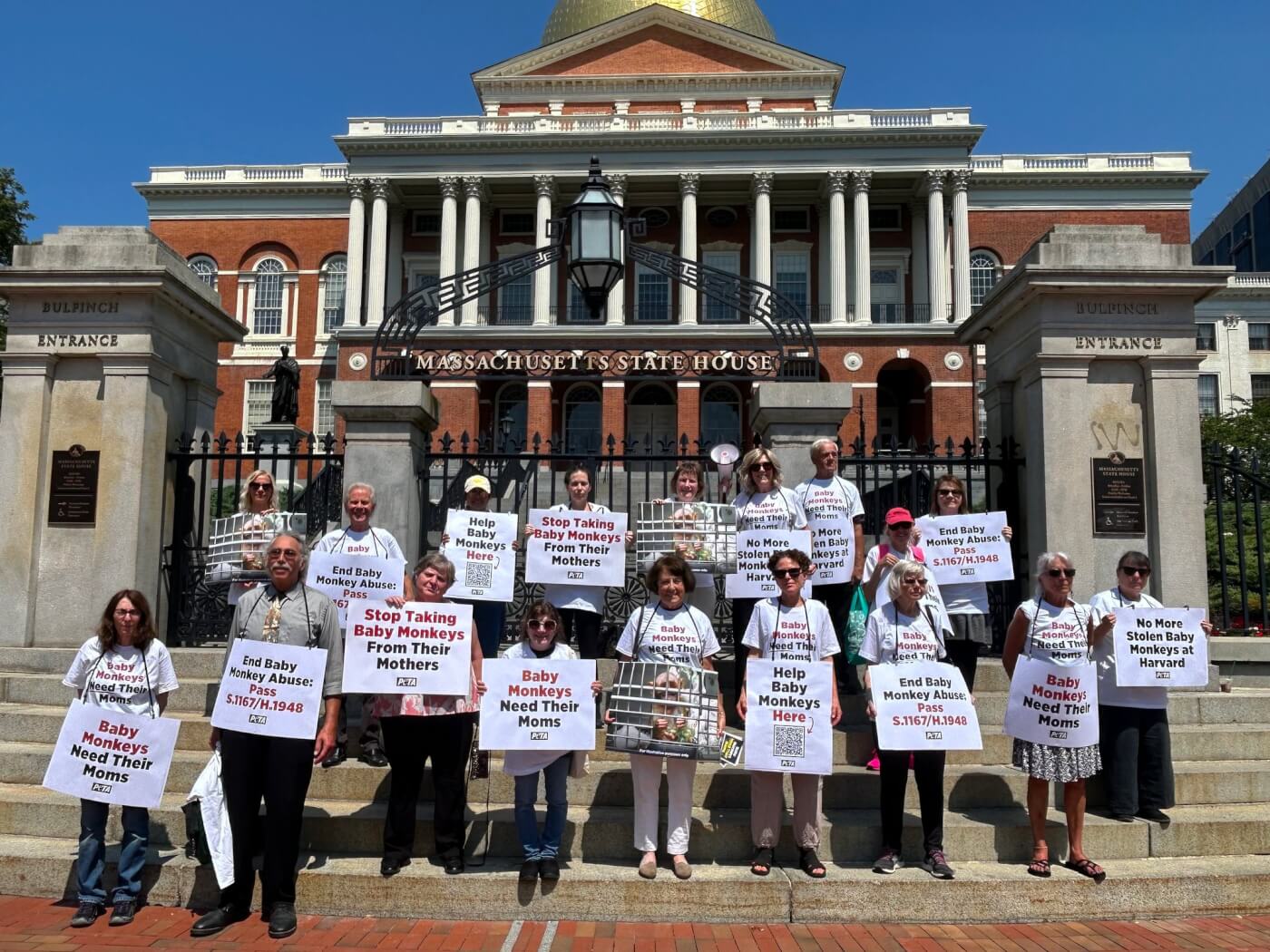
Outside the hearing, Massachusetts residents came out in force to support the common-sense bill, staging a boisterous rally in front of the State House, holding signs that read, “End Baby Monkey Abuse: Pass S.1167/H.1948.”
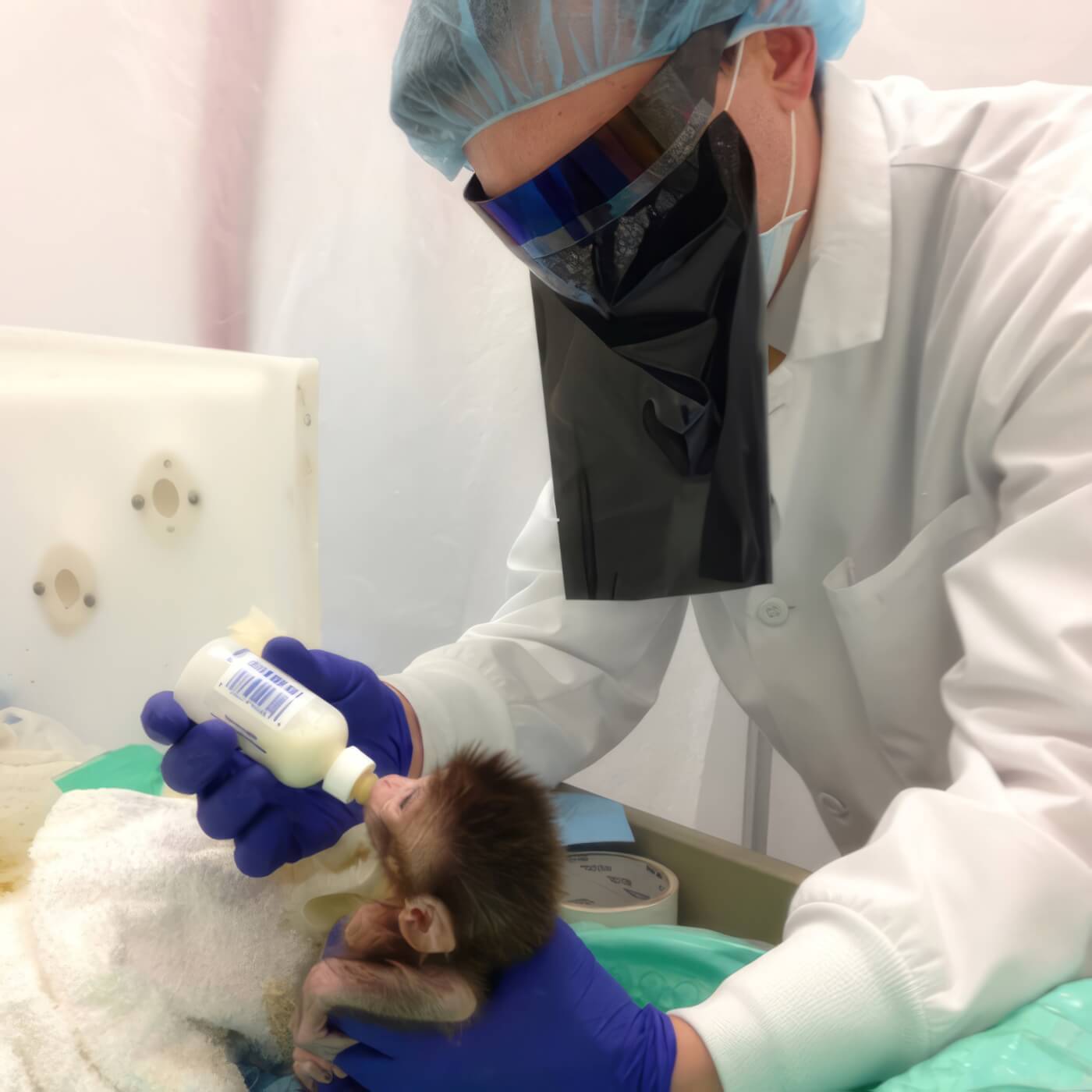
The bill was introduced after PETA exposed Harvard Medical School experimenter Margaret Livingstone’s cruel tests, in which newborn monkeys were ripped from their mothers and forced to wear goggles that simulated disorienting strobe lights for the first 18 months of their lives.
Livingstone also sewed other monkeys’ eyes shut, and after years of torment, killed and dissected many of them. After PETA’s exposé, nearly 400 scientists and animal welfare experts demanded a stop to Livingstone’s experiments.
What You Can Do
If you’re a Massachusetts resident, please urge your lawmakers to support this historic bill.
And everyone can urge the Department of the Interior to ban the import of endangered monkeys from Asia.