
The New Study That SeaWorld Doesn’t Want You to Know About…
A new comprehensive review of cetacean (including dolphins and whales) captivity confirms what we’ve long known: Keeping these intelligent, social, complex animals in tiny tanks is inherently cruel. Despite decades of industry promises and self-described “improvements,” the study found that marine parks still fail to meet even the most basic physical and psychological needs of cetaceans. From restricted space to chronic stress and often shortened lifespans, the evidence is clear: Life in a concrete pool can never compare to life in the ocean.
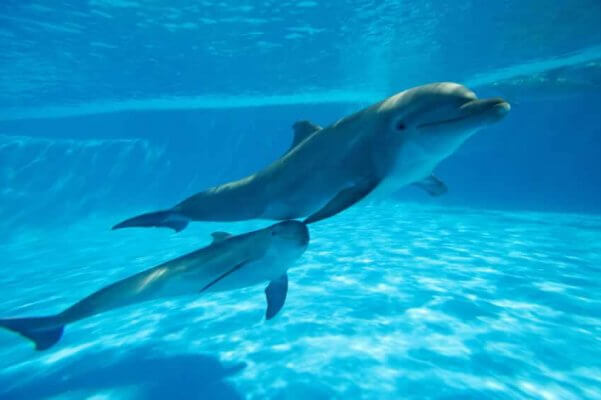
Tanks Can’t Meet Cetaceans’ Needs
The new research indicates that no tank, regardless of its size, can fully meet the complex needs of dolphins, whales, and other cetaceans. These animals are built for the open ocean, where they can swim vast distances, dive deep, and spend hours hunting and exploring. At marine parks, these animals have little to do but circle the same concrete enclosure day after day. Tanks are designed for human viewing—not for the animals’ well-being. Foraging, one of their most natural and enriching behaviors, is replaced with handouts of thawed fish on a schedule entirely controlled by humans.
No Freedom or Choice
In their ocean homes, cetaceans form lifelong bonds, choose their companions, and can swim away from conflict when needed. Marine parks force them into artificial groupings, and the animals can’t escape when aggression or tension arises. Even reproduction is controlled by humans—there’s no opportunity to choose their mates or decide when and with whom to breed. The result is social stress and frustration that no enrichment program can fix.
Although SeaWorld ended its sordid orca-breeding program following a persistent PETA campaign, the company still uses other whales and dolphins as breeding machines, creating more generations of animals to exploit.
Marine Park Captivity Takes a Physical and Psychological Toll
The study highlights what decades of evidence have already proven: Confinement damages cetaceans’ brains, behavior, and physical health. They often suffer from stress-related illnesses, dental injuries from chewing and jaw-popping on hard tank surfaces, and premature deaths. Many self-harm and repetitively regurgitate and re-ingest food as a response to severe boredom, stress, and social isolation or instability. Concrete pools bear no resemblance to the rich, ever-changing ocean world these animals evolved to navigate with their powerful sonar abilities and complex social intelligence.
The Solution: Seaside Sanctuaries
No animal is suited to life in a marine park tank—period. True progress means moving away from these abusement parks altogether and transitioning these animals to seaside sanctuaries, where they can live in a more natural, spacious, and stimulating environment—an environment where they can still receive human care, but be free from exploitation. True sanctuaries offer cetaceans the chance to feel ocean currents, engage in more natural behaviors, and live out their lives with dignity. It’s time to empty the tanks and send the orcas, other dolphins, and whales to their ocean homes, where they belong.

