Breaking New Ground: Lionsgate Issues Exclusive Statement as ‘Michael’ Puts Spotlight on Bubbles
PETA’s got thrilling news—and we’re not just talking about the release of the highly anticipated Michael Jackson biopic.
As fans turn out in droves to watch the King of Pop’s story unfold, they’ll see Bubbles the chimpanzee brought to life on screen using state-of-the-art, humane CGI.
PETA’s seizing the movie-magic moment to send a serious message: Our fellow primates are not “pets.” As one character in the film puts it: “Michael, you do know that chimps are wild animals that don’t belong in a house in Encino?”
Groundbreaking for Hollywood
Michael largely follows Jackson’s life through the 1980s—an era before the public widely understood how apes and monkeys suffer when kept in human homes. Behind the scenes of the exotic-animal trade are dealers breeding infants in captivity, tearing babies from their loving mothers, and selling them to anyone with a big enough bank account, no matter the suffering that follows. Studies have shown that depictions in the media of primates alongside humans can increase the demand to acquire these animals as “pets.”
That’s why Lionsgate shared this exclusive statement with PETA:
“We have had continuing constructive dialogue with PETA about the portrayal of Bubbles the chimpanzee as a pet. This portrayal is simply based on historical fact and is not intended to be an endorsement of keeping chimpanzees as pets. Bubbles is portrayed in the movie using CGI technology and the real Bubbles has been living a peaceful life at the Center for Great Apes sanctuary for more than 20 years.”
Bubbles’ Untold Story
In nature, chimpanzees and monkeys form deep family bonds, live in complex social groups, and spend their days roaming long distances and foraging through dense forests. That rich, natural life was stripped away from Bubbles early on.
When Bubbles was about seven years old—an age when male chimpanzees would still be by their mother’s side in nature—he was sent to a disgraced Hollywood trainer until he was retired in 2005.
In the pet trade, chimpanzees and monkeys often suffer from debilitating loneliness and depression and develop anxious behaviors like self-mutilation because their complex physical and psychological needs cannot be met in human homes.
Primates don’t “adjust” to human homes—they endure them. Animal dealers are quick to make a sale, but chimpanzees grow stronger, assert their independence, and become impossible to dominate. Like most chimpanzees bought as “pets,” Bubbles was no longer controllable once he reached adolescence.
Now 43, Bubbles flourishes at an accredited sanctuary, the Center for Great Apes, where he has what every chimpanzee deserves: a naturalistic environment, the opportunity to socialize with other chimpanzees, and freedom from exploitation.
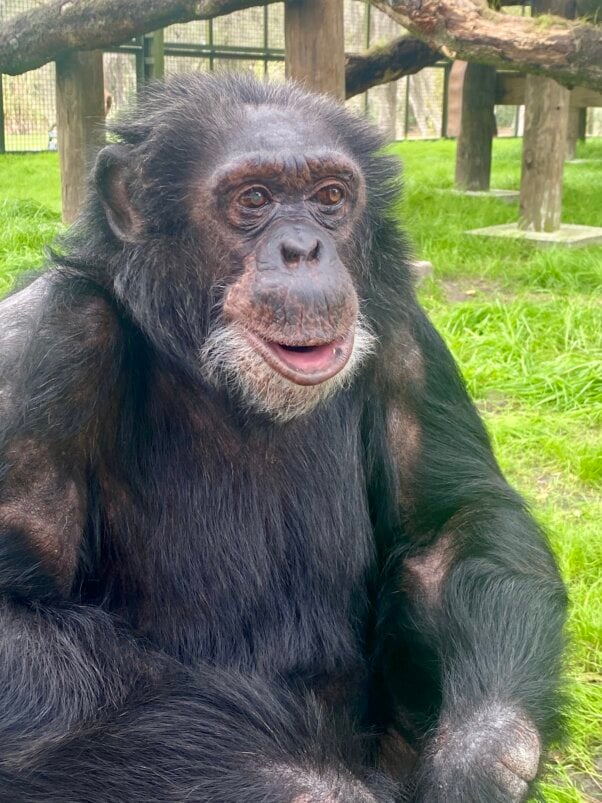
Most “pet” chimpanzees and monkeys never get that chance. When they become too big and difficult to control, they’re often locked in cages, dumped at roadside zoos, or sent back to dealers to breed more babies for the trade.
Tell Animal Dealers to Beat It
We’re applauding Lionsgate and the Michael production for using high-tech, compassionate filmmaking to portray Bubbles without using real animals. Thanks in large part to PETA’s bold campaigns, chimpanzees are no longer used in Hollywood productions. But some of our fellow primates still need our help right now.
Please help monkeys and apes suffering in the pet trade, at roadside zoos, and at sham “sanctuaries” that exploit them for profit.