Happy Hanukkah! Here Are 8 ‘Mitzvahs’ You Can Do to Help Animals
On each day of Hanukkah, we eat latkes, play dreidel, exchange gifts, and light the menorah to remember the Jewish people’s struggle for religious freedom. Known as the “Festival of Lights,” Hanukkah celebrates an ancient miracle: For eight long nights, a candle burned bright with just a tiny bit of oil as the Jews cleansed and rededicated their holy temple long ago.

Hanukkah is a time to reflect on the plight of all sentient beings—and that includes the suffering of our fellow animals who are used in experiments, killed for their flesh and skin, exploited for entertainment, and abused in other horrific ways. That’s why we must mark this long-held tradition by doing mitzvahs—or good deeds for others.
Here are eight actions you can take for animals on each day of Hanukkah.
Night One: Object to Oreo Maker’s Experiments on Mice
The maker of Oreo has paid experimenters to conduct pointless and cruel “nutritional science” tests in which they force mice to eat human feces before killing and slicing them open. Please urge the company to end its experiments on animals and join PETA’s revolutionary Eat Without Experiments program, which makes it easy for consumers to see which food and beverage companies do or do not test on animals:
Night Two: Tell the Government to Terminate Contracts With Monkey Tormentors
Alpha Genesis—where 43 monkeys escaped last year—is still raking in $19 million in National Institutes of Health (NIH) contracts despite a horrific record. Monkeys have suffered severe injuries, and the facility has kept them in filthy, pathogen-ridden enclosures and denied them veterinary care. According to a whistleblower, many have died from trauma, extreme temperatures, or preventable hazards, including one who froze and dehydrated after getting her head stuck in a fence and another who suffocated after being trapped under other monkeys. Even an infant died after becoming caught in a slide-bolt lock.
Night Three: Take PETA’s Three-Week Vegan Challenge
Animals do not want to be violently slaughtered for their flesh, forcibly manually impregnated and separated from their precious babies for their milk, or crammed into filthy, windowless sheds on misleadingly labeled “cage-free” farms. On farms and in slaughterhouses, billions of sensitive, feeling individuals suffer in these conditions every day. YOU can spare nearly 200 animals annually, reduce your carbon footprint, and boost your health by going vegan. Get started by taking PETA’s three-week vegan challenge, and encourage your friends and family to do the same:
Night Four: Fight Off False ‘Humane Washing’ Labels
PETA investigations have revealed filth, suffering, and abuse at all “animal welfare certified” locations we’ve investigated—including Plainville Farms, where a PETA investigator witnessed workers violently beating and sexually abusing birds. Whistleblowers also reported to PETA that chickens at “humane” meat supplier Farmer Focus’s slaughterhouse were subjected to botched killings and other cruelties. Don’t be misled by marketing claims that animals are raised in a “stress-free” environment and transported in “comfort.” Avoid eating animal flesh or anything stolen from them, even supposed “humane,” “organic,” and “free-range” meat, eggs, and milk. As long as profit is involved, animal well-being always takes a back seat.
Night Five: Free Corky
Corky, the longest-held captive orca in the world, has been imprisoned at marine parks for 55 years. Today, she swims in endless circles in a tiny tank at SeaWorld San Diego, while her siblings and other members of her pod swim free in the ocean.
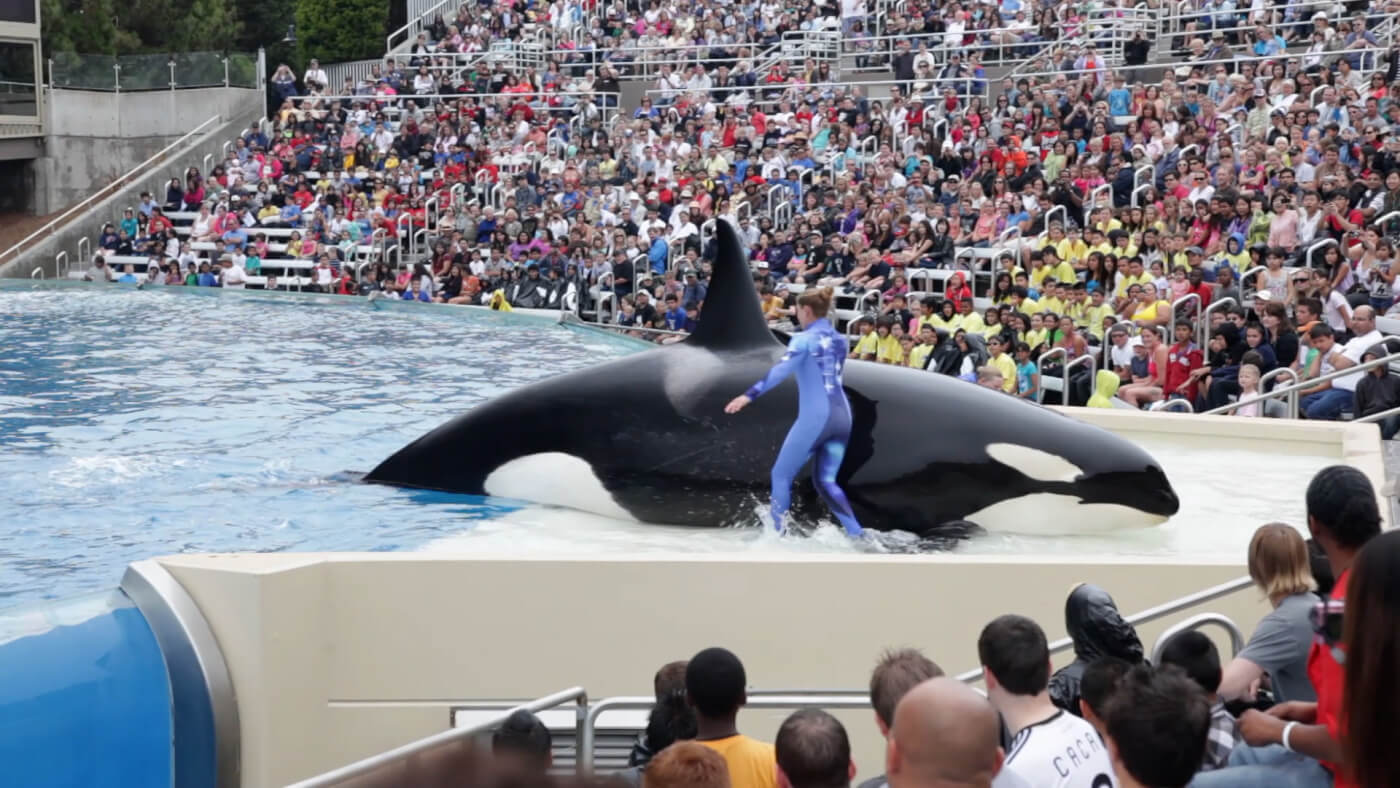
PETA’s extensive campaign for Corky has included bold demonstrations, public service announcements with celebrities such as Pamela Anderson and Christopher von Uckermann, a constitutional lawsuit on Corky’s behalf, and even a 150-mile relay run from Los Angeles to San Diego. More than 200,000 of our supporters have joined PETA in urging SeaWorld to release Corky into a seaside sanctuary, where she could finally feel ocean currents, hear the songs and calls of other free orcas, and possibly communicate with her siblings. Learn more about Corky and speak up for her before it’s too late:
Night Six: Sponsor a Sturdy Doghouse
As temperatures plummet, dogs who are left tethered or chained outside 24/7 struggle to survive without proper shelter to protect them from the elements. Unable to escape the freezing cold, these dogs are vulnerable to frostbite, hypothermia, and even death. Often, these lonely animals are deprived of even the basics—such as food, water, and veterinary care. All winter long, PETA’s fieldworkers deliver dry, fluffy straw bedding and sturdy wooden doghouses to dogs neglected outside.
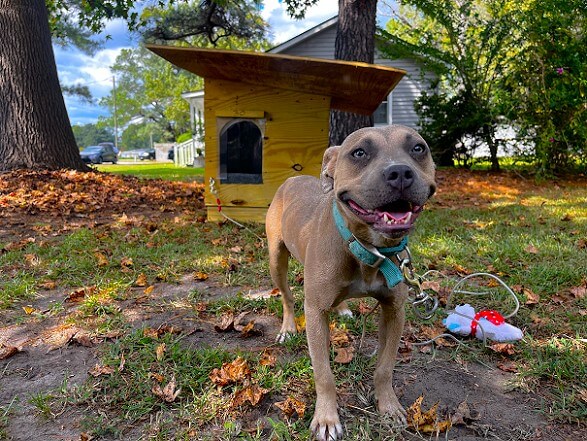
Although a doghouse is no substitute for a real home in which dogs could be warm, comfortable, and surrounded by their human families, it can mean the difference between life and death to dogs who previously had no shelter. Help us continue this vital work by sponsoring a doghouse:
Night Seven: Speak Out Against Coach’s Use of Cows’ Skins
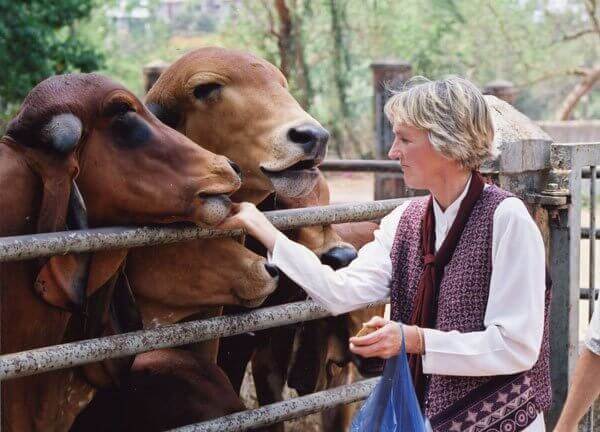
Every year, more than a billion gentle cows and other animals are slaughtered so that their skins can be used to make handbags and other leather accessories. A PETA exposé of the world’s largest leather processor—which has been linked to Coach—showed that workers brand calves on the face, beat cows and bulls, and shock them with electric prods. The leather industry also contributes to the climate catastrophe, land devastation, deforestation, pollution, water contamination, and loss of biodiversity. Join PETA in urging Coach to stop using animal- and planet-killing leather:
Night Eight: End the Abuse of Camels and Horses in Egypt
In Egypt’s tourism industry, horses and camels are forced to carry tourists at the pyramids in the sweltering heat. PETA’s latest mini documentary revealed that workers forcefully beat the exhausted animals, who were denied adequate food, rest, shade, and proper veterinary care. Injured and malnourished horses were seen eating from garbage dumps, and the bodies of dead horses were found discarded every day at trash sites outside gates to the pyramids of Giza.
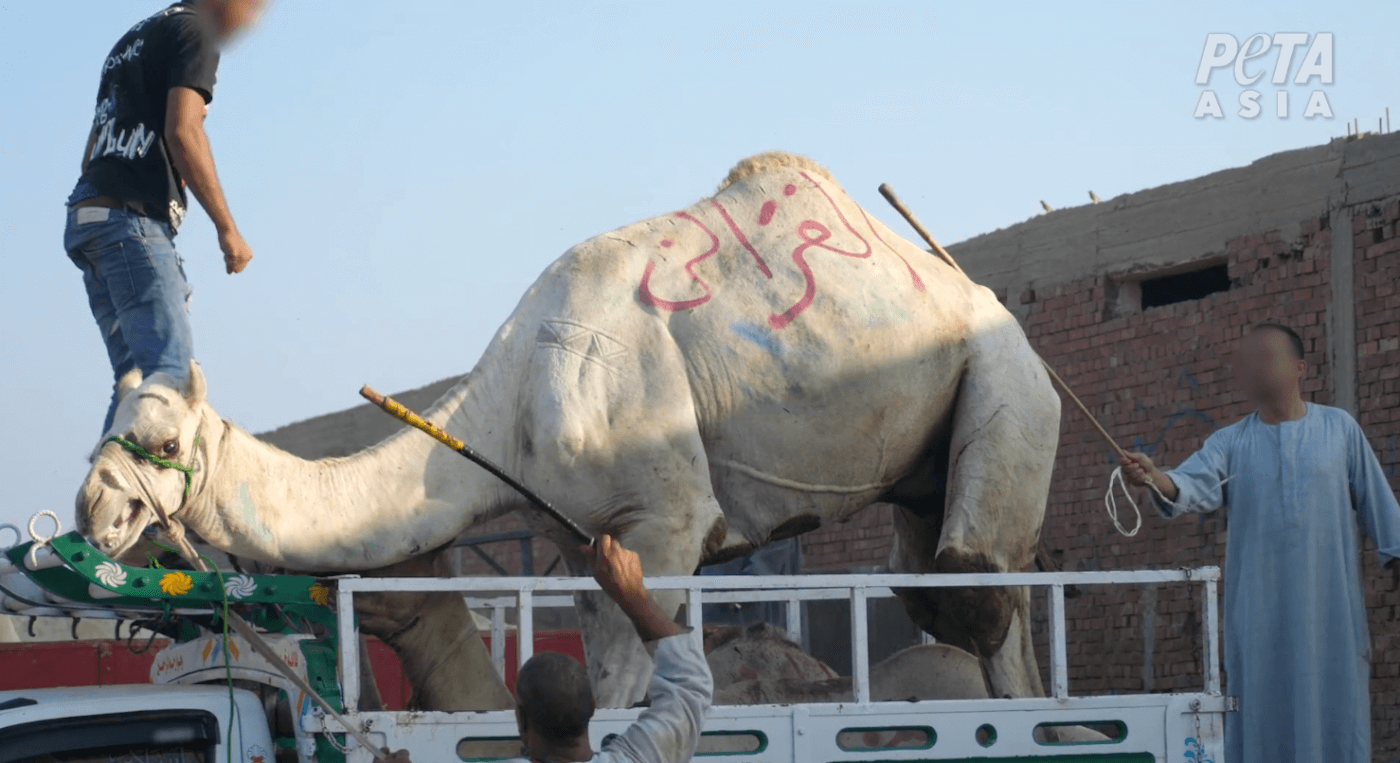
Following pressure from thousands of PETA supporters, Egyptian officials launched a program that aims to provide veterinary care for animals used at archaeological sites throughout the country. While this could mark some positive change, the only reliable way to ensure that horses and camels don’t suffer is to keep them away from the pyramids altogether. Please join PETA in urging Egyptian officials to ban the use of these animals in the tourism industry:
Want to Do More Mitzvahs? Join PETA’s Action Team!
With help from our dedicated supporters, PETA has secured numerous landmark victories for animals in laboratories, on farms, at marine parks, and in other dire circumstances. By joining PETA’s Action Team, you can stay up to date on our latest campaigns, join local protests, connect with other passionate animal rights advocates, and more. Get started today!