
Biosecurity Breach: PETA News Conference Exposes Tuberculosis-Infected Monkey Imports
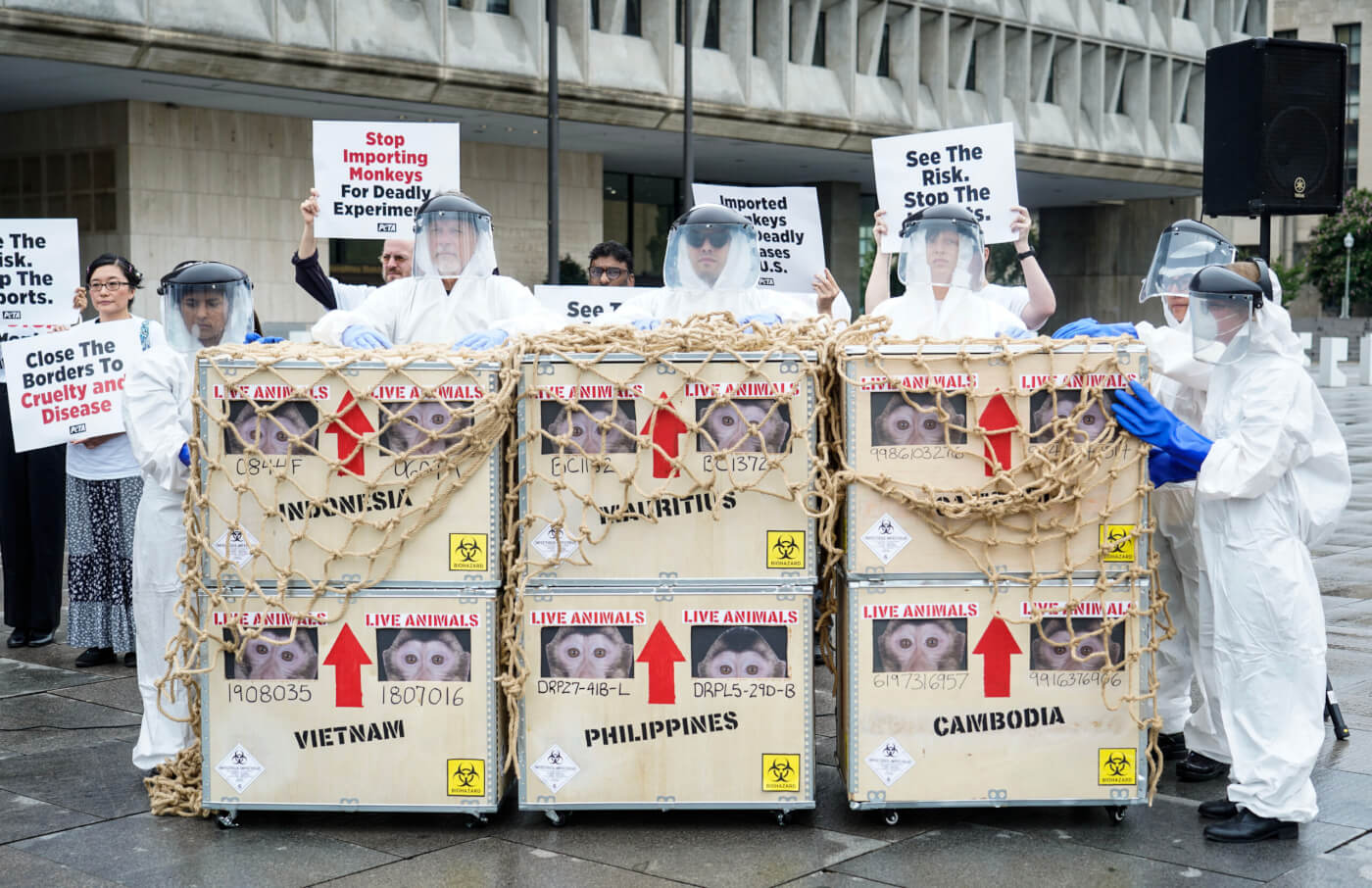
PETA held a striking news conference outside the Department of Health and Human Services—complete with crates of shrieking “monkeys” and humans in hazmat suits—to demand an immediate halt to the importation of monkeys from Asia and Africa. The warning? New data shows more monkeys infected with tuberculosis (TB) than ever are being imported into the U.S. and sent to laboratories across the country—carrying the deadly disease with them.
We released a groundbreaking report at the conference, revealing the hidden danger and the Centers for Disease Control’s (CDC) troubling role in enabling it. “We have been burned (before),” said Dr. Lisa Jones-Engel, PETA Senior Science Advisor for Primate Experimentation.
She referenced the Ebola Reston outbreak of the late 1980s, when shipments of monkeys from Asia arrived at a facility in Reston, Virginia, and the animals started bleeding from their noses and other orifices.
“That’s terrifying. You don’t want to see blood coming out of a monkey,” she said. The Ebola Reston outbreak was one of many incidents that showed just how little control there is over pathogens in imported monkeys—and how, when stolen from their natural homes, they can carry dangerous and contagious infections.
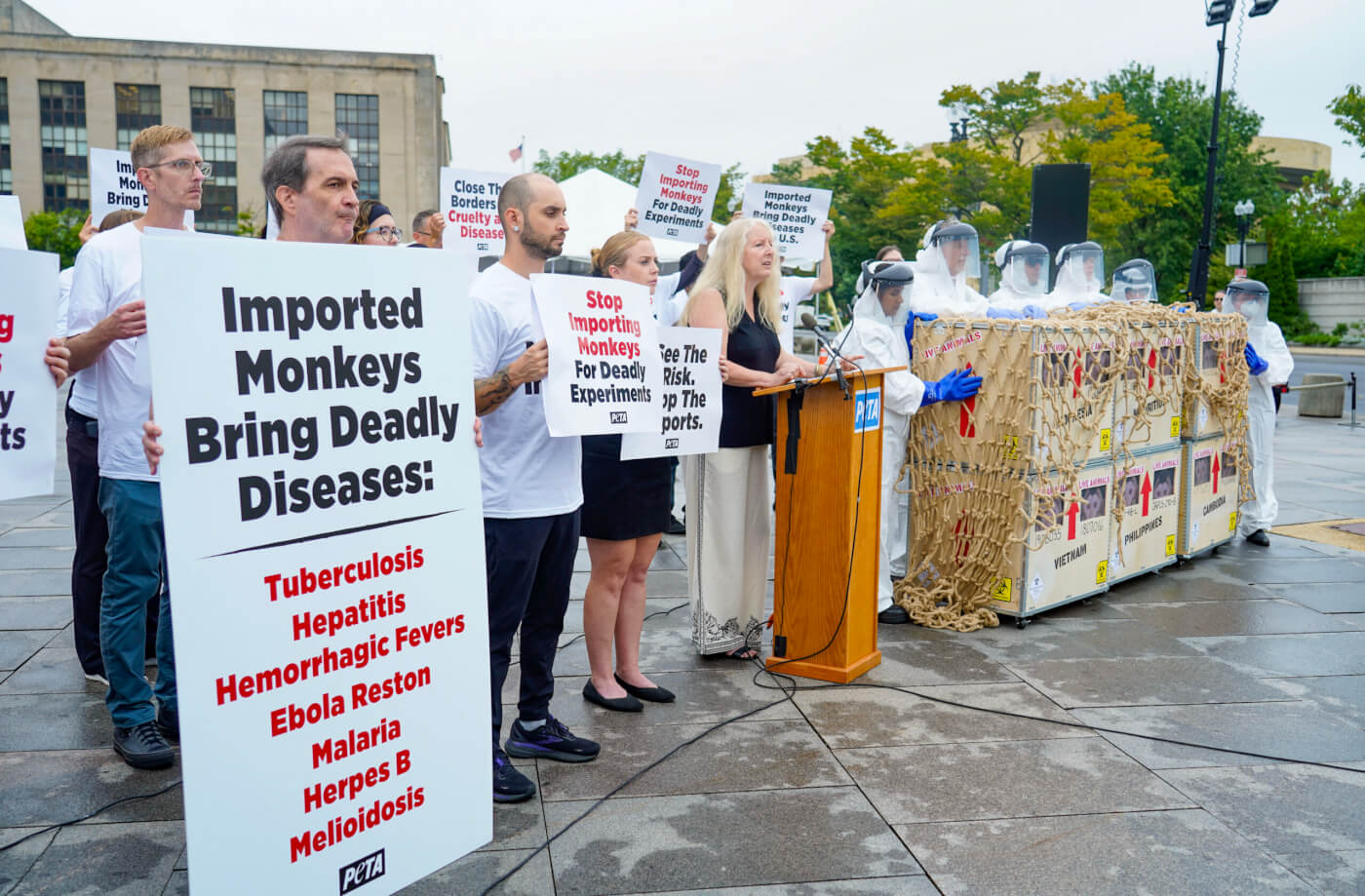
Dr. Jones-Engel also described firsthand the conditions at factory farms in Asia that breed monkeys to sell to U.S. laboratories for experimentation. Some of these monkeys are shipped on commercial passenger flights. “These crates are packed tightly with 120 or more animals, often wild-caught from Indonesia, Vietnam, or Cambodia. The trips can take up to 48 hours, and during that time, the monkeys are screaming, bleeding, urinating, defecating, and vocalizing. Any pathogens they carry—like TB, which is an aerosolized disease—are spreading throughout the crates and the pipeline into U.S. laboratories,” she explained.
Tuberculosis, Dr. Jones-Engel warned, is far more insidious. Unlike Ebola, infected monkeys don’t scream obvious warning signs—they may cough, lose weight, or have diarrhea. “These are very non-specific symptoms, and that’s one of the big reasons CDC and importers have been turning a blind eye. They see a little cough, a tummy upset, and they’re not testing for tuberculosis,” she explained. The result: over the past few decades, colonies in U.S. laboratories have been seeded with tuberculosis, and it’s virtually impossible to eradicate.
From 2021 to 2024, the CDC reported that 69 imported monkeys were diagnosed with tuberculosis in quarantine, and another 16 after arriving at laboratories, but disturbingly, the CDC examined records on only 107 out of nearly 100,000 animals. The agency relies on voluntary, limited reporting from importers instead of rigorous testing, leaving both human and animal health at risk.
“PETA has warned the CDC since 2022 that its monkey import pipeline is a ticking TB time bomb,” said Dr. Jones-Engel. “Yet its willful blindness has allowed a known biosecurity threat to pour into the U.S. We urge the CDC to end the importation of monkeys to laboratories—for public safety, scientific integrity, and the primates themselves.”
What YOU Can Do
In nature, monkeys live in large, complex social groups, raise their families, and spend their time swinging through lush forest branches. These sensitive, emotional animals do not want to be taken from their homes and families to be imprisoned in laboratory cages or tormented and killed in painful, invasive experiments.

PETA is calling for the CDC to take IMMEDIATE action to protect both humans and our fellow primates. Please join us.
We continue to advocate for progressive, effective, animal-free research, pushing for methods that do not put animals—or the public—at risk.
If you are a U.S. resident, help us push science forward by supporting our Research Modernization Now initiative, which provides a roadmap to replacing cruel, ineffective tests on animals with compassionate, state-of-the-art methods:

