
UW Primate Laboratories Operating Outside Public Health Reporting Systems, Groups Warn
For Immediate Release:
April 6, 2026
Contact:
Tasgola Bruner 202-483-7382
PETA, Seattle-based Northwest Animal Rights Network, and the Physicians Committee for Responsible Medicine, which collectively represent more than 155,000 members and supporters in Washington state, submitted a first-of-its-kind petition for rulemaking urging the Washington State Board of Health to require mandatory reporting of contagious diseases detected in primates used for experimentation, closing a critical gap in the state’s disease surveillance system.
The petition, submitted pursuant to the Washington State Administrative Procedure Act, formally asks the board to update its administrative code. The board now has 60 days to decide how to proceed.
PETA uncovered documents showing numerous cases of infectious disease at the University of Washington’s (UW) National Primate Research Center, which has since dropped “primate” from its name, and its breeding facility in Arizona. The Arizona facility frequently sends monkeys to the Seattle primate center.
Among the pathogens circulating at UW’s primate facilities are Shigella, Campylobacter, Coccidioides, Salmonella, strains of Mycobacteria, and pathogenic bacteria that cause intestinal illnesses. All must be reported to the Department of Health when identified in humans because they can spread from person to person. The primates weren’t deliberately infected with these pathogens for research purposes. These are naturally occurring infections that the institution has apparently been unable or unwilling to control.
As long as these pathogens remain confined to monkeys at UW, they fall into a regulatory blind spot, triggering no reporting, no surveillance, and no public health response. This creates a gap in oversight: pathogens that are reportable in humans are not tracked when they are circulating in animals housed in facilities physically integrated with UW Medical Center, including shared hallways, infrastructure, and staff movement between spaces.
A UW representative has admitted that “virtually everyone” gets ill within their first six months working at the primate center because of exposure to infectious diseases and the amount of fecal matter in the air.
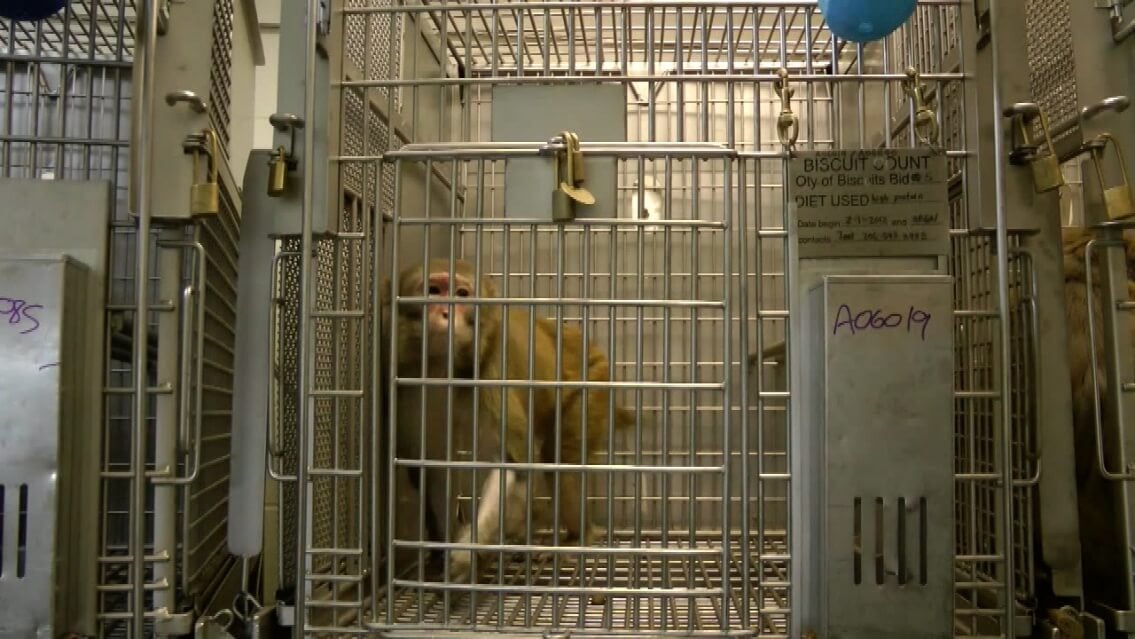
Monkey caged at the Washington National Primate Research Center. Image obtained through a public records request by PETA.
“The university’s primate laboratories house monkeys with infectious pathogens that would trigger mandatory reporting if found in humans—yet because they are in monkeys, they are not reported to public health authorities,” says PETA Chief Science Advisor on Primate Issues Dr. Lisa Jones-Engel. “PETA strongly urges the Department of Health to protect Washington residents and close this loophole.”
“Serious contagious diseases have been documented in this primate facility. A UW primate facility sits in the same complex as a hospital, in a building accessible to students and the public, yet the state Department of Health isn’t tracking disease spread,” says Northwest Animal Rights Network Policy and Programs Lead Amanda Elyse. “State leadership must take the presence of these diseases seriously and protect public health.”
“Reporting diseases that can be transmitted from monkeys to humans is common sense and will be essential if an outbreak turns into a public health crisis,” says the Physicians Committee for Responsible Medicine’s President, Dr. Neal Barnard. “The Board of Health has a duty to Washingtonians to track any pathogen that puts humans at risk, including those spreading in animals used in experiments.”
PETA—whose motto reads, in part, that “animals are not ours to experiment on”—points out that Every Animal Is Someone and offers free Empathy Kits for people who need a lesson in kindness. For more information, please visit PETA.org or follow PETA on X, Facebook, or Instagram.