
Update: Momentum Builds for Memorial Honoring Animals Killed for Wesleyan Dining Hall Meals
For Immediate Release:
April 10, 2026
Contact:
Andrew Grant 202-483-7382
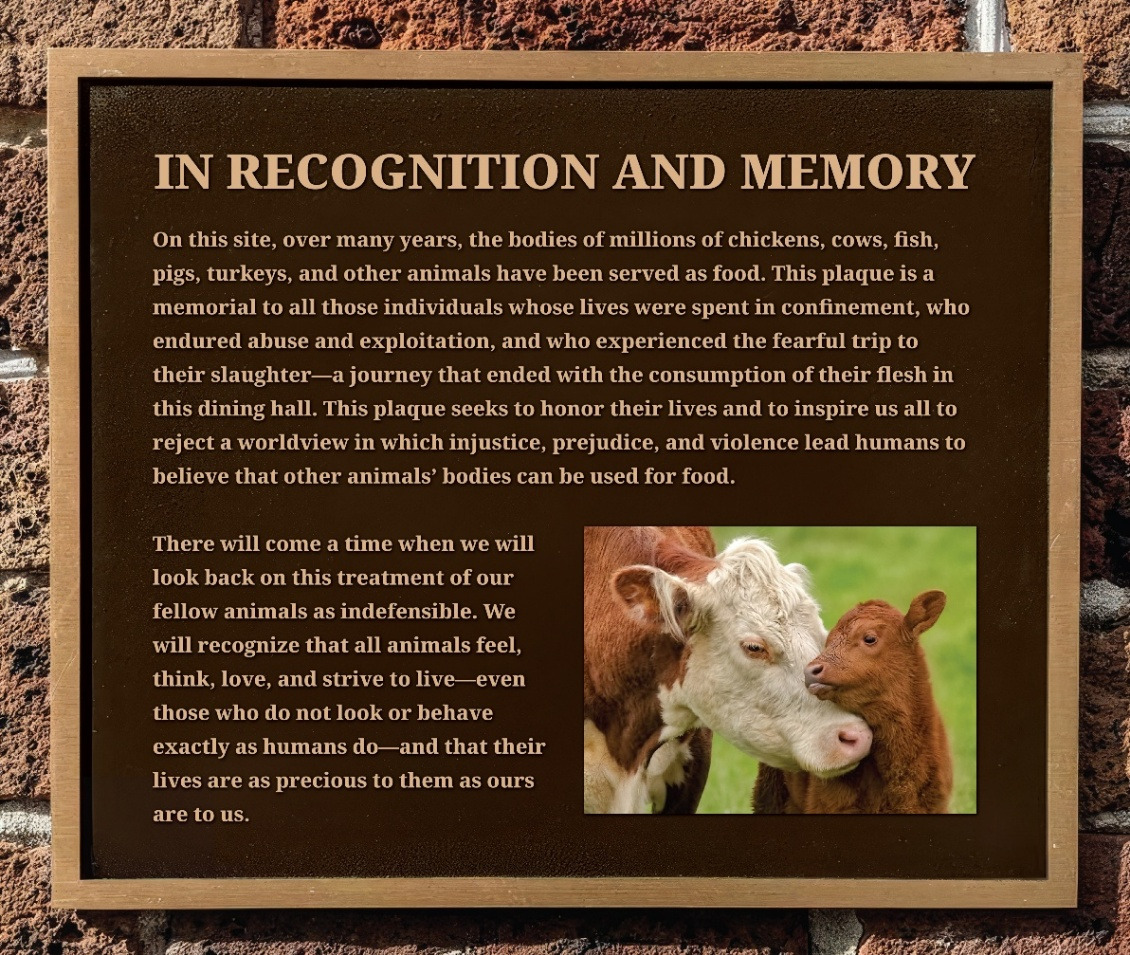
Following more than a year of collaboration between PETA and the Wesleyan community in support of students’ efforts to install the Wesleyan Animal Recognition Memorial plaque—which would honor the millions of animals killed and served as food in the campus dining hall—Wesleyan alum and PETA Manager Jakob Shaw sent a letter to university President Michael Roth this morning urging him to approve the installation.
The appeal follows a PETA tabling event on campus last month, held alongside a mockup of the proposed plaque and a banner reading, “How Will History Judge Our Treatment Of Our Fellow Animals?” during which students were eager to sign a petition in support of the plaque. More than 100 students, faculty, and alumni have added their names, and an editorial in The Wesleyan Argus on Tuesday urged the university to “consider the moral cost of our meals.” Shaw explains in the letter that the memorial would invite everyone on campus to consider the lives of animals, who are often overlooked and dismissed, and recognize the impact that our daily choices have on them.
“Wesleyan teaches students the critical importance of open dialogue and asks them to examine all forms of oppression,” Shaw writes. “Yet in the dining hall, it’s all too easy to ignore the inarguable suffering of the cows, chickens, pigs, and other animals who are confined on industrial factory farms, abused, exploited, and killed before they end up on our plates.”
PETA notes that a March 2026 study found that a simple empathy-based intervention—such as encouraging college students to think about animals before eating them by placing images of living animals next to meat-based dishes—raised students’ odds of ordering a meat-free meal by 22 percent.
“Choosing food options that aren’t made of animal products simply means not supporting the highly complex industrial agriculture system that puts profit over the feeling, living bodies and families of every animal lost,” says Yoyo Watanabe, Wesleyan University Class of 2028. “Animals cherish their lives and love their family and friends just as we do.”
Siobhan O’Keefe, Wesleyan University Class of 2028, says, “I think this plaque is a great opportunity to encourage our empathetic and passionate student body to more closely consider their daily practices.”
Each person who goes vegan spares nearly 200 animals every year, dramatically shrinks their food-related carbon footprint, and slashes their risk of suffering from cancer, heart disease, strokes, diabetes, and obesity. PETA’s free vegan starter kit is filled with tips to help anyone looking to make the switch.
PETA—whose motto reads, in part, that “animals are not ours to eat”—points out that Every Animal Is Someone and offers free Empathy Kits for people who need a lesson in kindness. For more information, please visit PETA.org or follow PETA on X, Facebook, or Instagram.