UMass Laboratory Horror: 121 Animals Suffer Slow Deaths, PETA Urges Feds to Act
For Immediate Release:
August 31, 2026
Contact:
Tasgola Bruner 202-483-7382
After uncovering numerous animal welfare violations revealing a pattern of botched euthanasia involving at least 121 small animals, PETA today urges the National Institutes of Health (NIH) to revoke the University of Massachusetts Chan Medical School’s (UMass Chan) Public Health Service Assurance, which is required to receive NIH funding for experiments on animals.
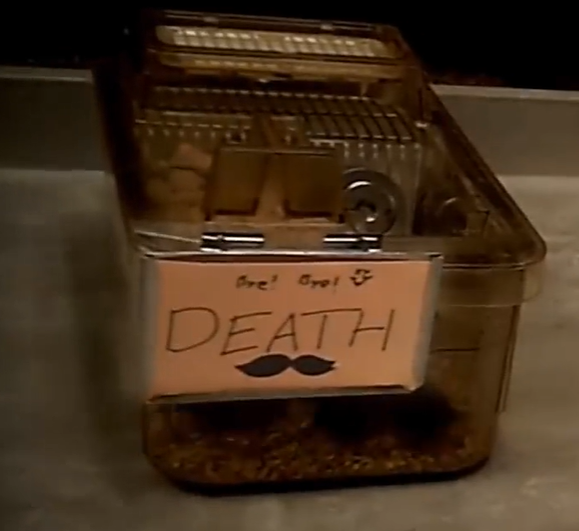
For illustration purposes only
The request follows the latest in a series of atrocities PETA has uncovered at the school. The latest public records obtained by PETA reveal a pattern of violations spanning years, laboratories, and species, and a failure to comply with its own correction plan:
· November 2018: Two live newborn mice were dumped in the trash along with discarded bedding and nesting material.
· September 2021: A live hamster who was supposed to be euthanized was left in a cage beside two dead cage mates after a procedure. Federal inspectors issued an Official Warning for a critical violation of the Animal Welfare Act because the delayed euthanasia likely caused unnecessary pain or distress.
· May–June 2023: Staff repeatedly crammed too many mice into gas chambers, exceeding capacity limits. Staff also put at least 22 mice in a carcass freezer without confirming they were dead.
· March 2024: Seven baby mice, about four days old, were found alive in a carcass freezer alongside 24 adult mice whom staff dumped there without confirming they were dead. A mouse was also tossed in the trash and found alive two days later.
· November 2025: Two months after the school adopted a self-described “no-tolerance” euthanasia policy, roughly 50 mice were killed in a gas chamber, again violating capacity limits, and were not given the required follow-up physical euthanasia to confirm they were dead and not suffering.
· January 2026: After gassing mice to death, an experimenter again failed to perform the required physical euthanasia.
“UMass Chan experimenters cannot even provide animals the final consolation of a humane death, instead stuffing them in freezers and trash cans while they’re still alive,” says PETA Chief Scientist Dr. Katherine Roe. “PETA urges the Office of Laboratory Animal Welfare to revoke the school’s Public Health Service Assurance, making it ineligible for federal funding for experiments on animals.”
UMass Chan experimenters subject animals to painful and invasive tests. They slice open dogs to induce heart attacks and strokes, infect animals with blood-sucking parasites, breed animals to suffer painful neurodegenerative diseases, inject chemicals into their brains, and more.
UMass Chan has a persistent pattern of animal welfare and compliance violations, including animals dying from dehydration, inadequate monitoring and veterinary communication, incomplete medical and anesthesia records, failures to provide required pain relief, and unauthorized or unapproved animal procedures. Many of these incidents recurred despite retraining, increased oversight, and other corrective actions, raising concerns about the institution’s ability to identify and correct systemic problems.
PETA encourages everyone to urge UMass Chan to modernize its research program by switching from outdated experiments on animals to state-of-the-art, human-relevant methods.
PETA—whose motto reads, in part, that “animals are not ours to experiment on or abuse in any other way”—points out that Every Animal Is Someone and offers free Empathy Kitsfor people who need a lesson in kindness. For more information, please visit PETA.org or follow PETA on X, Facebook, or Instagram.