PETA President Marks First Anniversary at the Organization’s Helm with First-Ever Science Education-Transforming “Piglet”
For Immediate Release:
July 28, 2026
Contact:
Sara Groves 202-483-7382
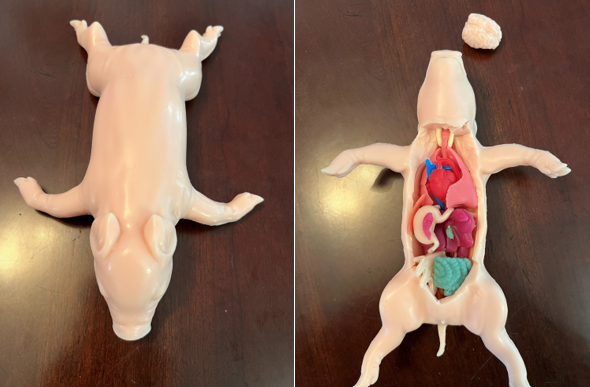
One year after becoming PETA’s president, Tracy Reiman is marking the milestone with the release of the Kind Piglet™—a life-like silicone model that replaces real animals in school dissection. It features color-coded organs and easy, setup and cleanup, offering students a hands-on dissection experience without the cruelty, mess, or hazardous chemicals—including formaldehyde—that come with the use of real, preserved piglets. It’s the first-ever classroom pig model and addresses a critical need: An estimated 500,000 fetal pigs are used in dissection each year in the United States; some are still alive when cut from their dead mother’s womb, only to be killed and their bodies sold for science class.
High school science teachers have been clamoring for a mammalian alternative to fetal pigs and even cats in biology courses and the Kind Piglet fits the bill. Educators have told PETA that “creating models for other body systems, like [mammal organs] would be helpful,” and “I would love if [PETA] made a mammal…because that is the main animal dissection we do at my school and I’d love to replace them with a humane alternative.” The Kind Piglet is less expensive and safer than the real piglet and doesn’t alienate many students, especially girls who have been shown to avoid science fields as a result of being teased at their “squeamishness.” It will be in classrooms in time for the new school year, as PETA will be sending models to teachers nationwide.
The project is deeply personal for Reiman. When she was in school, she refused to participate in the dissection of a fetal pig but was forced to watch—an experience that stayed with her. Years later, when her son was told he had to dissect a frog in his science class, he opted out (though it wasn’t easy and required his mother’s help). That moment sparked something: Through PETA’s humane education division, TeachKind Science, Tracy oversaw the creation of the Kind Frog™ to ensure teachers got what they wanted—a hands-on anatomy lesson for their students, along with the ability to learn without the cruelty and without compromising their values. Now, the Kind Piglet is taking that mission even further. School districts in Pasadena, CA, Reiman’s hometown, will be the first to receive Kind Piglets for their classrooms.
“As a student, I learned firsthand how dissection can leave a lasting impression for all the wrong reasons,” says Reiman. “Every student deserves the chance to explore science with curiosity, not discomfort, and the Kind Piglet helps make that possible while not harming a hair on a pig’s head.”
Reiman’s first year as president has been marked by more milestones and victories, just a few of which can be found below:
- A PETA investigation into a parakeet breeder in Petco’s supply chain led to the breeding factory being cited for thousands of federal animal welfare violations after PETA revealed parakeets crammed into tiny, filthy cages and staff killing them by crushing their necks. The case has served as a launchpad for PETA’s campaign to pressure Petco to stop selling birds.
- For the first time in history, four sheep shearers have been charged with animal welfare violations in New Zealand—for a total of 21 charges—following a PETA Asia Pacific investigation into more than 30 wool operations there, revealing shearers beating, kicking, and throwing terrified sheep, slamming them into hard floors, crudely stitching up gaping wounds without painkillers, and more.
- After learning from PETA that terrified goats are beaten and left with bleeding wounds in the mohair wool industry, high-end knitwear brand ZANKOV ditched the cruel fiber, TJX—the parent company of TJ Maxx, Marshalls, HomeGoods, and more—banned mohair, and Macy’s Inc.—which owns Bloomingdale’s—told PETA it had no plans to sell it in the collections of any of its private labels. Meanwhile, Nordstrom made its young-adult brand BP entirely free of animal skins, wool, and other animal-derived fibers.
- Two PETA undercover investigations into Grand Barr Dairy, a goat dairy farm, led to 492 charges of felony and misdemeanor animal neglect for its owners after PETA revealed goats were denied veterinary care for contagious infections, crippling lameness, burst abscesses, and other painful ailments; were punched and kicked; and were even left for dead. The investigations prompted law enforcement to seize all 234 surviving goats confined there and send them to sanctuaries—among them, a pregnant goat whose babies, Grace, Blossom, and Hope, were born at a sanctuary and will never know the cruelty their mother endured.
- Following a PETA undercover investigation, Red Beast Enterprises, Inc. (also known as High Quality Research), shut down, and nearly 70 surviving dogs and cats it forced to endure years of painful experiments were liberated. PETA’s Research Modernization NOW plan provides a detailed strategy for replacing animal experiments with human-relevant research methods. This work has resulted in the National Institutes of Health committing more than $237 million to human organoid technology and other non-animal research methods that better simulate human biology and reduce the use of animals.
“My motto is, ‘Modernize,’” says Reiman. “People are waking up to the fact that cruelty has no place in their classrooms, their closets, their plates, or anywhere else—and PETA is here to show that kindness and innovation make life better for everyone, animals included.”