
PETA Backs New Bipartisan Bill to Ban Cruel and Risky Monkey Imports to Laboratories
For Immediate Release:
April 24, 2026
Contact:
Tasgola Bruner 202-483-7382
PETA today announces support for groundbreaking legislation introduced by U.S. Reps. Greg Steube (R-Fla.-17) and Dina Titus (D-Nev.-01) that would stop all monkey imports destined for U.S. laboratories or their suppliers, ending the suffering and death of more than 20,000 monkeys shipped into the U.S. every year from Asia, Africa, and the Caribbean.
The Preventing Risky Importation of Monkeys to Avoid Toxic Exposures (PRIMATE) Act (H.R. 8471) would protect monkeys, public health, and the integrity of U.S. science by reducing biosecurity risks and eliminating reliance on animals who generate unreliable, non-reproducible data.
Over the last five years, using Centers for Disease Control and Prevention (CDC) records and internal laboratory reports, PETA has uncovered a sharp rise in monkeys imported into the U.S. carrying tuberculosis, shigella, malaria, Herpes B, and other dangerous pathogens. Human exposure to infectious diseases that are circulating in primate laboratories, as happened in a Michigan laboratory in 2023 and in the federally funded National Primate Research Centers, can lead to serious illness and create a real risk of spreading disease to family members and others outside the laboratory.
PETA scientists have shown that CDC requirements are dangerously outdated and ineffective. Monkeys continually enter and exit CDC-mandated quarantine infected with pathogens that can infect other monkeys in transit or in the destination laboratories. The CDC requires testing for only tuberculosis, and that test is done by method known to be inexact. When infections have been found post-quarantine, laboratories aren’t even required to inform the CDC.
“Americans shouldn’t have to worry about dangerous diseases entering our country through imported primates from countries we don’t trust to handle biosecurity risks,” says Rep. Greg Steube. “This bill is about protecting public health, strengthening accountability, and terminating an outdated trade practice that risks safety at the expense of the American taxpayer.”
“The humane treatment of monkeys is not just the responsible thing to do, it is also the right thing to do,” says Rep. Dina Titus. “That is why I am proud to join Rep. Steube in introducing legislation that prevents the importation of monkeys for the purposes of experimentation and research. There are alternative, scientifically backed technologies that enable safer, more effective, and more accurate testing to support public health.”
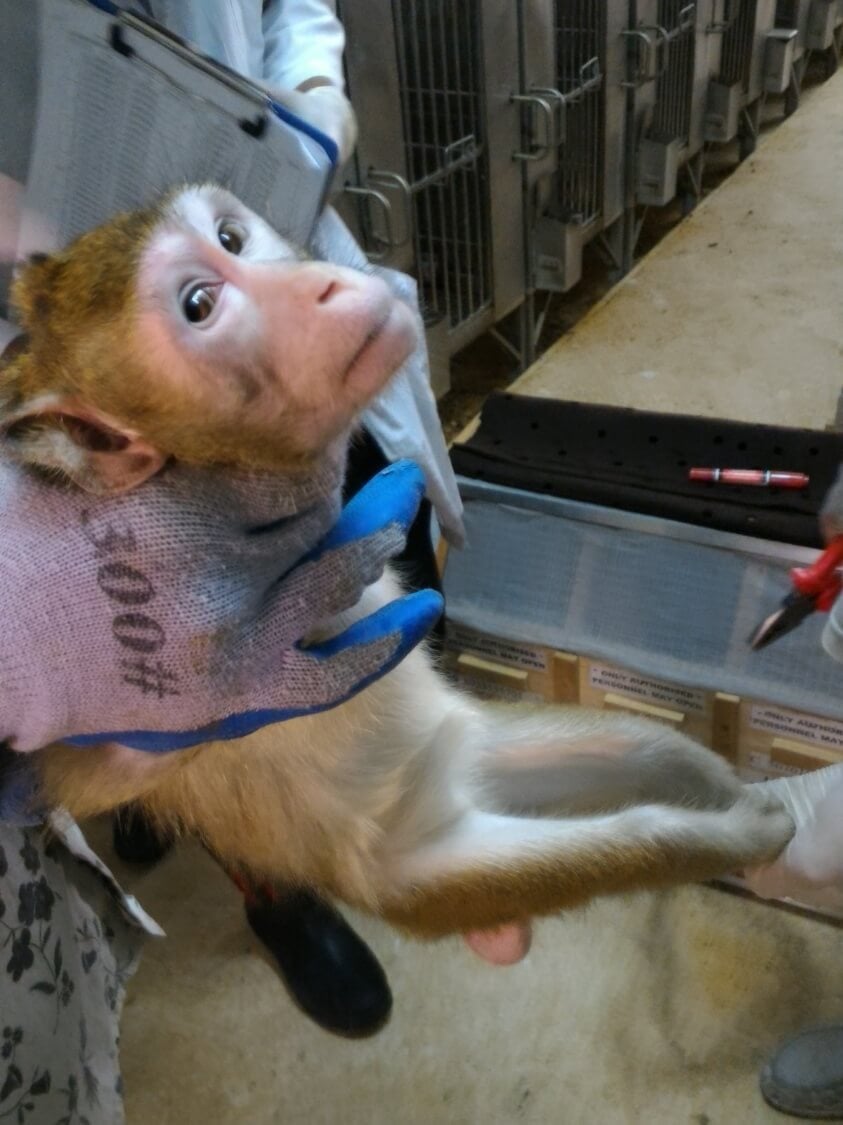
Workers at a Cambodian monkey farm prepare to stuff an endangered long-tailed macaque into a crate to ship her for use in experiments. Image obtained by PETA.
“Every year, tens of thousands of monkeys are funneled into the United States through a global supply chain that is inherently unstable, opaque, and a public health risk,” says PETA Chief Science Advisor for Primate Experimentation Dr. Lisa Jones-Engel. “PETA applauds Reps. Steube and Titus for recognizing that state-of-the-art research doesn’t need this pipeline, and that it’s time to shut it down.”
In February, a live monkey, just flown into the U.S. from Africa, was tossed in a biohazard dumpster in Florida and remained undiscovered for five days, posing a serious biosecurity risk. PETA reported it to state officials. The president of the monkey importation company, BC US, has been criminally charged.
The profit-driven monkey importation industry also threatens endangered species, destabilizes ecosystems, and rips culturally significant animals from the communities that have lived alongside them for generations. Those animals are then subjected to cruel and often deadly experiments. Decades of studies on monkeys have produced inconsistent, non-reproducible results that rarely translate into effective human vaccines and treatments.
Imported monkeys are bred on squalid farms or abducted from their forest homes, pushing long-tailed macaques toward extinction. Many die during capture or transport, and those who survive are ultimately killed in U.S. laboratories.
Note: PETA supports animal liberation, opposes all forms of animal exploitation, and educates the public on those issues. PETA does not directly or indirectly participate or intervene in any political campaign on behalf of or in opposition to any candidate for public office or any political party.
PETA—whose motto reads, in part, that “animals are not ours to experiment on”—points out that Every Animal Is Someone and offers free Empathy Kits for people who need a lesson in kindness. For more information, please visit PETA.org or follow PETA on X, Facebook, or Instagram.