OHSU Primate Center Trucks in Imported Monkeys While Warehousing 4,000; PETA Demands Answers
For Immediate Release:
September 8, 2025
Contact:
Tasgola Bruner 202-483-7382
In a letter sent today, PETA urges Oregon Health & Science University (OHSU) officials to investigate why the Oregon National Primate Research Center (ONPRC) acquired macaque monkeys from an importation company even though it currently houses more than 4,000 monkeys who aren’t being used in experiments. The primate center already receives millions of taxpayer dollars annually to breed macaques in its troubled facility.
PETA obtained a certificate of veterinary inspection showing that a dozen female long-tailed macaques were trucked from Florida-based primate importer BCUS to the primate center in July—a grueling journey that took days.
BCUS imports monkeys from Mauritius, where tuberculosis (TB) outbreaks in primate export facilities are well documented and BCUS has had TB problems in its facility. The health certificate accompanying the monkeys did not list any tuberculosis testing information, making it impossible to verify if any precautions were taken to screen the monkeys before they entered the center, or what measures were taken to protect the primates already there.
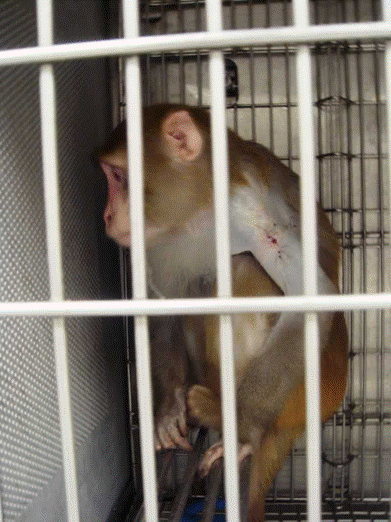
PETA urges OHSU officials to disclose why it is bringing yet more monkeys to cage and experiment on when it already warehouses thousands who aren’t being used. PETA also asks what, if any, precautions were taken to prevent a TB outbreak, and to release all 12 monkeys to a sanctuary immediately.
“Somebody at OHSU apparently can’t count. Trucking in 12 monkeys of uncertain health, possibly from a disease-ridden facility, while 4,000 others are warehoused is cruel, reckless, and casts a darker shadow than the forests these animals belong in,” says PETA Senior Science Advisor for Primate Issues Dr. Lisa Jones-Engel. “OHSU officials must investigate this deeply troubling shipment and spare these monkeys from further harm by sending them to a reputable sanctuary.”
In 2019, an ONPRC experimenter imported 20 monkeys for experiments but found they had latent tuberculosis. The disease rendered the experimental data useless, wasting hundreds of thousands of dollars. A study co-authored by the same experimenter revealed macaques imported from Mauritius previously introduced a deadly, antibiotic-resistant bacterium into the primate center’s colony.
ONPRC experimenters have torn infant monkeys from their mothers intentionally causing psychological damage, and starved monkeys to force them to consume alcohol “voluntarily.” Other experimenters impregnate monkeys and expose them to dangerous levels of nicotine, inducing birth defects before killing and dissecting their babies. The center has a dismal animal care record and was recently hit with a citation for a critical violation of the federal Animal Welfare Act when a young monkey died of sepsis after staff ignored her symptoms and failed to provide necessary medical attention.
In nature, macaques live in large, tight-knit groups and cuddle together in their favorite sleeping trees at night.
PETA—whose motto reads, in part, that “animals are not ours to experiment on”—points out that Every Animal Is Someone and offers free Empathy Kits for people who need a lesson in kindness. For more information, please visit PETA.org or follow PETA on X, Facebook, or Instagram.