NIH ‘Enhanced’ Oversight of Foreign Animal Labs Fails and Animals Still Suffer, PETA Reveals
For Immediate Release:
November 23, 2026
Contact:
Tasgola Bruner 202-483-7382
PETA sent an urgent letter today to National Institutes of Health (NIH) Director Jay Bhattacharya calling on him to acknowledge the failure of the agency’s efforts to police experiments on animals in foreign countries and to stop funding all animal tests outside the U.S. immediately.
Records obtained by PETA reveal conditions have not improved since PETA exposed a fraudulent Colombian research organization that received $17 million of U.S. funds over 20 years while violating a host of regulations, including confining monkeys to filthy, decrepit cages and starving mice to the point of cannibalism. NIH turned off the money spigot to this facility in 2023 and, under pressure from Congress, pledged last year to increase oversight of all overseas animal laboratories.
As outlined in the letter, NIH’s own documents show little has changed. PETA identified multiple deficiencies, including:
- Site visits were done virtually, announced months in advance, conducted through prearranged briefings with institution-selected participants and documents, and with institution-controlled camera tours.
- Animals were subjected to procedures that had not been approved.
- Facilities approved by NIH outsourced animal tests to unapproved institutions.
- NIH could not produce required records from foreign facilities demonstrating compliance with NIH animal welfare requirements.
- Veterinary and other records were incomplete or nonexistent.
- Animals who should have been euthanized were allowed to suffer far longer than allowed under NIH guidelines.
- When violations of NIH guidelines are uncovered, no effective action is taken.
“NIH has shown itself incapable of policing foreign experiments on animals, and its costly so-called enhancement program has failed,” says PETA’s Dr. Magnolia Martínez. “PETA urges Dr. Bhattacharya to take scientific and fiscal responsibility and cease funding animal torment overseas immediately.”
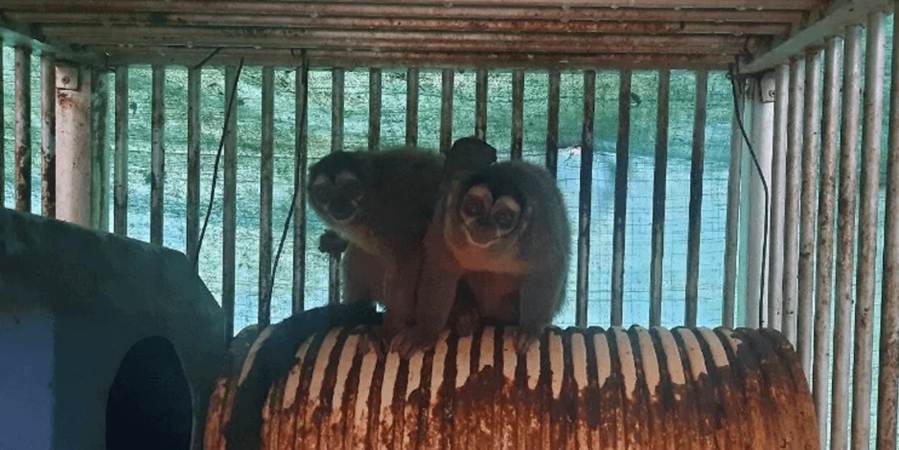
Owl monkeys were confined to filthy cages and left to die without veterinary care at an NIH-funded facility in Colombia.
PETA found a long list of problems at private and public institutions in Argentina, Australia, Canada, Colombia, Israel, Kenya, Peru, and St. Kitts and Nevis, involving nearly $34 million in NIH-awarded funds. Among them:
- NIH apparently didn’t notice that it did not have the required animal welfare assurance paperwork from Kinoxis Therapeutics in Australia, which conducted a U.S.-funded opioid addiction test on 80 dogs.
- NIH approved funding for a virus test on bats at CSIRO’s Australian Centre for Disease Preparedness despite known deficiencies in staffing, containment, biosafety, or compliance systems, and for Newcastle University in the U.K. even though there were concerns about human exposure to monkeys infected with tuberculosis and the deadly Herpes B virus.
- NIH had apparently not noticed that the Research Center in Clinical Biochemistry and Immunology in Argentina allowed mice infected with Chagas disease to suffer from whole-body tremors and the loss of hind-limb mobility—even though the experimenter’s own protocol required that the animals be euthanized as soon as their mobility was reduced.
These cases demonstrate that NIH has funded animal experiments at foreign institutions without ensuring that they were adequately prepared to meet animal welfare, biosafety, and reporting standards.
Members of Congress have also asked NIH to stop sending federal funds to foreign laboratories, both in a letter to Bhattacharya and with proposed legislation. The bipartisan Cease Animal Research Grants Overseas (CARGO) Act would end NIH funding for any experiments on animals outside the U.S., freeing up funding for human-relevant research methods.
PETA—whose motto reads, in part, that “animals are not ours to experiment on”—points out that Every Animal Is Someone and offers free Empathy Kits for people who need a lesson in kindness. For more information, please visit PETA.org or follow PETA on X, Facebook, or Instagram.