
New Poll Cracks Deceptive ‘Cage-Free’ Egg Labels: Kind Consumers Pay More, Birds Still Suffer
For Immediate Release:
September 8, 2026
Contact:
Sara Groves 202-483-7382
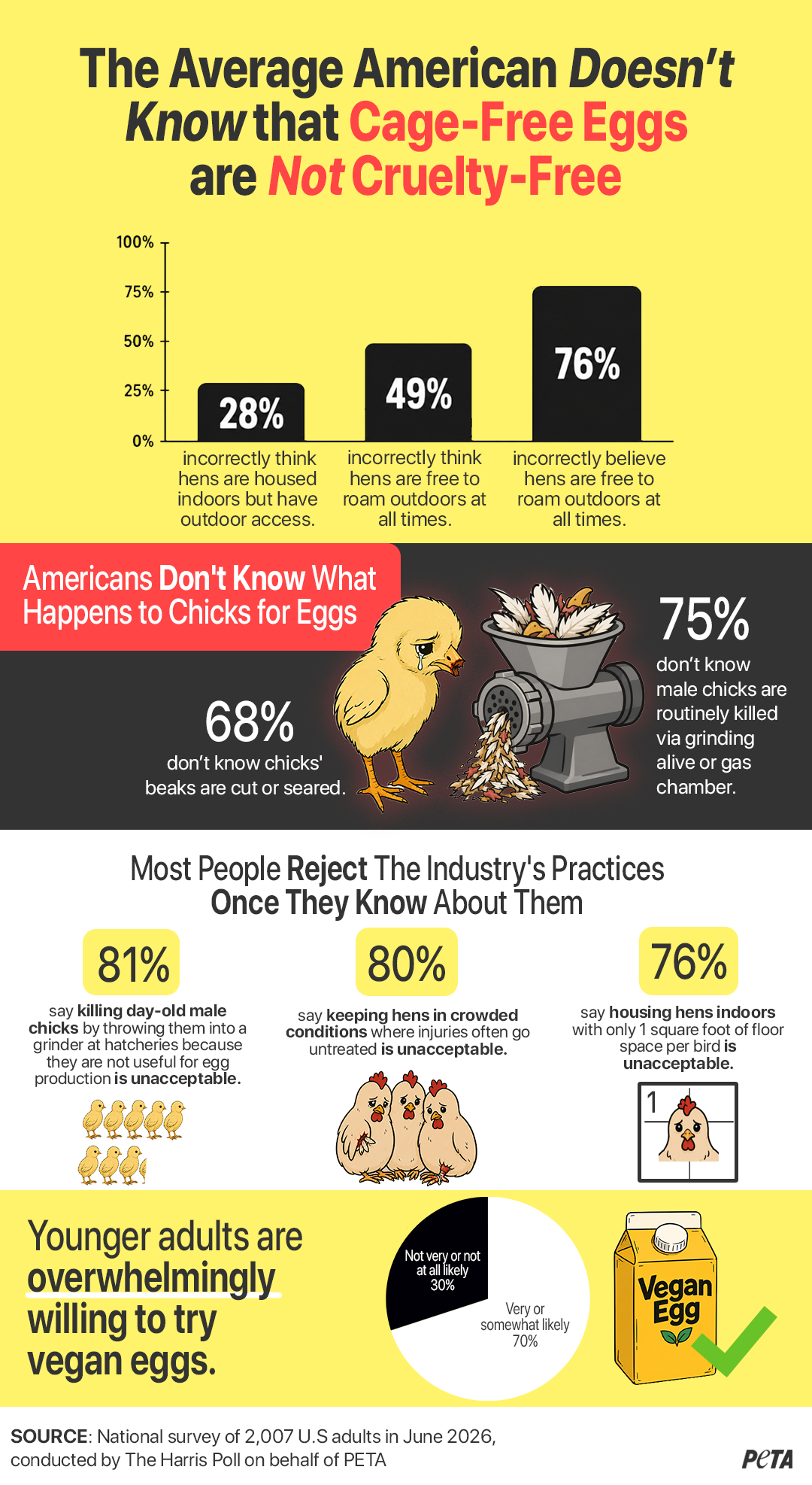
With the egg industry already in hot water over a price-fixing scandal, a new survey of over 2,000 U.S. adults conducted by The Harris Poll on behalf of PETA reveals that consumers are getting price-gouged for another deception: “cage-free” eggs aren’t all they’re cracked up to be. While 73% of Americans say animal welfare claims are important when purchasing eggs, many don’t realize that cage-free systems do not necessarily improve hen welfare, and, in some cases, can even cause more suffering.
The poll also shows that consumers are largely unaware of other routine practices in “cage-free” egg production. While 81% say grinding or gassing of day-old male chicks because they are not useful for egg production is unacceptable, only 25% even knew this happens. 68% didn’t know the sensitive tips of chicks’ beaks are routinely cut or burned off to reduce harmful pecking behavior and cannibalism—a painful mutilation that can make eating, drinking, and grooming themselves difficult.
A PETA review of egg prices at grocery store chains across the U.S. reveals that consumers are often paying several hundred percent more for “cage-free” eggs, PETA finds. Smith’s Food and Drug in Salt Lake City priced “cage-free” eggs at $5.99—a 302% markupover conventional eggs on its shelves—while Albertsons in Boise, Idaho charged up to 277% more, Publix in Miami charged up to 179% more, and Giant stores in Baltimore charged up to $6.49 for “cage-free” eggs, compared to $2.79 for conventional eggs.
Why are shoppers willing to pay these higher prices? Nearly half of Americans (49%) incorrectly believe “cage-free” means hens are always free to roam outdoors. But, as video footage confirms, birds in “cage-free” facilities are typically crammed into filthy, windowless sheds with tens of thousands of other birds with each hen having as little as 1 square foot of floor space.
After learning about cage-free egg production, 51% of Americans say they would be likely to consider vegan or plant-based egg alternatives such as Just Egg, YoEgg, or scrambled tofu—with that number jumping to 70% among 18- to 34-year-olds.
“Shoppers believed they were doing the right thing by paying premium prices for ‘cage-free’ eggs, but the industry has been profiting off a cruel con—hens in these facilities are crammed by the tens of thousands in giant warehouses where they never breathe fresh air or feel the sun on their backs, and suffer from painful beak mutilations, broken bones, and respiratory infections,” says PETA President Tracy Reiman. “PETA is warning consumers not to fall for deceptive labels and to choose vegan options that actually spare hens from the suffering they thought they were paying for.”
Chickens form complex social structures, dream when they sleep, and worry about the future, just as humans do. PETA notes that vegan egg options are widely available, and the global vegan egg market is expected to reach $4.5 billion by 2030. PETA’s free vegan starter kit is filled with tips to help anyone looking to make the switch.
Survey Method:
This survey was conducted online within the United States by The Harris Poll on behalf of PETA from June 15 – 16, 2026 among 2007 adults ages 18 and older. The sampling precision of Harris online polls is measured by using a Bayesian credible interval. For this study, the sample data is accurate to within +/- 2.6 percentage points using a 95% confidence level. For complete survey methodology, including weighting variables and subgroup sample sizes, please contact PETA at 757-622-7382 or [email protected].
PETA—whose motto reads, in part, that “animals are not ours to eat”—points out that Every Animal Is Someone and offers free Empathy Kits for people who need a lesson in kindness. For more information, please visit PETA.org or follow PETA on X, Facebook, or Instagram.