
Monkeys Likely Denied Water During 44-Hour SmartLynx Flight, PETA Demands Investigation
For Immediate Release:
October 17, 2025
Contact:
Tasgola Bruner 202-483-7382
In a complaint filed today, PETA urges the U.S. Department of Agriculture (USDA) to investigate credible whistleblower allegations that SmartLynx Airlines violated the Animal Welfare Act by failing to provide monkeys with water every 12 hours, as required, on a lengthy flight from Mauritius to Miami, Florida.
The October 7 flight lasted more than 44 hours, not including loading and unloading time, and involved multiple layovers across Africa, Europe, and North America. The layovers were too brief to allow the monkeys to be removed from the aircraft, provided with water, and reloaded safely. A flight leg from Brussels to New York lasted nearly 14 hours, already exceeding the 12-hour requirement for access to potable water, and continued to Miami for a travel time of 18.5 hours.
According to the whistleblower, some monkeys were taken off the plane in New York and transferred to animal testing laboratory LC Preclinical Research Inc., while the remaining animals were flown to Miami monkey importer BC US. These monkeys were confined in small wooden boxes for more than 50 hours.
“These monkeys, who spent more time on this plane than the average American work week, suffer enough on journeys to their deaths in laboratories without adding thirst and dehydration to it,” says PETA Senior Vice President Kathy Guillermo. “PETA calls on the USDA to investigate and hold SmartLynx accountable for these monkeys’ misery.”
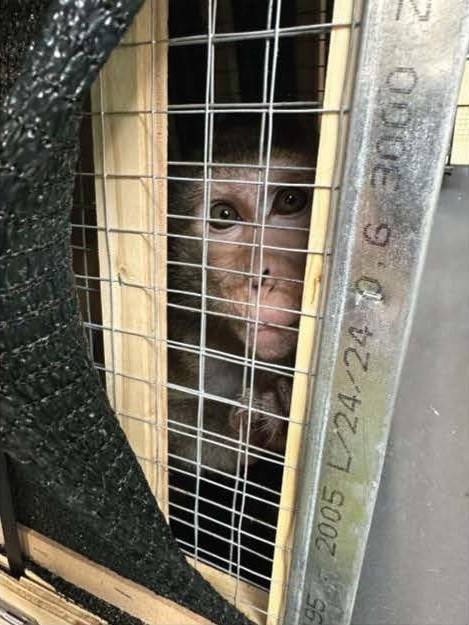
A long-tailed macaque in a shipping crate during a layover on a previous SmartLynx flight. Photo shared with PETA by Stitching Animal Rights.
This isn’t the first time SmartLynx has been implicated in violating animal protection regulations. The USDA cited the broker of a SmartLynx-operated flight in July for failing to provide monkeys with water at least every 12 hours during a nearly 41-hour journey. SmartLynx was also cited for improperly stacking crates containing monkeys, a serious handling and transport deficiency that increases the risk of injury and disease.
In nature, macaques live in large, tight-knit groups, travel several miles each day exploring diverse habitats, and cuddle together in their favorite “sleeping trees” at night. Monkeys imported to U.S. laboratories are bred on squalid factory farms or abducted from their forest homes, pushing some species toward extinction. The International Union for Conservation of Nature recently reaffirmed the long-tailed macaque’s Endangered status.
PETA—whose motto reads, in part, that “animals are not ours to experiment on”—points out that Every Animal Is Someone and offers free Empathy Kits for people who need a lesson in kindness. For more information, please visit PETA.org or follow PETA on X, Facebook, or Instagram.