Monkey Transporter Flouts Health Regulations as TB Cases Rise in U.S. Labs; PETA Demands Investigation
For Immediate Release:
September 2, 2025
Contact:
Tasgola Bruner 202-483-7382
In a complaint filed today, PETA urges the U.S. Department of Agriculture (USDA) to investigate the University of Louisiana at Lafayette New Iberia Research Center (NIRC) and trucking company JKL Secure Freight after obtaining documents showing monkeys were transported to Reno, Nevada, without valid health certificates, a violation of federal law.
A USDA-accredited veterinarian is required to examine primates no more than 10 days before they cross state lines. PETA obtained documents showing that 10 long-tailed macaques were examined at NIRC a full 28 days before the January 8 shipment, which was accepted and transported by JKL. The monkeys were trucked to animal experimentation giant Charles River Laboratories. PETA is asking the USDA to investigate and issue citations to both JKL Secure Freight and NIRC.
PETA’s request for investigation follows its release in August of a report revealing that cases of tuberculosis (TB) are rising among monkeys imported to the U.S. and that multiple strains of TB have been detected in imported monkeys used for experimentation, making timely, accurate health exams essential for protecting animal welfare and public health.
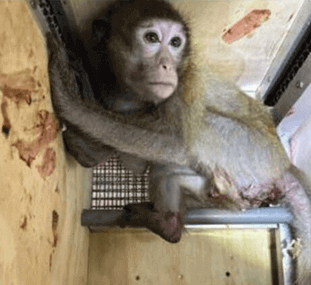
“JKL crossed multiple state lines with monkeys whose health status was unknown, risking human health and the lives of the monkeys they shoved into their trucks,” says PETA Senior Science Advisor for Primate Issues Dr. Lisa Jones-Engel. “JKL is apparently incompetent, or it doesn’t care about the law, but either way, the USDA should take action immediately.”
JKL has racked up eight violations of the federal Animal Welfare Act in the last three years alone, including citations for shipping monkeys on multiple occasions without valid veterinary certificates.
In July 2023, JKL was again cited for leaving crates packed with 336 monkeys imported by Ethiopian Airlines on a hot Atlanta tarmac with no shade for more than 90 minutes.
In nature, macaques live in large, tight-knit groups, travel several miles each day exploring diverse habitats, and cuddle together in their favorite “sleeping trees” at night. Monkeys imported to U.S. laboratories are bred on squalid factory farms or abducted from their forest homes, pushing some species toward extinction. They’re packed into small wooden crates, shoved into cargo holds, and flown across the world, often for 30 hours or more.
PETA—whose motto reads, in part, that “animals are not ours to experiment on”—points out that Every Animal Is Someone and offers free Empathy Kits for people who need a lesson in kindness. For more information, please visit PETA.org or follow PETA on X, Facebook, or Instagram.