
Harvard University Busted! Promises to Replace Animals in Laboratories Broken for Years
For Immediate Release:
September 10, 2025
Contact:
Tasgola Bruner 202-483-7382
In letters sent today, PETA threw down a gauntlet at the feet of Harvard University and seven other Ivy Leagues on the universities’ failure to make good on their stated commitments to replace, reduce, and refine the use of animals in experiments, known as the “3Rs” principle.
First published in 1959, the 3Rs principle was enthusiastically embraced by universities worldwide as a way to phase out the use of animals. But it has been used as a smokescreen to placate the public while studies using animals continued.
In a letter to President Alan Garber and Harvard Medical School Dean George Daley, PETA reveals that despite its repeated claims of reducing the use of animals in experiments, recent inventory reports document that the university used more than 31,300 mice, 270 rats, and 91,400 fishes in experiments. A federal report also documented that the school used 213 dogs, 50 monkeys, and 586 hamsters in 2024.

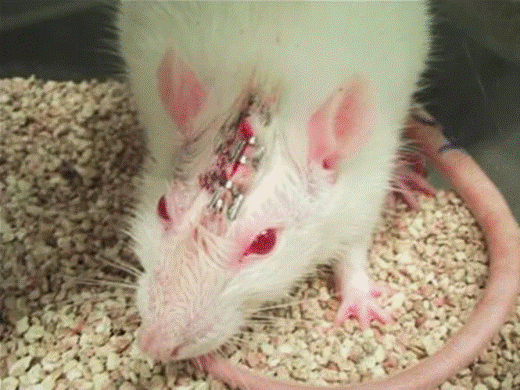
Despite receiving massive amounts of public funding—sometimes hundreds of millions of dollars—Ivy League institutions aren’t held to the same standards of transparency and accountability as public universities. Harvard received more than $247 million in funding from the National Institutes of Health last year, and about half of that money bankrolled experiments on animals. Its failure to follow the 3Rs not only harms animals, but it also erodes public trust.
“For decades, the 3Rs principle has been a convenient smokescreen for universities to hide behind while their laboratories imprison animals that are kept in metal boxes, subjected to every horror under the sun, and killed,” says PETA Vice President Dr. Alka Chandna. “PETA calls on President Garber and Dean Daley to come clean and if there’s a real plan in place, make it public now or stop pretending.”
Studies show that 90 percent of basic research, most of which involves animals, fails to lead to effective treatments for humans, while 95 percent of new drugs that test safe and effective in animals later fail in humans. According to a 2024 poll, 80 to 85 percent of U.S. residents support phasing out experiments on animals and diverting tax dollars to non-animal methods. PETA urges universities to transition to superior, non-animal research methods.
PETA—whose motto reads, in part, that “animals are not ours to experiment on”—points out that Every Animal Is Someone and offers free Empathy Kits for people who need a lesson in kindness. For more information, please visit PETA.org or follow PETA on X, Facebook, or Instagram.