
Decrepit Conditions for Military Dogs at Langley Prompts PETA Plea to President Trump: ‘Please Fund Robo Dogs!’
For Immediate Release:
March 2, 2026
Contact:
Moira Colley 202-483-7382
Joint Base Langley-Eustis and 11 other military bases are the subject of a disturbing, just-released report from the Defense Department’s Inspector General’s office which reveals that at least four dogs used by the U.S. military died after being confined in decrepit kennels and dozens more were sickened or injured. In response, PETA sent an urgent letter to President Trump requesting a boost in federal funding for military and law enforcement agencies or an allocation of funds to allow them to replace the use of dogs with state-of-the-art robotic “dogs.”
The report revealed that dogs were confined almost constantly to small concrete pens without adequate protection from extreme weather. At JB Langley-Eustis, mold was found growing in the kennels due to significant water damage and a noted lack of ventilation put dogs at serious risk due to the increased likelihood of disease outbreaks. PETA points out that dogs used by the military have an extremely high mortality rate due to traumatic injuries from explosive devices and gunshot wounds, heat stress, and disease, and those who survive are at high risk of suffering from post-traumatic stress disorder for the rest of their lives and their use is often the cheapest and easiest but the least state-of-the-art “equipment” choice.
PETA notes that as global conflicts escalate, robot dogs are already being deployed in active combat zones. Robot dogs like “Spot” from manufacturer Boston Dynamics can perform many of the same duties as traditional military working dogs and police K-9s, while sparing real dogs from being shot, blown up, strangled, or suffering slow, agonizing deaths from heatstroke. In the war between Russia and Ukraine, remotely operated “dogs” have been used for reconnaissance, building clearance, and detecting explosives. A British‑supplied robotic‑dog program in Ukraine uses walking, drone‑like units to explore trenches, dense woodlands, and booby‑trapped buildings that would pose extreme danger to live dogs. And the U.S. military sent an AI-enabled robodog to the Middle East in 2024 to evaluate counter‑drone capabilities, and in 2022, deployed a robotic dog to Ukraine to assist in mine and ordnance clearing.
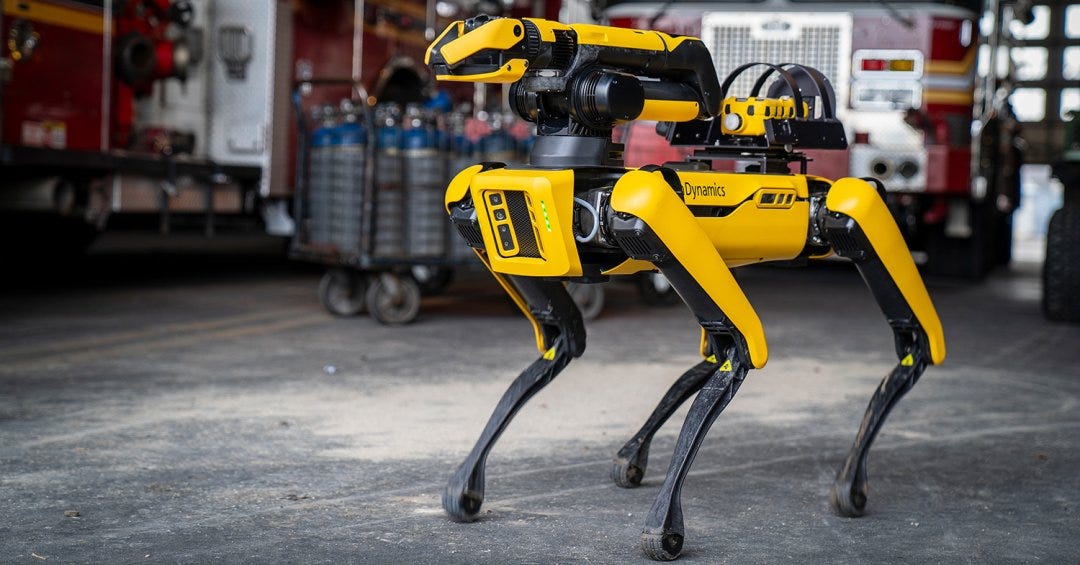
“Hampton Roads prides itself on supporting the troops, and that must include protecting the dogs forced into dangerous missions and deplorable living conditions,” says PETA Senior Vice President Daphna Nachminovitch. “PETA is asking President Trump to give America’s military and law-enforcement agencies advanced robotic K-9s and spare real dogs from misery and death.”
Besides being injured and killed in the line of duty, K-9s used by police are often subjected to cruel, antiquated training methods, as well as abused, injured, or even killed by their handlers when off duty.
PETA—whose motto reads, in part, that “animals are not ours to abuse in any way”—points out that Every Animal Is Someone and offers free Empathy Kits for people who need a lesson in kindness. For more information, please visit PETA.org or follow PETA on X, Facebook, or Instagram.
PETA’s letter to President Trump follows.
Dear Mr. President:
Long ago, you helped PETA end mule diving in Atlantic City. Animals need your help again today. We respectfully request that your administration support our troops and fund the police by providing American-made robotic dogs to replace dogs used for military operations and police work in the U.S. and overseas.
Numerous federal, state, and local agencies use dogs. There are approximately 50,000 active police K-9s across the country and 1,600 “military working dogs” (MWDs) across four branches. Unlike the brave service members and officers who choose to put their lives on the line, MWDs and police K-9s can’t consent to being used as living shields or being sent into violent situations they did not cause—and many pay with their lives.
Robot K-9s like “Spot” from Boston Dynamics can perform many of the same duties as live police dogs but obviously won’t suffer or die if they are shot, stabbed, punched, kicked, strung up, hit by a car, left inside a hot car, or left outside in a kennel in triple-digit heat without shade or water. Although statistics regarding police K-9 line-of-duty mortality rates are not available, a study of 92 MWDs who died during Operation Iraqi Freedom and Operation Enduring Freedom showed that 77% of the deaths were due to traumatic injuries, mostly caused by explosive devices and gunshot wounds. Those who survive are at high risk of suffering from post-traumatic stress disorder for the rest of their lives. MWDs are not even safe on domestic bases: According to a recent report from the Defense Department’s Inspector General’s office, four MWDs died because of “unsatisfactory kennel facility conditions,” and 22 dogs at just one base in Texas sustained heat injuries over a three-year period.
The Massachusetts State Police and others are already using robots to de-escalate highly volatile and dangerous situations, like domestic violence calls. Tactical robots can enhance community safety and protect officers (both human and canine). Four of these “mechanical first responders” will be used for security during the World Cup in Mexico. At the same time, Florida International University researchers are developing technology capable of detecting explosives with even greater accuracy than dogs—a potentially lifesaving breakthrough, both domestically and in combat zones.
Will your administration please give our troops and law-enforcement agencies the state-of-the-art tools they need to do their jobs—and allow them to retire dogs who are routinely being killed in the line of duty—by funding their use of robotic dogs made right here at home, which can do the job without loss of life or limb?
Thank you for your time and consideration.
Most respectfully,
Daniel Paden
Vice President of Legal Advocacy
Investigations, Research, & Legal Advocacy
People for the Ethical Treatment of Animals