
Dangerous Lemur Encounters Draw Federal Citation for Sarasota Roadside Zoo
For Immediate Release:
April 9, 2026
Contact:
David Perle 202-483-7382
Just-released federal records reveal Big Cat Habitat has been formally cited by the U.S. Department of Agriculture (USDA) following a PETA tip about the roadside zoo hosting dangerous yoga sessions in which visitors entered lemurs’ enclosures and the animals climbed on them and touched their faces.
PETA points out that across the country, hands-on encounters with lemurs and other primates have repeatedly led to human injuries—incidents that have also proved deadly for the animals involved. At the Laredo Safari and Adventure Park in Texas, a ring-tailed lemur bit a 5-year-old on the arm after jumping onto the child’s back. In Bogart, Georgia, a 1-year-old was sent to the hospital with a head injury after the family was allowed into a lemur enclosure and animals jumped on the toddler’s head and shoulders. And in Greenwich, New York, three lemurs were killed and tested for rabies after a lemur at the Ashville Game Farm bit a 7-year-old boy during a petting encounter.
“Allowing lemurs to roam freely with, and even climb on, the public could easily end in disaster for everyone involved,” says primatologist and PETA Foundation Managing Director of Captive Wildlife Debbie Metzler. “PETA urges everyone to stay away from Big Cat Habitat and any other roadside zoo that treats animals as nothing more than props.”
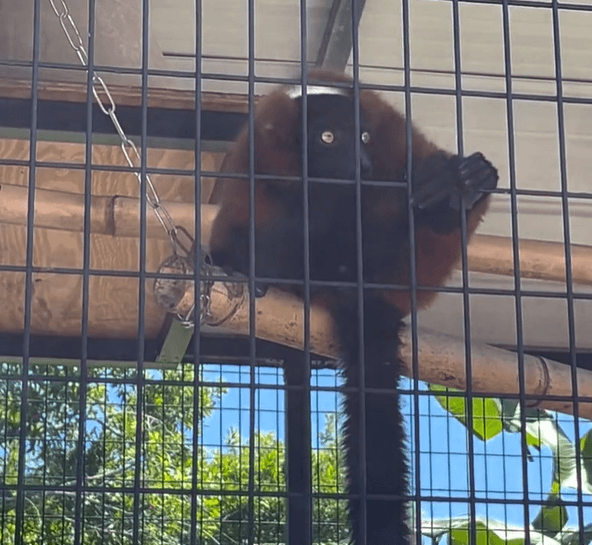
As PETA has pointed out and the USDA affirmed, these interactions also pose a serious risk of disease spread between lemurs and humans. Lemurs have been known to carry and spread tuberculosis, Salmonella, E. coli, and Giardia, among other dangerous and deadly pathogens, and bites or scratches often require antibiotics and preventive rabies and tetanus shots. Meanwhile, mild human viruses, including the common cold, can cause severe or even fatal infections in lemurs.
In nature, female lemurs stay with their family groups for life, while males stay for up to five years. Lemurs used for hands-on encounters with humans are typically separated from their mothers shortly after birth and subjected to constant human handling, depriving them of the maternal bond that is essential to their physical and psychological well-being.
Big Cat Habitat is run by the notorious Rosaire family, which exploited wild animals in abusive circus shows for decades. The roadside zoo was previously cited for a critical violation after it allowed a visitor to touch a jaguar inside the animal’s cage without any barriers in place. Many animals at the sleazy operation live in small concrete cages and exhibit signs of psychological distress.
PETA—whose motto reads, in part, that “animals are not ours to use for entertainment”—points out that Every Animal Is Someone and offers free Empathy Kits for people who need a lesson in kindness. For more information, please visit PETA.org or follow PETA on X, Facebook, or Instagram.