
Biosecurity Breach: PETA Press Conference to Expose TB-Infected Monkey Imports
For Immediate Release:
August 19, 2025
Contact:
Brandi Pharris 202-483-7382
Flanked by crates of shrieking “monkeys” and humans in hazmat suits, PETA at a Wednesday news conference outside the Department of Health and Human Services will appeal to the agency to immediately ban dangerous and outdated monkey importation from Asia and Africa to the U.S, which for years has silently funneled tuberculosis (TB) into U.S. laboratories.
At the conference, PETA will release a report revealing the true and hidden scope of the TB threat and the Centers for Disease Control and Prevention’s (CDC) role in enabling it, including a study from the CDC itself confirming that imported monkeys bring TB with them, a clear biosecurity threat. From 2021 to 2024, 69 cases were detected while the monkeys were in quarantine, with another 16 after the monkeys were sent to laboratories. But disturbingly, the CDC looked at just 107 of the nearly 100,000 imported animals. The CDC relies on limited, voluntary data from importers and doesn’t require rigorous TB tests.
“PETA has warned the CDC since 2022 that its monkey import pipeline is a ticking TB time bomb, but its willful blindness has allowed a known biosecurity threat to pour into the U.S.,” says report co-author and PETA Senior Science Advisor for Primate Experimentation Dr. Lisa Jones-Engel, who will speak at the conference. “PETA urges the CDC to end the importation of monkeys to U.S. laboratories for public safety, scientific integrity, and the monkeys themselves.”
Where: Outside the U.S. Department of Health and Human Services, 200 Independence Ave. S.W. (near Washington Ave.)
When: Wednesday, August 20, 10 a.m.
Interviews will be available on-site and remotely.
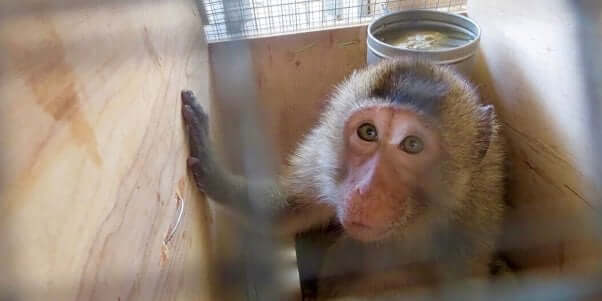
A macaque inside a shipping crate. Credit: PETA
Why: Tests used by the CDC to detect TB in monkeys frequently produce false negatives, rendering quarantine protocols useless to prevent disease spread. PETA’s report reveals numerous infected monkeys have been found recently at multiple sites, including at Charles River Laboratories’ Houston, Texas, facility, where nearly 40 animals tested positive for TB between 2023 and 2024.
In their natural habitat, macaques form lifelong bonds, nurture their children, and travel several miles each day to explore diverse habitats. In addition to being killed in experiments, monkeys in laboratories are starved and strangled, scalded to death in high-temperature cage washers, caught behind cages and allowed to die, given the wrong experimental compounds, and more.
PETA—whose motto reads, in part, that “animals are not ours to experiment on”—points out that Every Animal Is Someone and offers free Empathy Kits for people who need a lesson in kindness. For more information, please visit PETA.org or follow PETA on X, Facebook, or Instagram.