

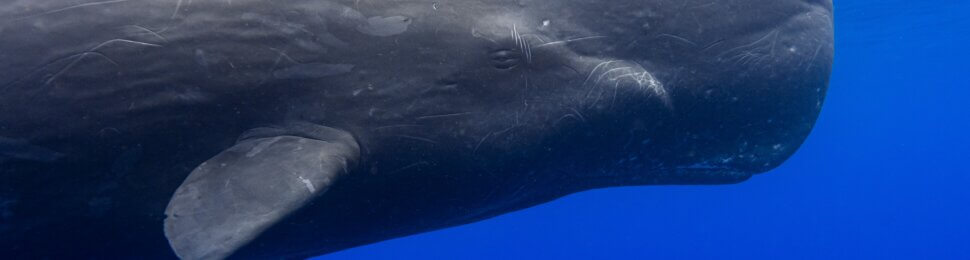
A Whale of a Tale: The Eighth Member of Her Family to Run Afoul of Fishing Gear
The young right whale – known to researchers as #5120 – spent most of her short life entangled in fishing gear. She was born in 2021, and by the following summer, she was spotted with a fishing rope wound around her tail. Since #5120 was still growing, the rope would continue to tighten, painfully cutting into her flesh. Rescue teams tried to free her, but every attempt ended in heartbreak. They knew they were running out of time. By June 2023, #5120 was suffering from severe wounds caused by the deeply embedded rope. By January 2024, she was dead. Shockingly, #5120 is believed to have been the eighth member of her family to have become entangled in fishing gear.
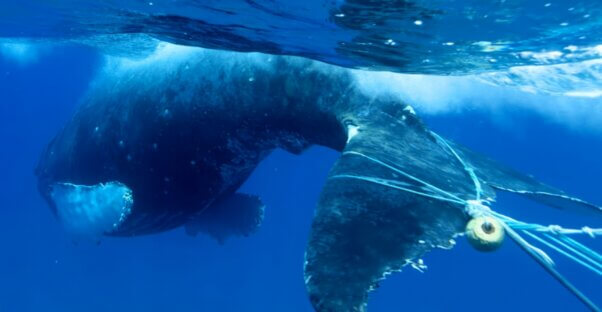
To be serious about saving the whales requires making a commitment to not eating fish. It’s not hard to do when you think about #5120’s fate, that of her family, and all the other whales who slowly become so weighted down by fishing gear that they can’t come up for air.
“Save the Whales” is a great slogan, but here’s the catch: Crabs, lobsters, and fish value their lives as much as whales do, and unless we save them, whales are doomed.
Rise in Whale Deaths in Crab Traps
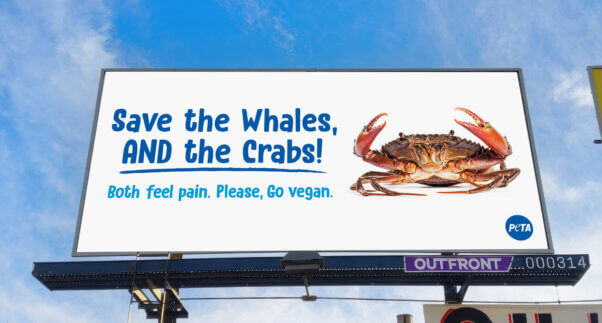
People order crab cakes as if they were ordering corn on the cob, but crabs are clever animals who work together to feed and defend their families and protect new mothers in their communities, just as whales and dolphins do – a point PETA made by placing billboards (see left) outside seafood restaurants after the US National Oceanic and Atmospheric Administration announced a spike in the number of whales who were becoming entangled in crab traps and other fishing gear.
Lobsters who manage to avoid traps and pots can live for a century – raising families right up to the end. They have excellent memories and recognize friends from long ago. And there’s no doubt that both lobsters and crabs suffer and feel pain, as all animals do. In December, the British government started cracking down on cruelty to crustaceans, announcing plans to ban boiling them alive. New Zealand, Norway, and Switzerland already outlaw the barbaric practice.
As for fish, a little research reveals that they have cultural traditions, share knowledge, and use tools. Some fish can recognize themselves in mirrors or photos, and others woo potential partners by creating intricate works of art in the sand on the ocean floor. When guppies get angry, their eyes turn black – only one way among many that fish communicate with one another. Yet more fish are killed for food than all other animals combined. When you stop to consider that every fish is an individual who feels, the scale of the cruelty becomes horrifically obvious.
One Lucky Whale Gets Away
Marine scientists were in remote waters off New South Wales, Australia, when they spotted a humpback whale entangled in rope and chain. Whales who become entangled in heavy fishing gear can drown or die of exhaustion after weeks of struggling to free themselves – and this whale was clearly in trouble. Two other whales were trying to help her by supporting her from below. Because this is such a common occurrence, the research team had experience freeing whales from fishing gear, and they knew exactly what to do. This whale was saved, but marine scientist Olaf Meynecke, one of the rescuers, says “it’s sobering to think that many aren’t that lucky and die tangled in the gear.”
PETA Makes Waves to Save Sea Life
From ad blitzes on ferries targeting whale-watchers to billboards near fishing spots, PETA seizes opportunities to encourage people to relate to who’s on their plate and make kind choices that will help all marine life. PETA entities’ “cat mongers” have set up shop in Australia, India, the UK, and elsewhere to remind shocked onlookers that if you wouldn’t eat a cat, you shouldn’t eat a fish. After PETA Australia pointed out that fish are sentient beings, South Australia officials agreed, reforming the state’s Animal Welfare Act to recognize fish as animals. While communities in Connecticut and New Jersey were considering banning plastic straws, our ads alerted viewers that these measures don’t hold water when it comes to protecting ocean inhabitants, as commercial fishing gear poses a far greater threat.
And what about birds and sea lions? Crab traps, lobster pots, and fishing hooks maim and kill millions of birds, turtles, sea lions, and other animals every year. Lost and abandoned fishing gear kills at least 300,000 whales, dolphins, and porpoises annually. And it’s estimated that more than 85% of the critically endangered North Atlantic right whale population – just like #5120 – have become entangled in fishing gear at least once.
What You Can Do
The solution is simple: To save the whales, we cannot eat any sea life! Visit our vegan seafood page for terrific animal-friendly options.