
BAD MEDICINE: A Bombshell Documentary
Suffering From Depression, Filmmaker Journey Zephyr Investigates How Drugs Are Made
Imagine if a commercial jet manufacturer said, “Oh, yes, we know our planes crash nine times out of 10. But we’re going to keep building them in exactly the same way. So just hop back on a flight and trust us.” We’re told to trust medicine, too, yet Big Pharma’s model crashes and burns even more often: 95% of drugs that test safe and effective in animals fail in human trials – sometimes killing the people who take them.
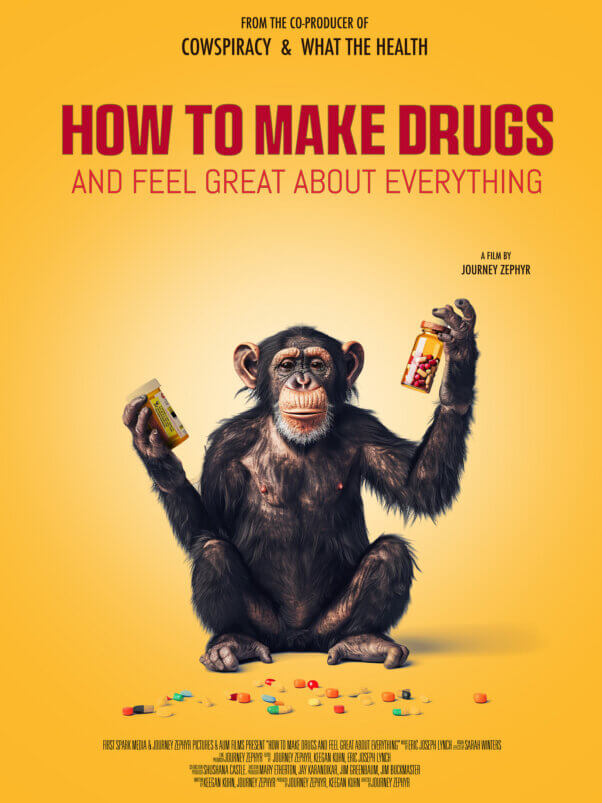
Filmmaker Journey Zephyr’s explosive new documentary, HOW TO MAKE DRUGS (And Feel Great About Everything), which includes interviews with PETA scientists and harrowing footage from PETA’s undercover investigations, unravels a twisted system that continues not because it works but because of scientific inertia, self-serving interests, and a steady stream of government funding.
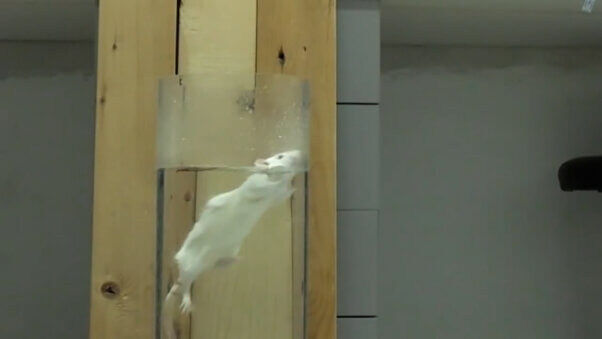
His research into the safety of drugs used to treat depression takes him down a rabbit hole of appalling discoveries. Among them: Antidepressants are tested by dropping small animals into cylinders of water and timing them to see how long they paddle frantically before giving up. It’s called the forced swim test, and as Dr. Neal Barnard, president of the Physicians Committee for Responsible Medicine, explains, “[I]t’s been discredited. It really does not apply to the depression a person would feel. … It’s done because you can get a number. And experimenters love numbers.”
Adverse Drug Reactions: Now the Fourth Leading Cause of Death in the US
Zephyr wonders if tests for other drugs are equally crude and cruel. Like many people, he thought that tests on animals were supposed to ensure safety. “But then I found out that over 14,000 FDA-approved drugs have been recalled in the last 10 years,” Zephyr notes. Vioxx, for example, which passed numerous animal tests, caused heart attacks in humans, killing over 140,000 people before it was yanked off the market.
And don’t forget the flip side. “We know that penicillin, which is an important, lifesaving drug, is lethal to guinea pigs and we know that aspirin is toxic to dogs,” says PETA head of regulatory toxicology, Dr. Amy Clippinger. “So if those medications had been tested first on those species, someone might have said, Ah, maybe we shelve this.’” How many potentially lifesaving medicines for humans have been tossed away because they failed in animals? It’s anyone’s guess.
And then there’s the cruelty – and the lengths to which the animal experimentation industry goes to hide it. Zephyr interviews Andy Stepanian, who was imprisoned for protesting a laboratory called Huntingdon Life Sciences after a PETA undercover investigation revealed horrific abuses there.
Workers slammed monkeys into cages, suspended them midair while pumping their stomachs full of chemicals, and screamed and shook their fists in the terrified animals’ faces while they were strapped down for electrocardiograms.
Stepanian is now free, but Huntingdon is still imprisoning animal victims, just under a different name. It rebranded as Envigo – and then PETA busted it again. At its massive puppy factory farm in Virginia, our undercover investigator documented workers sticking needles into puppies’ heads to drain hematomas without any pain relief, killing them with painful injections directly into their hearts, and more.
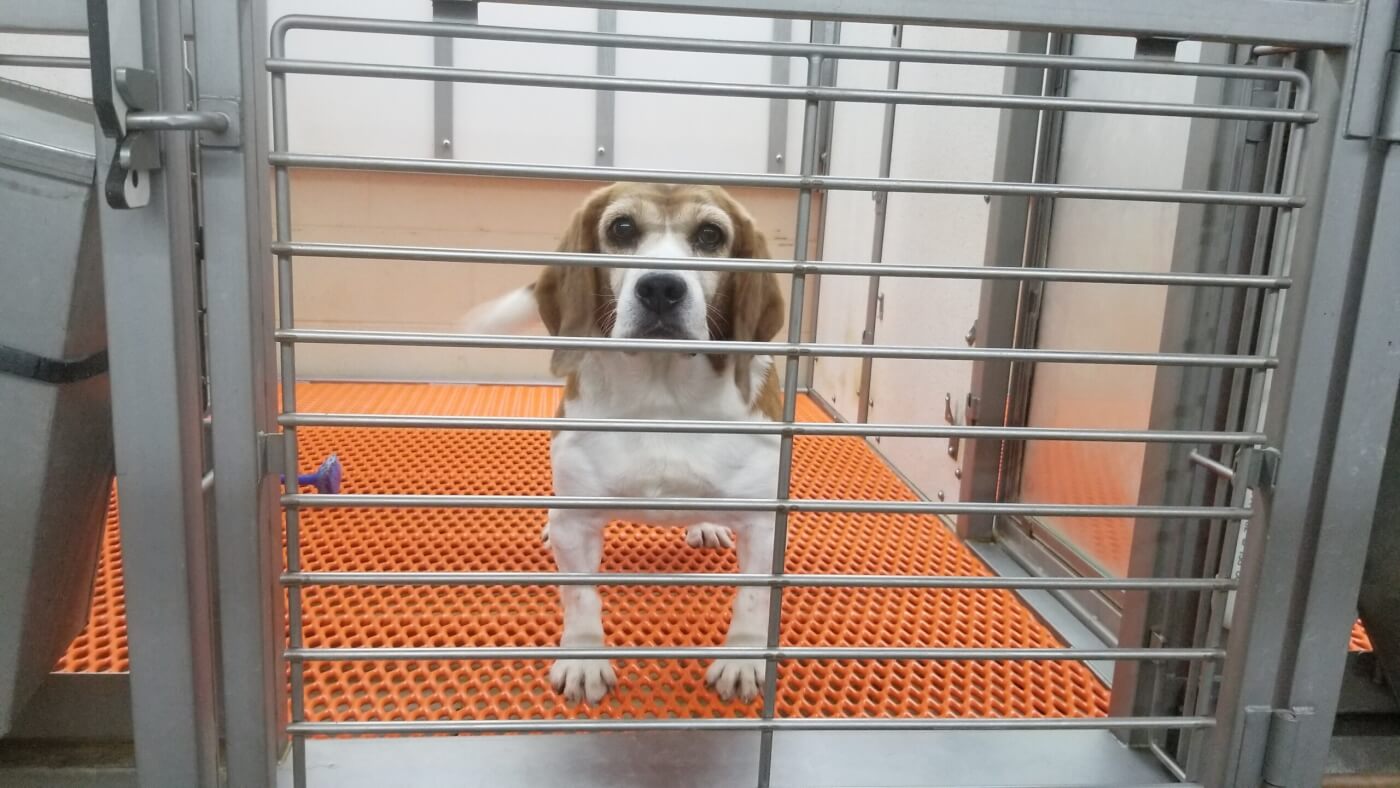
Following PETA’s investigation, that warehouse closed and 4,000 beagles were rescued. One of them, Samson, appears in the film just days after his liberation.

Thinking Outside the Cage
Instead of using someones like Samson, the film shows how forward-thinking scientists are using somethings: state-of-the art methods. It takes viewers inside Emulate, a company that makes organs-on-chips, tiny devices that use human cells to produce human-relevant results. In one study, a liver-on-a-chip correctly identified 87% of compounds that caused liver injury in humans, which animal tests had previously missed. Zephyr also visits the Terasaki Institute, which is 3D bioprinting entire human organs. This technology could allow scientists to use a patient’s own cells to print a model of their organ and then test an array of drugs on it to see which are safe and effective for that individual. It’s the future of medical research – and it’s here.
What YOU Can Do
Host a watch party for the documentary (available on Vimeo), and share the information in this article with someone who needs to know the truth. Urge your legislators to implement PETA’s Research Modernization NOW strategy to end the reliance on cruel, useless experiments on animals.
“Looking at a rat or a mouse or a monkey to understand what’s going on in the human system is like looking at a map of Australia to figure out how to get from San Francisco to Washington, DC. Sure, it’s a map. It’s the wrong map.” — Alka Chandna, PhD, PETA Vice President of Laboratory Oversight & Special Cases