


Animal Experimenters Fail … but PETA Will Persist and Prevail!
Try to imagine his teeth-chattering terror: Torn from everything he had ever known, the monkey was shoved into a crate and loaded into a dark, deafening cargo hold with hundreds of other petrified monkeys. For 28 long hours, not understanding what was happening or why, he endured flight after flight.
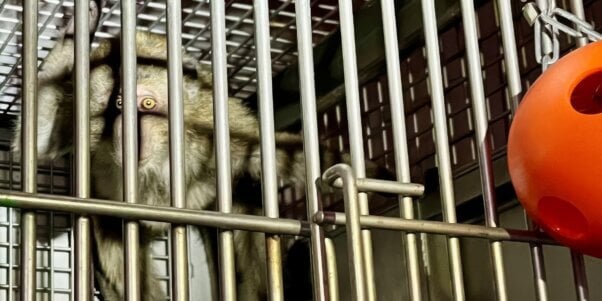
But when he finally reached the US, a worker at BC US – the company that imported him to be used in experiments – threw the crate away with him still in it. Alive. Into a trash dumpster. Five days later, he escaped at a waste facility, starving and confused. He was recaptured, returned to BC US, and killed.

Carelessness and Callousness Come Standard
This monkey’s ordeal – and the carelessness that caused it – came to light only because PETA received whistleblower evidence and went public with it. That exposure led to a criminal charge against the owner of BC US, an extraordinary step in an industry rarely ever held accountable. Now, PETA is urging authorities to revoke the company’s license. But the callousness that killed this monkey isn’t an anomaly. It’s standard practice in an industry that uses living beings as something, not someone. That’s what we’re out to stop.
Dogs Deliberately Starved to Fit Into Cages

At the University of Massachusetts Chan School of Medicine, PETA obtained whistleblower evidence showing that experimenters sidestepped federal requirements by deliberately starving dogs so they’d stay small enough to fit into undersized cages. Expecting a government inspection, the laboratory hid the “evidence” … by killing all of the dogs before inspectors arrived! PETA’s complaints led to US Department of Agriculture citations for even more failures, including sloppy handling that allowed a dog to ingest a catheter left behind after surgery and rabbits to be overdosed with drugs.
20 Screws in a Monkey’s Brain
At the University of Minnesota, PETA exposed botched brain experiments on monkeys. One of them was Everett. Documents revealed that an experimenter had drilled as many as 20 screws into his skull – so deeply that they pierced his brain. Afterward, Everett grew lethargic and weak, he vomited, and his eyes moved abnormally. He pressed his head against the bars of his cage over and over, finding no relief from his crushing pain. He languished like this for months before experimenters simply killed him.
Bilbo suffered from a surgically implanted device, which failed so disastrously that it left his brain exposed for days, while he was denied pain relief. PETA brought the evidence to authorities and demanded action. One experimenter has now been suspended from experimenting on animals. It’s one, but many more need to be given the boot.
How Is a 95% Failure Rate Acceptable?
Animals suffer horrifically in experiments – and all for what? Experiments on animals fail to deliver on their big-talk promises of treatments and cures. Ninety-five percent of new drugs that test safe and effective in animals fail in human clinical trials because they don’t work or turn out to be dangerous. In some areas of research – including HIV vaccines, strokes, and sepsis – the failure rate is 100%.
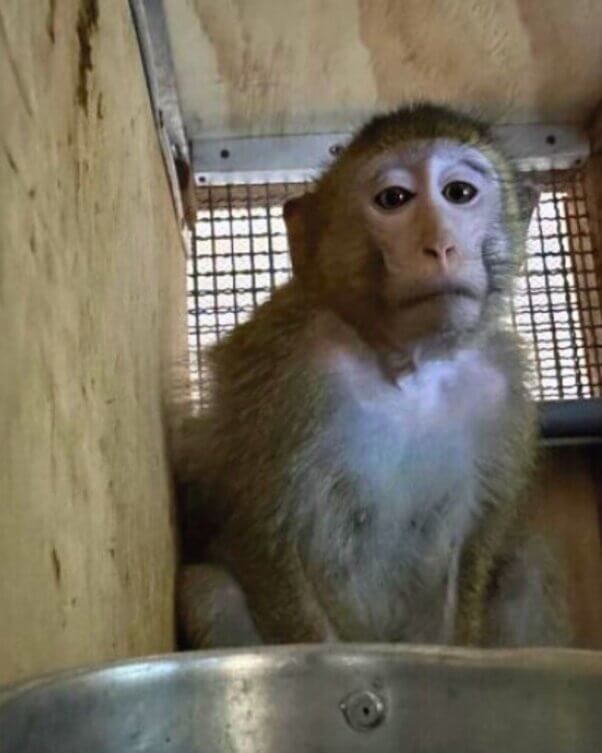
And importing animals for experiments is a public health disaster: Many monkeys carry pathogens that can spread to humans, including tuberculosis, shigellosis, malaria, or Herpes B, and some have been found harboring other even more dangerous pathogens, such as Ebola and Marburg virus. Laboratories sometimes fail to prevent diseases from spreading outside of their facilities, putting communities at risk, as when trucks carrying monkeys crash on a highway, which happens, setting monkeys free, or when there are escapes from laboratories, several of which have occurred in the last few years.
Winning for Animals, Science, and Human Health
PETA is determined to end this massive moral and scientific failure. Momentum is building, including with the PETA-backed PRIMATE Act. This bipartisan legislation would stop all monkey imports destined for US laboratories or their suppliers, sparing more than 20,000 monkeys every year from suffering and death. That’s not all! Responding to PETA’s message:
• The US Environmental Protection Agency is ending its reliance on toxicity tests on mammals.
• The Centers for Disease Control and Prevention will phase out all experiments on monkeys.
• The National Institutes of Health (NIH) has ended funding calls for animal-only experiments.
• The US Food and Drug Administration is leaning into superior, human-relevant methods.
These measures will reduce public health risks and accelerate the shift to state-of-the-art research methods that advance science without suffering.
What You Can Do
Join in, please, and help us prevail! If you’re in the US, please urge your representative to become a cosponsor of the PRIMATE Act.
Urge the US Department of Health and Human Services to shut down the primate importation pipeline.
Please also demand that NIH pull funding for the University of Minnesota’s deadly monkey experiments.