

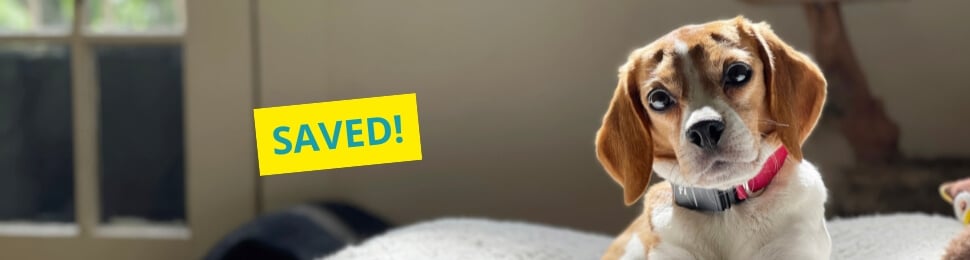
How PETA’s Investigator Sprang Temple From a Seedy Lab
Now We’re Out to Save More Than 100 Dogs and Cats Still Inside It
For nearly three years, Temple never got to be a dog. She never felt the earth beneath her feet, chased a tennis ball, or snuggled with her person on the couch. She was locked inside a barren chain-link kennel in a cinderblock room, without so much as a blanket. She craved affection but was too scared to trust humans. Inside the kennel, she lay in the corner and shook.
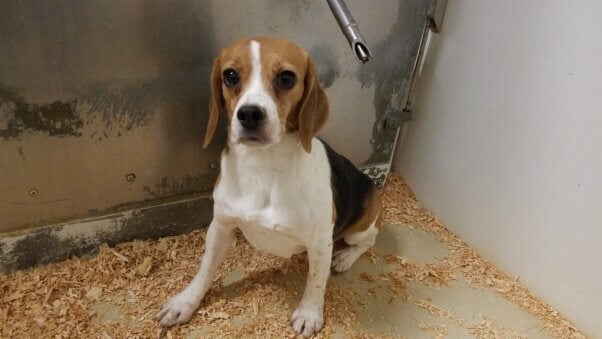
PETA’s investigator met Temple at Red Beast Enterprises Inc., a contract laboratory doing business as the far more respectable-sounding High Quality Research (HQR) in Colorado. Temple crept toward the investigator’s outstretched hand before retreating into the corner of her cell. Her low, fast-wagging tail signaled her anxiety.
To HQR, Temple was defective lab equipment, too “jumpy” to make blood draws easy to do, let alone the other poking and prodding that occur before animals are subjected to experiments. Miraculously, we got her out of there. Temple has now been adopted by two PETA staff members and is relishing walks, trips to the beach, and playtime with the family’s other rescued animals. She is finally a dog!
PETA uncovered a litany of horrors during our six-month investigation into HQR, which tests drugs and other products in crude ways on dogs, cats, and rats for pharmaceutical and university clients. We compiled our notes and video evidence carefully and submitted a formal complaint to the US Department of Agriculture (USDA), which conducted a multi-day on-site inspection – and cited HQR for more than 200 alleged violations of 11 federal Animal Welfare Act regulations.
Dogs Debarked and Driven Crazy by Constant Confinement
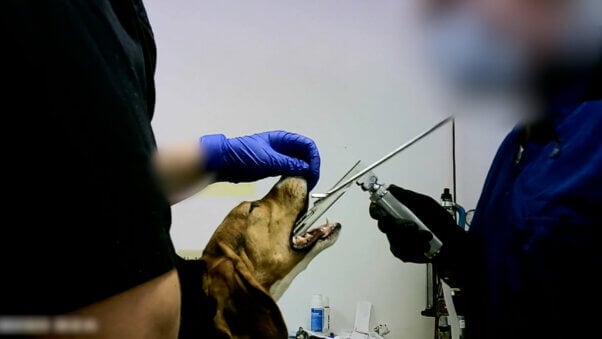
As was done to other dogs at HQR, gynecological forceps were jammed down Temple’s throat and her vocal cords were cut so that she’d bother staff less with her “shrill” barking. Some dogs endured this mutilation twice. The USDA’s damning inspection report found that HQR lacked records indicating that dogs were given pain relief afterward.
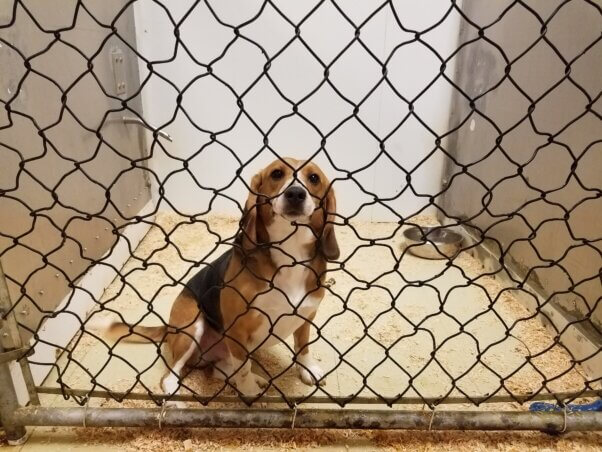
Many of the beagles, who were confined nearly 24 hours a day, paced incessantly or ran in frantic circles – signs of psychological distress or “zoochosis.” One dog, Bug, chewed at the metal cage bars so desperately that he bent the wire. When PETA’s investigator pointed this out, a senior worker shrugged it off and said they’d simply replace the door with a solid one.
HQR’s Vet Failed to Treat Suffering Animals
PETA’s investigator documented that HQR left animals to suffer from open wounds, inflamed skin, and chronic, sometimes painful eye conditions.
Kegan had a prolapsed eyelid gland and an eye ulcer that the lab’s veterinarian said would cause a human to “writh[e] on the floor” in pain. But the vet admitted that even after 29 years at the laboratory, he didn’t have the “skills” to help her.
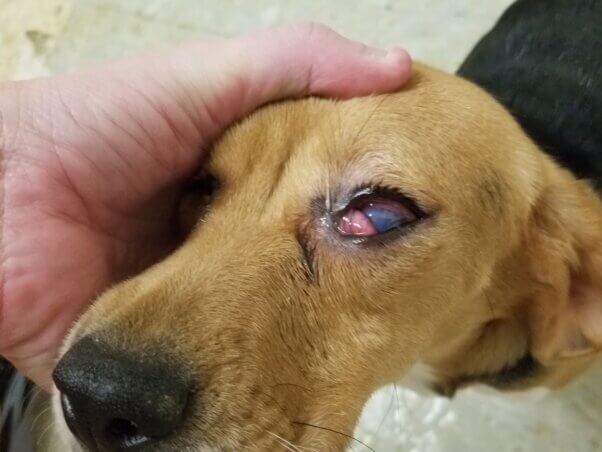
An 11-year-old beagle named Bo suffered from neck pain and walked stiffly on his bowed legs, but the vet acknowledged that he didn’t know how to treat him, calling it “expensive” to find out. Another elderly beagle, Docker, had a golf ball–sized neck mass, which the vet apparently ignored for “years” until PETA’s investigator brought it up.
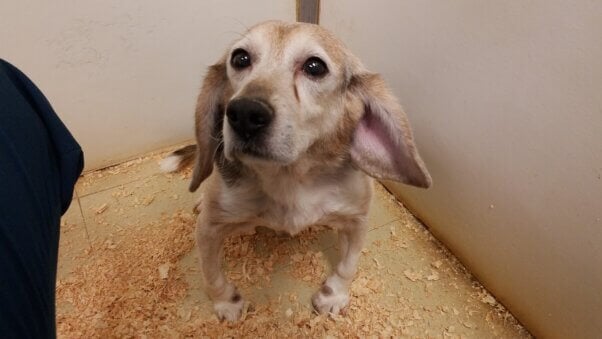
The feds cited HQR for neglecting Bo and Docker. They also found that one dog was denied any treatment for an ear infection for four days after the condition – which they noted could be “painful and distressing” and lead to permanent damage – was diagnosed. A dog with hair loss and red skin on his face – apparently the result of mange – was not examined by the lab’s vet until nine days after his condition was reported and was not given any treatment for another 10 days.
Cats Stuck for Years in Stark, Windowless Rooms
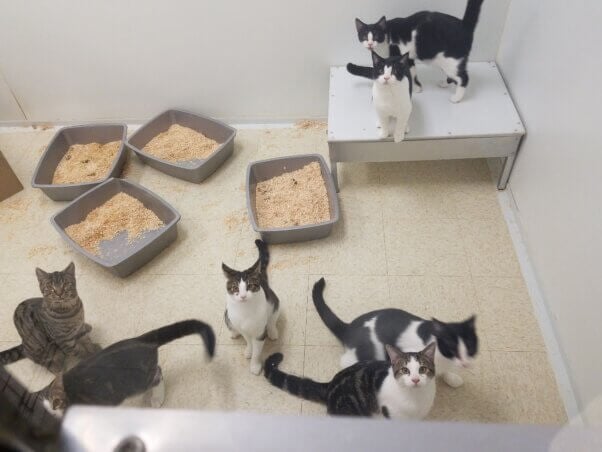
The laboratory confined nearly 30 cats – some for over a decade – to barren rooms lacking beds, blankets, or soft surfaces. With up to 12 cats crammed into a single space with nowhere to hide, they lived in constant stress. Workers shut those used in experiments inside crates without toys or enrichment. Desperate for affection, the cats climbed all over PETA’s investigator. But when the investigator asked to adopt, the facility’s president said Colorado State University experimenters were “not done with them.” According to the USDA’s report, HQR failed to provide adequate veterinary care to cats with chronic eye discharge and failed to document that routine care, like cutting overgrown nails and assessing body condition, had ever been provided to 18 cats.
What You Can Do
Help us get animals out of this laboratory and all others! Urge Colorado State University to reconsider its ties with HQR.

