
Sanitizing Sadism: What They Don’t Teach You in Psych 101 About Harry Harlow
A “pit of despair,” a “rape rack,” and a “wire mother” sound like props from a horror film, but they were real devices used to torture baby monkeys. Harry Harlow, a psychologist at the University of Wisconsin–Madison, claimed he wanted to study the “nature of love,” but his experiments on infant monkeys were anything but loving.
Today, the psychological torture Harlow inflicted on baby primates in the name of “science” is still taught in many introductory psychology courses—but here’s what they don’t teach you in Psych 101.
Harry Harlow Exploited Infant Monkeys Who Needed Their Mothers
Just like human babies, monkeys depend on their mothers for milk, warmth, protection, and comfort. In nature, rhesus macaques live in close-knit social groups where mothers gaze into their babies’ eyes, gently touch them, and carry them everywhere. When frightened or cold, an infant instinctively runs to her mother for safety. When an infant dies, some grieving mothers carry their child’s body for days.

Harlow deliberately and repeatedly separated infant monkeys from their mothers and tormented them to study what would happen to the babies without this vital connection.
Wire Mother vs. Cloth Mother
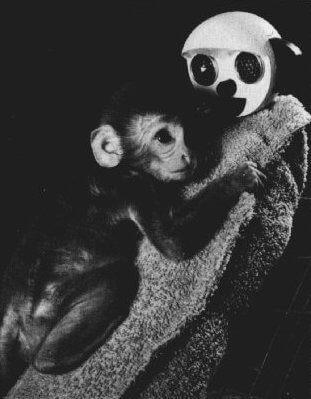
In his earliest experiments, Harlow tore apart monkey families to determine if infants form bonds with their mothers because they provide food or comfort. To test this, he isolated the newborn monkeys, save for inanimate “surrogate mothers.” One “mother” was fashioned from bare, uncomfortable wire and fitted with a feeding bottle, and the other was made from soft terrycloth but offered no food. Even when hungry, the infants clung desperately to the cloth “mother,” only briefly darting to the wire “mother” to nurse.
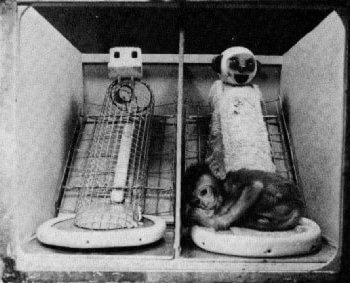
Harlow then decided to terrify the young monkeys to see how they would react with and without their surrogate mothers. When a cloth or wire “mother” was in the cage, the monkeys would cower against them but eventually explore something new or frightening. When Harlow removed the wire and cloth “mothers,” the baby monkeys cowered on the floor, never exploring. From these experiments, Harlow concluded that love and comfort mattered more than food to the infants—a fact that human parents and primate experts already knew.
The Iron Maiden and Other “Evil Mothers”
Harlow didn’t stop after creating the cloth and wire mothers—if anything, those experiments just encouraged him to try other ways to torment infant monkeys with the only comfort he allowed them. He created other surrogate mothers meant to torment desperate infants, such as:
- A surrogate mother that would blast pressurized air so powerful that a clinging infant’s fur was pressed down flat against their skin.
- A “shaking mother” that would move so much that baby monkey’s teeth chattered in their mouths while holding onto it.
- A surrogate mother with a device that catapulted baby monkeys across the cage.
- “The Iron Maiden,” a surrogate mother with brass spikes that could be stabbed into the body of an infant monkey clinging to its body. Apparently, the baby would scream in shock, jump away, and wait until the spikes retracted before clinging again.
Despite the pain and mental torment these “Evil Mothers” inflicted on them, Harlow noted that the baby monkeys returned to them time after time for comfort.
Isolation Chambers: Breaking Monkeys’ Spirits
Through tormenting and depriving infant monkeys of everything natural and important to them, Harlow concluded that babies crave comfort from their mothers. Then he escalated his cruelty. To see how extreme isolation would affect infant monkeys, Harlow imprisoned several babies in desolate cages. Some would remain in these enclosures for years, without contact with their mothers or peers. The only outside contact they had with anyone was when Harlow’s team placed food and water in their cages.
The young monkeys quickly developed abnormal behaviors. They paced, rocked, bit themselves, and pulled out their hair. Once their condition deteriorated to a degree that Harlow felt satisfied with, he would place the traumatized, isolated monkeys with others and see what happened. They struggled to interact with other monkeys and often stayed alone. Some died after refusing to eat.
These experiments produced no groundbreaking insights about humans; we already knew that depriving social animals of companionship—and everything else natural and important to them—devastates them.
Harlow Invented the “Rape Rack” to Force Monkeys to Reproduce
After breaking baby monkeys’ spirits, Harlow wanted to test how isolation affects parenting. However, Harlow’s isolated monkeys grew up so psychologically damaged that they all refused to mate. To solve this “problem,” Harlow devised a restraining device he chillingly called the “rape rack” to force female monkeys to reproduce against their will.
Female monkeys were strapped down to the rape rack and forcibly impregnated. When the traumatized mothers gave birth, they had no idea how to care for their young, since Harlow deprived them of all social contact during their formative periods. According to Harlow, some of the socially deprived, tortured mothers ignored their babies entirely, while others crushed their babies into the floor and rubbed their faces back and forth.
The “Pit of Despair”
Following the death of his wife, Harlow turned his attention from maternal bonding to depression. He invented the “pit of despair,” a small, inverted metal pyramid with slippery sides leading down to a point he said mimicked the feeling of a depressive episode.
Harlow then allowed mother and infant monkeys to bond, just to separate them later. He then placed the infants inside the pits of despair for weeks. At first, the infant monkeys tried to escape by climbing the sides. Eventually, they gave up, curling into corners. Within days, even the most outgoing monkeys became withdrawn, staring blankly and refusing to move.
The pit of despair experiments offered no insight or advance to human psychology, nor any steps towards curing depression.
Did Harlow’s Monkey Experiments Help Anyone?
Several members of the scientific community were outraged by Harlow’s cruel experiments. Many of Harlow’s experiments concluded with nothing but “common sense” results, meaning that they proved nothing and benefited no one. The claim that social animals suffer when deprived of love is something anyone who has felt loneliness could have told him, without being tortured to insanity.
The only possible benefit of Harlow’s horrific monkey experiments is that they upset people widely, encouraging people to speak up for animals used in experiments. Although no amount of “oversight” and no “committee” can make animal experimentation ethical, Harlow’s horrible experiments helped lead to some minimal improvements for animals used in laboratories. Harlow’s former doctoral student and animal experimenter, Gene Sackett, believed that Harlow—to his own disdain—led many to support the Animal Liberation Movement, as his studies on maternal deprivation and isolation were a significant contributing factor to the rising public and scientific concern that led to the passage of the Animal Welfare Act of 1966. Another former student, William Mason, explained, “… it was clear to many people that the work was really violating ordinary sensibilities, that anybody with respect for life or people would find this offensive. It’s as if he sat down and said, ‘I’m only going to be around another ten years. What I’d like to do, then, is leave a great big mess behind.’ If that was his aim, he did a perfect job.”
Monkey Torment Didn’t Die With Harlow
Harlow died in 1981, but the cruelty he normalized continued. For decades, his protégé Stephen Suomi carried on with experiments that tore infants away from their mothers at the National Institutes of Health. Suomi also gave them inanimate surrogates, such as cloth-covered bottles. He exposed restrained baby monkeys to frightening sounds inside “startle chambers” and even sedated mother monkeys, taped over their nipples, and locked their babies in cages with them. In one experiment, researchers even laughed while infants frantically tried to wake their drugged, unresponsive mothers.
Thankfully, a relentless, 18-month-long PETA campaign led to the shutdown of Suomi’s laboratory and the end of his cruel experiments in 2015.
Monkeys Still Suffer Today
Monkeys are suffering in government facilities that inflict pain, fear, and isolation on them right now. You can help stop it.
The seven National Primate Research Centers have lapped up billions of dollars to prop up their infrastructure since their inception in the 1960s. Taxpayers like you are also bankrolling the horrors in these labs—including infecting monkeys with deadly pathogens, electro-ejaculating male monkeys, scaring monkeys with real snakes, cutting into monkeys’ skulls and implanting electrodes in their brains—and the violations, like scalding a monkey to death in a high-temperature cage washer.
Please take action and urge your members of Congress to shut off the funding to the seven National Primate Research Centers today.

The world is mourning Dr. Biruté Galdikas, a tireless champion for our fellow primates and their forests.

PETA continues to save animals and end cruel experiments. Learn which mushroom company just ended tests on animals after hearing from us.

Inside the diseases festering behind locked laboratory doors.

