Two Piglets Found Dead After Gruesome UMass Heart Experiments; PETA Seeks Federal Probe
For Immediate Release:
October 19, 2026
Contact:
Sydney Rader 202-483-7382
In a complaint filed today, PETA calls on the U.S. Department of Agriculture (USDA) to investigate possible violations of the federal Animal Welfare Act after leaked records showing that two young pigs died—apparently without timely veterinary treatment—following invasive heart experiments at the University of Massachusetts Chan Medical School (UMass Chan).
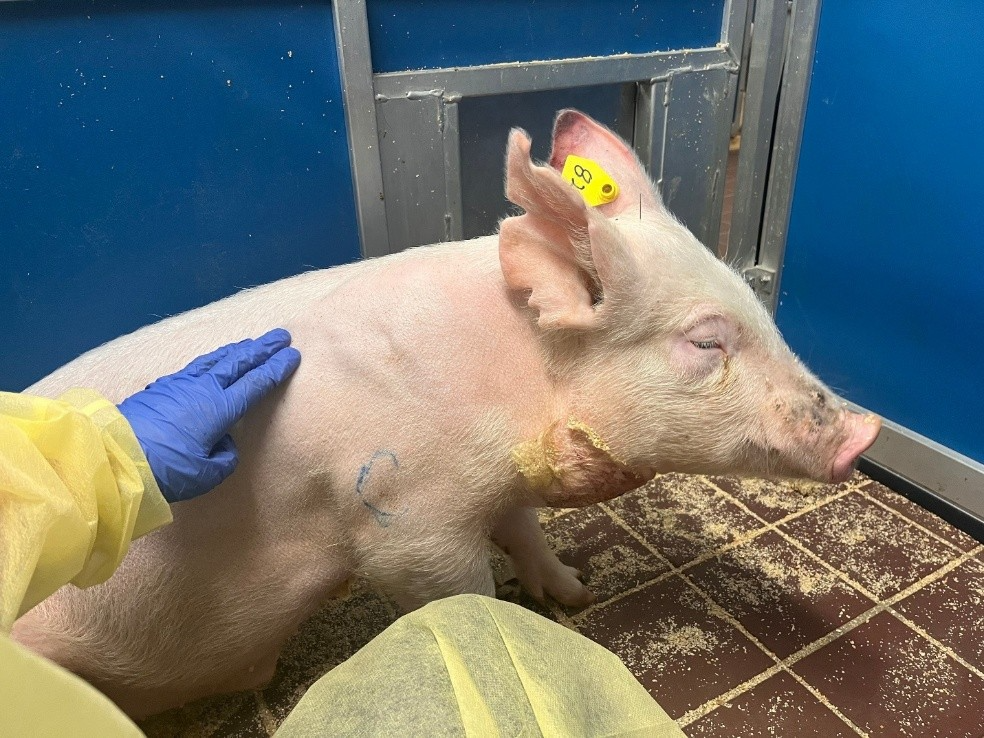
According to these records, experimenters blocked a blood vessel in one pig for more than two hours, inducing a heart attack. Afterward, records show the pig was sluggish and bled from his rectum but no veterinarian examined the animal in the hours following surgery. Later that evening, he was found dead in his concrete kennel.
These records likewise reveal that experimenters also cut open a 12-week-old piglet’s chest, exposed his heart, applied genetically modified viruses to the organ’s surface, and implanted a pacemaker. A pacemaker wire moved out of place—possibly as the result of a botched surgery—triggering an abnormal heart rhythm that led to cardiac arrest. The pig was dead the next day.
“These piglets endured invasive heart experiments, were denied timely care, and were found dead in concrete cells,” says PETA Vice President of Laboratory Investigations Dr. Alka Chandna. “They were living, feeling beings who were treated like disposable raw materials in a system that took what it wanted from their bodies—the feds must investigate and hold the medical school accountable.”
PETA also asks the USDA to investigate whether the supplier of three of the pigs (one of whom died) was legally authorized to sell pigs to UMass Chan. The company, Earle M. Parsons & Sons Inc., does not appear in the agency’s public database of licensed animal dealers.
UMass Chan has a persistent pattern of animal welfare and compliance violations. Animals have died from dehydration, inadequate monitoring, and failures in veterinary communication. Federal authorities have cited UMass Chan for incomplete medical and anesthesia records, failing to provide required pain relief, and unauthorized or unapproved animal procedures. Many incidents recur despite retraining, increased oversight, and other corrective actions, raising concerns about the school’s ability to identify and correct systemic problems.
PETA encourages everyone to urge UMass Chan to modernize its research program by switching from outdated experiments on animals to state-of-the-art, human-relevant methods.
PETA—whose motto reads, in part, that “animals are not ours to experiment on or abuse in any other way”—points out that Every Animal Is Someone and offers free Empathy Kits for people who need a lesson in kindness. For more information, please visit PETA.org or follow PETA on X, Facebook, or Instagram.