
Capybara Café Prompts PETA Call for Investigation Into Legality, Closure
For Immediate Release:
September 23, 2026
Contact:
David Perle 202-483-7382
A newly opened Fort Lauderdale business where customers pay to handle capybaras, armadillos, African crested porcupines, and fennec foxes appears to be operating illegally, according to records reviewed by PETA. In an urgent letter sent last night to Senior Assistant City Attorney Rhonda Montoya Hasan, PETA calls for an investigation into the Capybara Café, whose business tax receipt remains under review and whose location is not zoned for a wild-animal petting zoo—and requests that the roadside zoo be shut down and the animals sent to reputable facilities for their sake and for public safety.
When the café closes for the day, the animals are reportedly moved to a residential property that also is not zoned for an animal-oriented business—and where the Fort Lauderdale government has already opened a code case over an attempted “cage and pond” construction without building permits. On September 17, a visitor also documented capybaras showing signs consistent with respiratory illness and a fennec fox showing signs consistent with intestinal parasites, which, according to a veterinarian who reviewed the photo evidence, could be transmitted to customers.
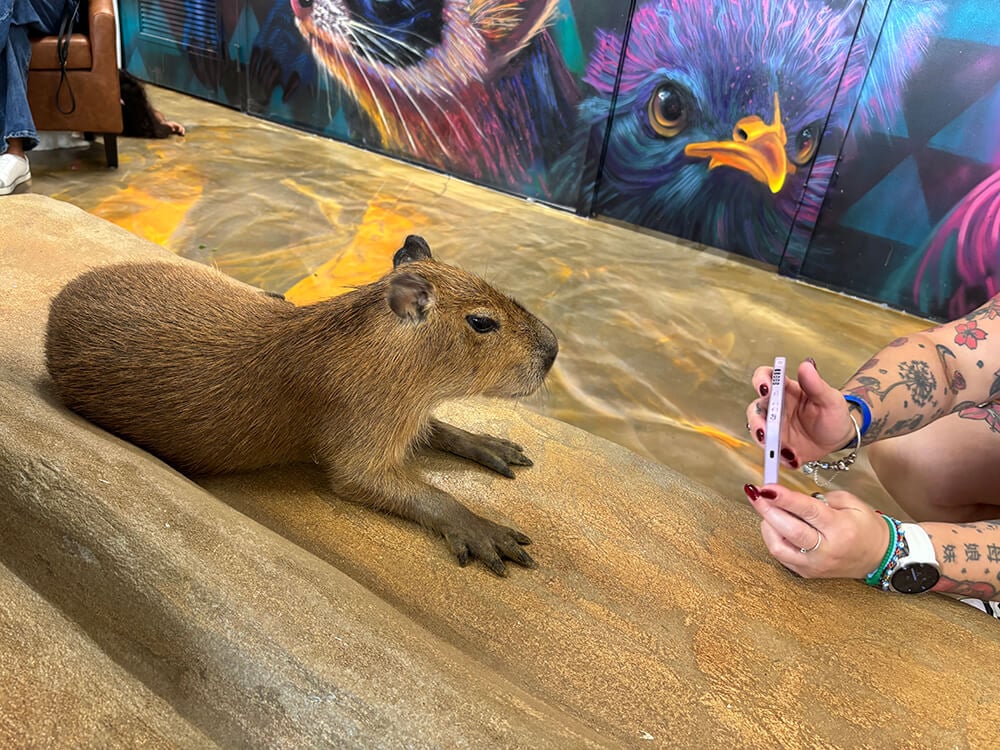
“Wild animals are being passed from customer to customer, which is not acceptable in any way, and this ‘café’ lacks the city approvals required to operate,” says PETA Foundation Managing Director of Captive Wildlife Debbie Metzler. “PETA is calling on Fort Lauderdale officials to enforce the law, shutter this roadside zoo, and stop these animals from being treated like photo props.”
The Capybara Café’s owner, Stephanie Angel, operates various petting zoos in Florida, where the U.S. Department of Agriculture (USDA) cited her for four young capybaras who died without adequate veterinary care; St. Johns County cited another operation as an unpermitted use; and the Florida Fish and Wildlife Conservation Commission is currently pursuing charges against her for failing to report a lemur bite, among other violations.
PETA has also shared its findings with Chief of Police William Schultz and Development Services Director Anthony Fajardo and urged the agencies to investigate the Capybara Café. PETA has requested records from these agencies related to the business but has been told, variously, that the records don’t exist, are unavailable, or that Capybara Café has “all of its permits”—meaning that either the permits exist and PETA was unlawfully denied access to public records, or that the permits don’t exist and the City has been operating under erroneous information.
In nature, capybaras spend much of their days swimming, submerging themselves in water, and basking along the muddy shores of South American rivers and swamps. PETA is now mobilizing its members and supporters to contact Fort Lauderdale Mayor Dean Trantalis and urge him to shut down the Capybara Café.
PETA—whose motto reads, in part, that “animals are not ours to use for entertainment or abuse in any other way”—points out that when it comes to the ability to feel pain, hunger, and thirst, a capybara is a dog is a boy. For more information, please visit PETA.org or follow PETA on X, Facebook, or Instagram.