Dogs Starved in His Lab: PETA Will Protest UMass Chan Experimenter at Boston Symposium
For Immediate Release:
September 16, 2026
Contact:
Tasgola Bruner 202-483-7382
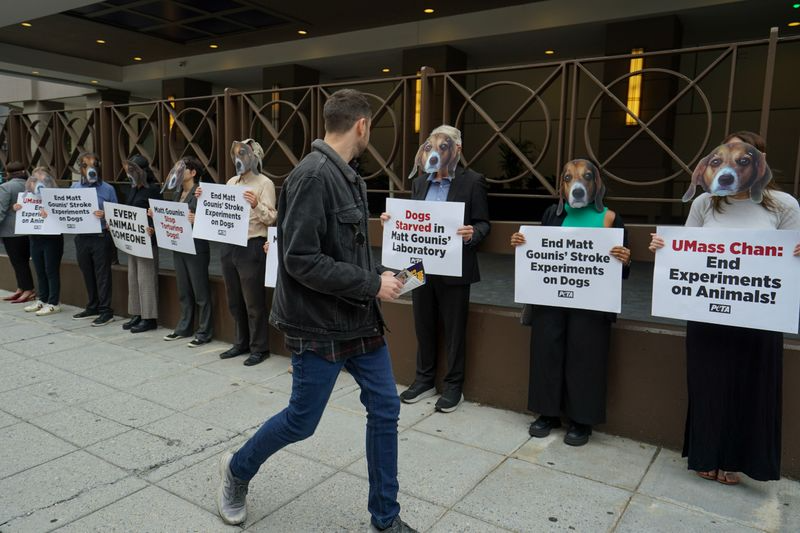
On Friday, PETA supporters wearing dog masks will be at the Annual Interventional Neuroradiology Symposium—attended by University of Massachusetts Chan Medical School (UMass Chan) experimenter Matt Gounis—to call for an end to his invasive, painful, and deadly experiments on dogs. The action follows PETA’s latest exposé, revealing a years-long pattern of botched euthanasia UMass Chan laboratories involving at least 121 small animals.
Gounis subjects dogs to repeated invasive surgeries, including cutting into blood vessels in their necks to create artificial aneurysms and induce strokes, before killing them. A whistleblower reports that dogs were deliberately underfed to keep their body weight low to circumvent federal laws requiring larger cages. Laboratory records and photographs show the dogs’ visible ribs and protruding hip bones.
“Matt Gounis starves dogs until their ribs stick out, cuts into their necks over and over again until they’re of no more use to him, then kills them,” says PETA Chief Scientist Dr. Katherine Roe. “PETA challenges UMass Chan—which can’t even kill animals humanely—to end this cruelty now and replace deadly experiments with animal-free, human-relevant research methods.”
Where: Sheraton Commander Hotel, 16 Garden St., Cambridge
When: Friday, September 18, 7:30 a.m.
Why: Gounis chairs UMass Chan’s Institutional Animal Care and Use Committee, which oversees compliance with federal animal welfare regulations. A whistleblower in UMass Chan laboratories documented starved and neglected animals, chronic veterinary understaffing, inadequate pain management, delayed or withheld treatment, unsafe housing conditions, and repeated failures to stop experiments or treat or euthanize animals before they reached an extreme state of suffering or death.
UMass Chan has a persistent pattern of animal welfare and compliance violations, including animals dying from dehydration, inadequate monitoring and veterinary communication, incomplete medical and anesthesia records, failures to provide required pain relief, and unauthorized or unapproved animal procedures. Many of these incidents recurred despite retraining, increased oversight, and other corrective actions, raising concerns about the institution’s ability to identify and correct systemic problems.
PETA—whose motto reads, in part, that “animals are not ours to experiment on”—points out that Every Animal Is Someone and offers free Empathy Kits for people who need a lesson in kindness. For more information, please visit PETA.org or follow PETA on X, Facebook, or Instagram.