
Poll: Voters Overwhelmingly Want Dolphins Out of Marine Parks—Why Aren’t the Keys Listening?
For Immediate Release:
September 10, 2026
Contact:
David Perle 202-483-7382
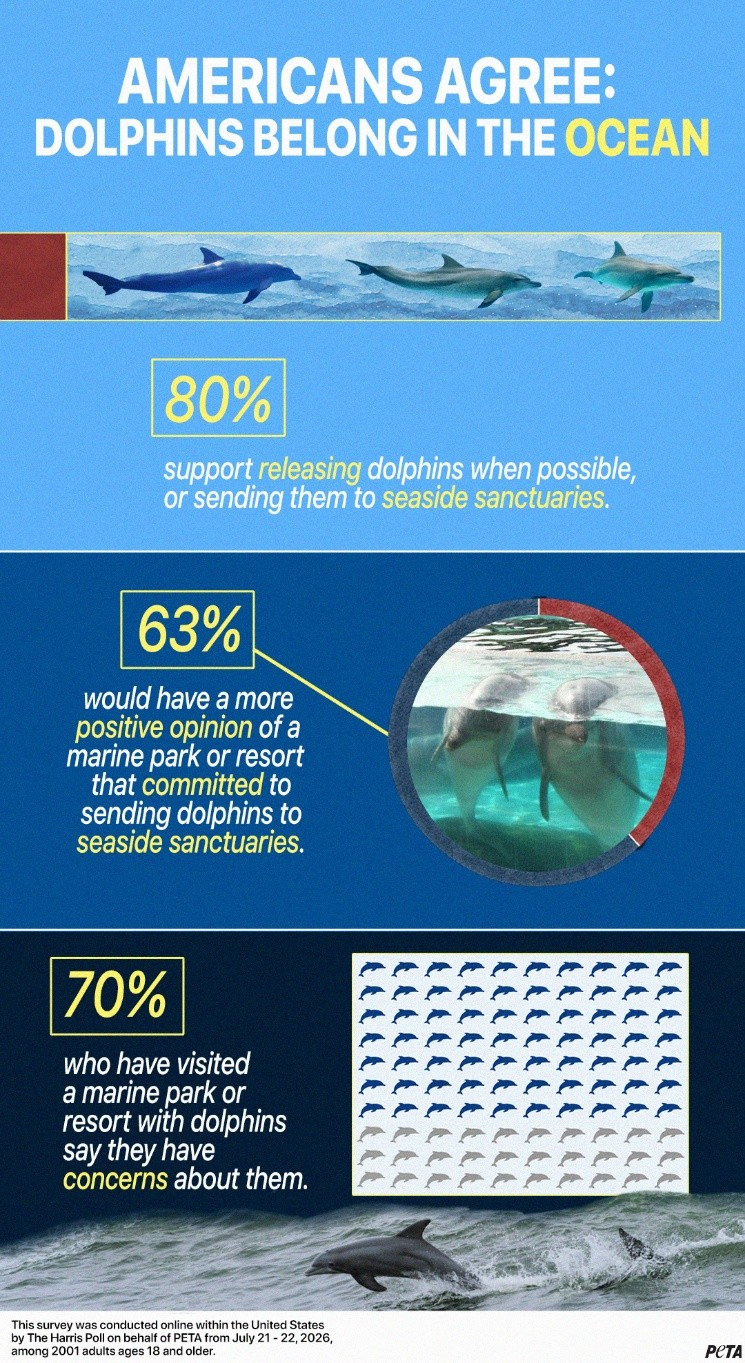
An overwhelming 80% of Americans support releasing dolphins currently held at marine parks and resorts or moving them to seaside sanctuaries, according to a new survey conducted by The Harris Poll of 2,001 U.S. adults commissioned by PETA. Yet 61 bottlenose dolphins remain in captivity at five facilities throughout the Florida Keys, including Dolphin Research Center and Theater of the Sea—and hundreds more are confined at marine parks, resorts, and shoddy aquariums across five states nationwide—putting the industry sharply at odds with the public it tries to sell tickets to.
The poll revealed that 70% of those who have visited a marine park or resort in the U.S. say they have concerns about the dolphins there. The greatest concerns include the small size of the dolphins’ enclosure (42%), the condition of their tanks (30%), the dolphins’ mental health (37%), mistreatment by handlers (28%), and injury and illness (19%).
At captive dolphin facilities in the Florida Keys—including Dolphin Research Center, Dolphins Plus Bayside, Island Dolphin Care, Dolphin Life, and Theater of the Sea—dolphins are subjected to stressful “swim with dolphins” encounters and hands-on interactions, in which the animals are repeatedly touched, grabbed, forced to kiss strangers, or forced to hold paintbrushes in their mouths for “painting” sessions. Several of the facilities also breed dolphins in captivity, creating more animals to suffer for human entertainment.
The poll also revealed the following:
- More than half of Americans (57%) said that learning that a marine park or resort keeps dolphins for entertainment would negatively affect their view of it.
- 63% of Americans would think more highly of a marine park or resort that publicly committed to sending dolphins from its facility to seaside sanctuaries—yet captive dolphin facilities in the Florida Keys have refused to do so.
- 63% oppose breeding programs after learning that some facilities breed dolphins for public interactions and shows through forced artificial insemination.
“The public has spoken, and Americans are overwhelmingly opposed to keeping dolphins in captivity—yet marine parks in the Florida Keys are covering their ears and clinging to a cruel relic of the past,” says PETA President Tracy Reiman. “These intelligent, far-ranging animals don’t belong in pens swimming in mind-numbingly endless circles, and PETA is calling on facilities throughout the Keys to make the smart move, listen to what the public wants, and release them to seaside sanctuaries.”
In nature, dolphins maintain dynamic relationships with large social networks and can swim up to 60 miles a day. Yet at marine parks and similar captive dolphin facilities, they’re often forced into incompatible social groups, with nowhere to escape when conflicts erupt among other frustrated animals. Those exploited for hands-on encounters endure frequent handling, which can cause stress, illness, and injury. These attractions also pose health risks to humans, as many illnesses—including viral, fungal, and bacterial infections such as salmonella—can be passed from dolphins to human visitors.
PETA—whose motto reads, in part, that “animals are not ours to use for entertainment”—points out that Every Animal Is Someone and offers free Empathy Kits for people who need a lesson in kindness. For more information, please visit PETA.org or follow PETA on X, Facebook, or Instagram.
Survey Method:
This survey was conducted online within the United States by The Harris Poll on behalf of PETA from July 21-22, 2026, among 2,001 adults ages 18 and older. The sampling precision of Harris online polls is measured by using a Bayesian credible interval. For this study, the sample data is accurate to within +/- 2.7 percentage points using a 95% confidence level.