
VIDEO: Donkey Handlers Violently Attack Peaceful Protesters on Santorini
For Immediate Release:
September 4, 2026
Contact:
David Perle 202-483-7382
Earlier today, three PETA Germany supporters were attacked by donkey handlers on the Karavolades Stairway on the island of Santorini in Greece. The animal allies were preparing to rally against the cruel treatment of donkeys used to haul tourists up the island’s steps when the men destroyed their signs and turned violent—grabbing the young women, pushing them down the stairs, pressing them against a wall, and striking one of them in the face. Video footage of the attack is available here.
The PETA Germany supporters had gathered to plead for relief from the suffering of donkeys and mules as “tourist taxis” on Santorini, where they’re forced to carry travelers—some obese—up the more than 500 steep steps to the old town of Firá, often in scorching heat—despite the presence of a cable car that has operated nearby for decades. To show that the stairs can be climbed easily without relying on animals, the animal advocates intended to demonstrate an innovative, animal-friendly alternative: robotic leg devices known as exoskeletons, which would allow people to ascend with ease.
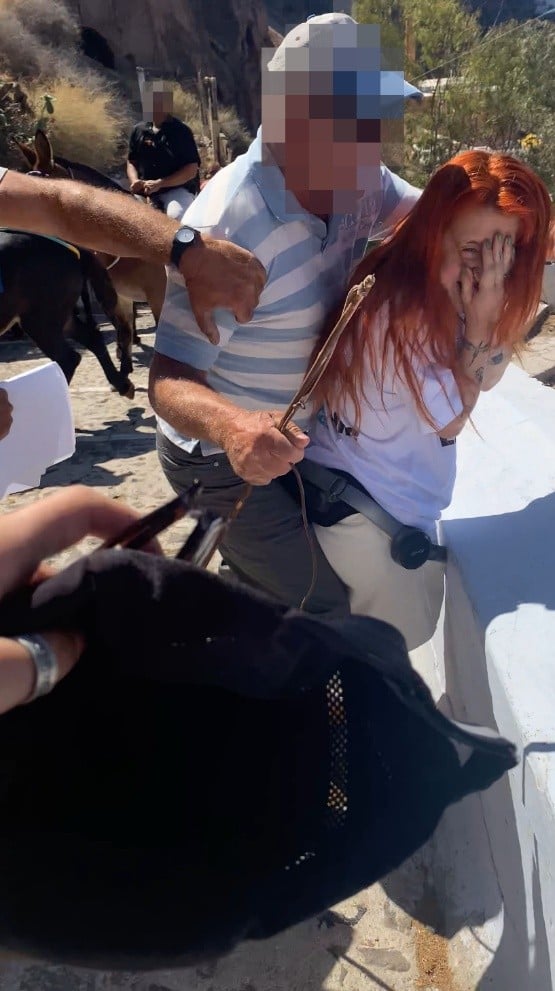
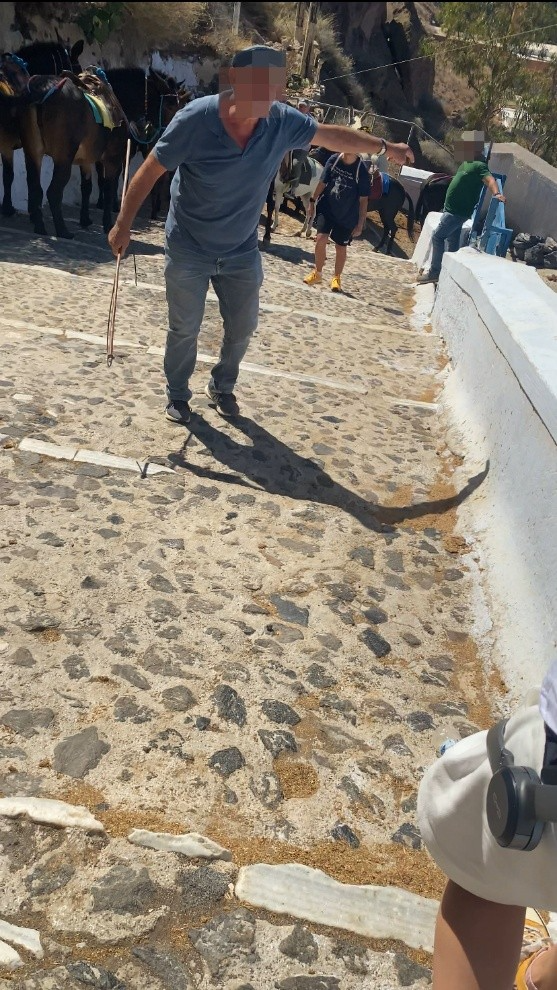
Credit: PETA Germany
“The donkeys and mules are treated as living taxis on Santorini and are constantly pushed to the brink of collapse, they are forced to endure lives of pain and suffering, and their handlers’ violent attack on peaceful animal advocates speaks volumes,” says biologist and PETA Germany advisor Dr. Yvonne Würz. “Modern options such as robotic exoskeletons, which PETA Germany has offered to fund, prove that no animal needs to suffer for this climb, and we’re urging officials to end this cruelty by banning all donkey and mule rides on Santorini in this, the 21st century.”
Since 2018, PETA has repeatedly exposed donkeys on Santorini suffering from painful abrasions and wounds caused by ill-fitting, worn-out saddles and makeshift girths. The animals are often equipped with unsuitable bridles, and some have wounds covered with flies. Handlers frequently fail to provide water, shade, or shelter between rides, leaving the animals to suffer in the blazing Mediterranean sun. The exhausted animals often stumble on the stairs—sometimes after being struck with sticks—creating a danger both for the animals and for people nearby.
PETA notes that a pilot project in China has already demonstrated that exoskeleton technology can be used to replace animals in the tourism industry. Travelers were able to rent exoskeletons for a fee to assist with climbing Mount Tai, which has more than 7,000 steps. In a letter to the mayor and the president of the Firá Port Authority, PETA Germany offered to financially support the purchase of such exoskeletons if the donkey rides are discontinued.
PETA Germany intends to file criminal charges against the violent donkey handlers who attacked the animal allies—and is asking tourists and local residents who witnessed the incident to contact [email protected].
PETA—whose motto reads, in part, that “animals are not ours to use for entertainment or abuse in any other way”—points out that when it comes to the ability to feel pain, hunger, and thirst, a donkey is a dog is a boy. For more information, please visit PETA.org or follow PETA on X, Facebook, or Instagram.