
Chrishell Stause, Gavin Rossdale, and Other Celebrities React to Shocking Monkey Experiment Footage
“I can’t take it.”
“Why are we torturing them? Why are we doing this?”
Those were just some of the horrified reactions after Gavin Rossdale, Kate del Castillo, Courtney Stodden, and other big names sat down to watch disturbing footage obtained by PETA exposing the suffering of monkeys used in cruel experiments.
The Footage They Couldn’t Believe Was Real
Sitting in front of a monitor, each celebrity watched actual footage of painful, invasive experiments on monkeys. The videos showed experimenters exposing brain-damaged monkeys to realistic-looking snakes and spiders to provoke fear, tearing terrified baby monkeys away from their mothers, and forcing thick plastic tubes up monkeys’ nostrils to pump chemicals into their bodies.
“There’s so many other options and ways to do testing that doesn’t involve innocent animals,” said a visibly shaken Chrishell Stause.
Pointing to footage of a screaming monkey trapped inside a tiny cage, Gavin Rossdale expressed what many viewers are likely to feel: “The least we could do is stop this bullsh*t.”
Congress Has a Chance to Stop the Monkey Pipeline
This new video comes as PETA urges Congress to pass the bipartisan Preventing Risky Importation of Monkeys to Avoid Toxic Exposures (PRIMATE) Act (H.R. 8471), which would ban the trafficking of monkeys destined for U.S. laboratories or their suppliers.
Introduced by U.S. Reps. Greg Steube (R-Fla.-17) and Dina Titus (D-Nev.-01), the legislation would also help prevent the introduction of dangerous and drug-resistant pathogens, including those linked to tuberculosis, malaria, Shigella, measles, and other diseases associated with monkey importation.
More Than 22,000 Monkeys Imported in One Year
Despite growing calls for state-of-the-art, human-relevant research methods, the experimentation industry continues to ship thousands of monkeys into the U.S. for experiments that don’t benefit human health or research. In 2025 alone, more than 22,000 monkeys were imported from Asia and Africa.
From Forest Homes to Laboratory Cages
In nature, macaques live in large, tightly bonded social groups. They spend their days exploring vast territories, forming relationships, caring for their families, and resting together in favorite sleeping trees.
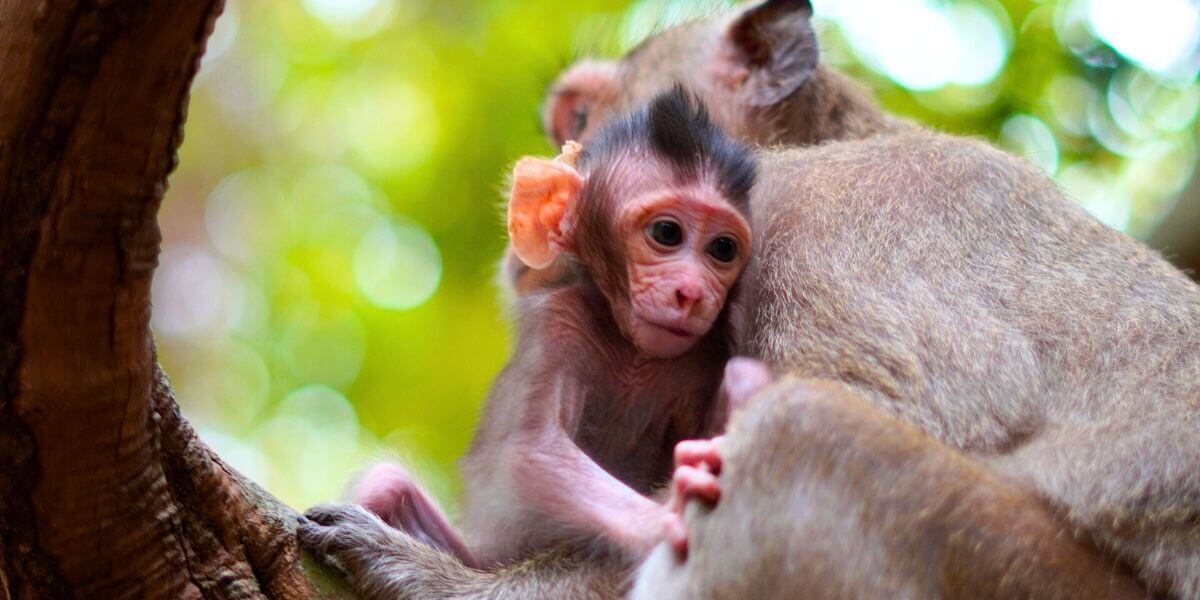
But monkeys in laboratories are often bred on factory farms or abducted from their forest homes, which is pushing some species toward extinction. Many die during capture or transportation, during which humans cram them into small wooden crates and fly them across the globe. Then, in laboratories, experimenters repeatedly torment them before ultimately killing them.
Watch Their Reactions—Then Take Action
The cruel monkey trafficking pipeline doesn’t just condemn thousands of monkeys to lives of fear, confinement, and death—it also puts public health on the line. Monkeys imported into the U.S. can carry dangerous pathogens, while experiments on them often yield unreliable results that fail to advance human medicine. It’s a lose-lose system that harms animals, wastes resources, and exposes humans to serious risks. It’s time to shut it down.
Watch the celebrities’ reactions to PETA’s disturbing footage, then urge Congress to support the PRIMATE Act and help spare monkeys from suffering in laboratories.
If you’re not in the U.S., you can still speak up today:
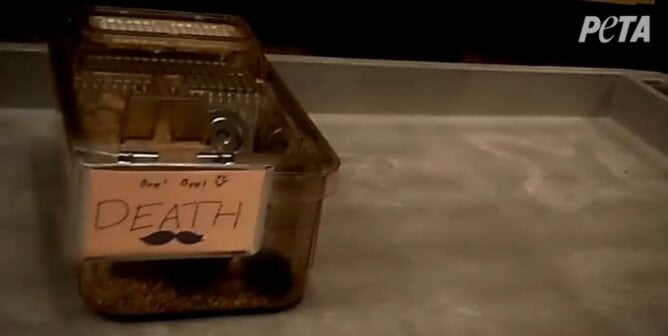
PETA found more than a dozen cases of animals suffering slow, terrifying deaths, including live mice thrown in the trash and too many animals crammed inside gas chambers, at UMass Chan.

From Albany to Marshall BioResources, marchers will cover 207 miles in a call for science without suffering. Find out how you can take part from anywhere.
Jin Zhang, who cut the tongues out of mice after painful surgeries and pointless tests, had to go no-contact with animals for an entire year