
PETA Appeals to Governor After Board of Health Shrugs Off Zoonotic Disease Risk in UW Primate Labs
For Immediate Release:
July 6, 2026
Contact:
Tasgola Bruner 202-483-7382
PETA today called on Governor Bob Ferguson to protect Washington residents after the State Board of Health denied a rulemaking petition that would have required primate laboratories to report dangerous infectious diseases detected in monkeys used for experimentation.
PETA’s appeal comes after Secretary of Health Dennis Worsham and the board falsely claimed that dangerous diseases were already being reported to the state and voted to continue allowing officials to ignore diseases that can spread from monkeys to humans.
The appeal cites a documented failure of the state’s current system. In 2023, 64 monkeys arriving at the University of Washington’s (UW) primate center from its Arizona breeding facility tested positive for Shigella, a serious diarrheal illness transmissible to humans, and other infectious diseases. But records obtained by PETA show that neither the Washington Department of Health nor the Washington State Department of Agriculture received reports of the incident, leaving state officials unaware of a significant disease event at one of the state’s largest primate experimentation facilities.
“The Board of Health ignored expert testimony, relied on incorrect information, and rejected a commonsense reporting requirement designed to alert health officials when dangerous diseases are detected in laboratories that have primates,” says PETA Chief Science Advisor on Primate Experimentation Dr. Lisa Jones-Engel. “PETA urges Governor Ferguson to step in before another disease incident occurs without the knowledge of state health authorities.”
The Board of Health petition was brought by PETA, the Physicians Committee for Responsible Medicine, and the Northwest Animal Rights Network and was supported by tens of thousands of Washingtonians, veterinarians, physicians, and other supporters. Board members argued at their June 4 meeting that existing reporting requirements already include diseases such as Campylobacteriosis, Cryptosporidiosis, Giardiasis, and Shigellosis. Days later, however, the Department of Health confirmed to PETA that these diseases “are not reportable” when detected in primates confined in laboratories.
Secretary of Health Worsham also claimed that “no other state really requires a specific zoonotic reporting of research animals. And so that doesn’t exist anywhere.” Yet California and Oregon, which also house federally funded and other primate experimentation facilities, require reporting of diseases that Washington has chosen not to track.
UW and Altasciences, a contract testing laboratory in Everett, collectively bring in and confine thousands of monkeys in the state for experimentation. While records from UW can be obtained through open records requests, Altasciences operates largely outside public scrutiny, making disease reporting one of the few mechanisms available to ensure state health authorities are alerted when dangerous infectious diseases are detected in primates.
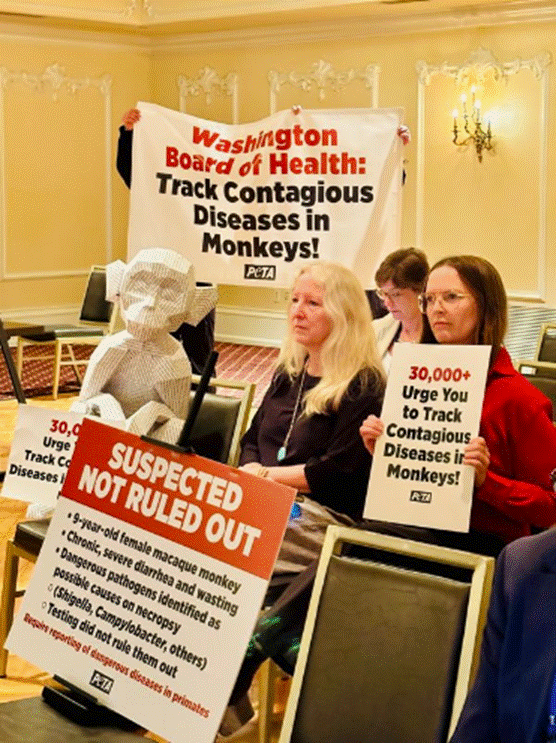
Credit: PETA
Zoonotic diseases known to circulate in primate facilities, including Campylobacteriosis, Cryptosporidiosis, Giardiasis, and Shigellosis, could easily be added to the list that the Washington State Department of Agriculture already reports to the Department of Health.
PETA—whose motto reads, in part, that “animals are not ours to experiment on”—points out that Every Animal Is Someone and offers free Empathy Kits for people who need a lesson in kindness. For more information, please visit PETA.org or follow PETA on X, Facebook, or Instagram.