
PETA Praises Universidad Austral de Chile’s Leadership in Banning Cruel Experiment
For Immediate Release:
June 18, 2026
Contact:
Tasgola Bruner 202-483-7382
After hearing from PETA scientists, the Universidad Austral de Chile (UACh) Office of the Rector has confirmed that it has banned the cruel and scientifically unsound forced swim test.
In an email to PETA, Rector Dr. Egon Montecinos announced that UACh “has established an explicit prohibition” of the forced swim test “across the entire institution,” in accordance with the official Resolution No. 10/2026 issued by the Vice Rector’s Office for Research, Development and Artistic Creation.
The widely discredited near-drowning test purportedly sheds light on human depression. Mice, hamsters, or other small animals are dosed with a test substance and put in inescapable containers of water, where they are forced to swim to keep from drowning. The test assumes that when animals stop swimming and begin floating, they have given up, which experimenters interpret as a sign of “depression.”
Scientists argue that floating is not a sign of despair, and research suggests the test is less reliable than a coin toss in determining the effectiveness of antidepressant medications.
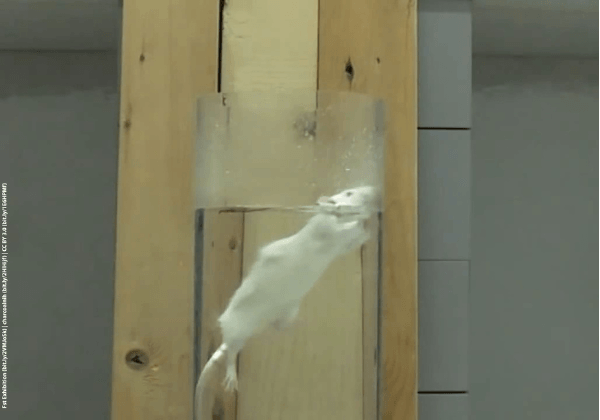
“Forcing tiny, terrified animals to swim for their lives is horrifically cruel and tells us nothing about human mental health,” says PETA Director of Science Advancement and Outreach Dr. Emily Trunnell. “PETA thanks Universidad Austral de Chile for this compassionate decision and urges all institutions still using this discredited test to follow suit.”
At least 40 universities and 19 companies, including many of the world’s top pharmaceutical companies, have said they will not conduct or permit forced swim test experiments. The test is now banned in New South Wales, Australia, and the U.S. Congress recently issued a report for the 2026 appropriations bill urging the National Institutes of Health to stop funding the forced swim test.
PETA—whose motto reads, in part, that “animals are not ours to experiment on”—points out that when it comes to the ability to feel pain, hunger, and thirst, a mouse is a dog is a boy. For more information, please visit PETA.org or follow PETA on X, Facebook, or Instagram.