
UW Cleared Monkeys as Healthy—But They Carried Multiple Pathogens; Were State Officials Notified?
For Immediate Release:
June 11, 2026
Contact:
Tasgola Bruner 202-483-7382
One week after the Washington State Board of Health rejected a petition for rulemaking seeking mandatory reporting of pathogens detected in primates confined in laboratories, PETA sent letters to the state departments of Health and Agriculture with evidence that in a single shipment of monkeys, nearly every animal declared healthy just days before carried contagious diseases—and asks a blunt question: Were officials ever told?
At its June 4 meeting, the Board of Health concluded, after reviewing the petition submitted by PETA, the Physicians Committee for Responsible Medicine, and the Northwest Animal Rights Network, that existing reporting systems were sufficient.
But records obtained by PETA reveal a reason for concern. In late 2023, 68 pigtailed macaques were imported from the University of Washington’s Mesa, Arizona, breeding facility to Seattle. A university veterinarian signed a certificate of inspection claiming that the macaques “are not showing signs of infectious, contagious, and/or communicable disease.” Yet within days of arrival, laboratory tests confirmed the monkeys carried Norovirus, Shigella, Enteropathogenic E. coli (EPEC), Campylobacter, Entamoeba, Giardia, Vibrio, and Cryptosporidium.
Seventy-five percent of the monkeys tested positive for three pathogens, and 70 percent carried Shigella, which causes severe diarrhea and is difficult to control in primate colonies. Shigella is not a hypothetical risk at UW, where internal records show that the university has grappled with monkey‑to‑human transmission in its primate facilities for years. One monkey had surgery for a rectal prolapse, likely caused by acute diarrhea, two days before being crammed into the transport truck. She later tested positive for Shigella, Enteropathogenic E. coli (EPEC), Campylobacter, and Entamoeba.
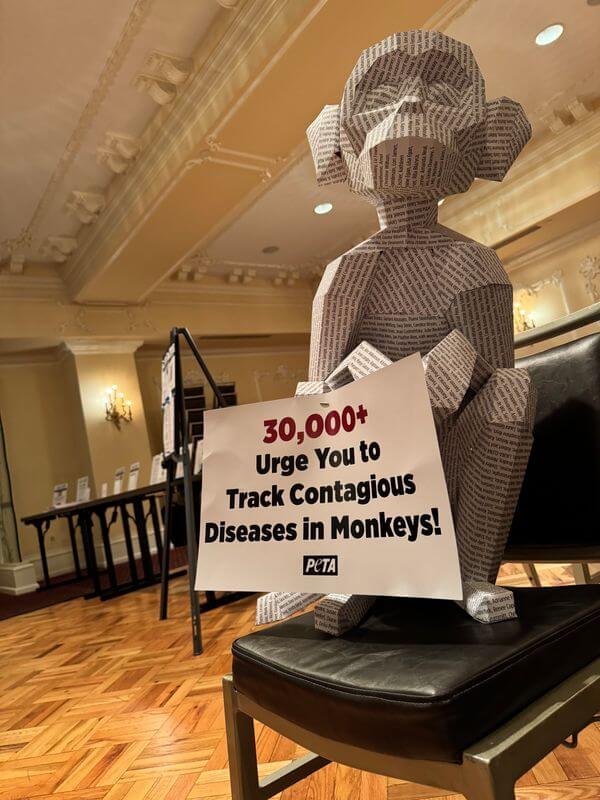
Credit: PETA
“Just a week ago, Washington State Secretary of Health Dennis Worsham said that current reporting systems were fine, but did those systems work as intended when dozens of monkeys tested positive for Shigella and other communicable pathogens shortly after arriving in Washington?” asked Dr. Lisa Jones-Engel, chief science advisor on primate experimentation for PETA. “Were state officials notified, or were these findings known only to the university?”
Documents also show that for years, monkeys at UW primate facilities have tested positive for a host of diseases that, if they occurred in humans, would have to be reported to the state Department of Health. Open records requests by PETA have returned no evidence that these pathogens have been reported to state agencies.
PETA—whose motto reads, in part, that “animals are not ours to experiment on”—points out that Every Animal Is Someone and offers free Empathy Kitsfor people who need a lesson in kindness. For more information, please visit PETA.org or follow PETA on X, Facebook, or Instagram.