Lovelace Biomedical Urged to Probe Studies Using Monkeys From Filthy Lab After PETA Exposé
For Immediate Release:
April 17, 2026
Contact:
Brandi Pharris 202-483-7382
In a letter sent yesterday, PETA urges Lovelace Biomedical to review all experiments on monkeys purchased from the University of Louisiana’s New Iberia Research Center (NIRC), the nation’s largest primate laboratory with 12,000 monkeys.
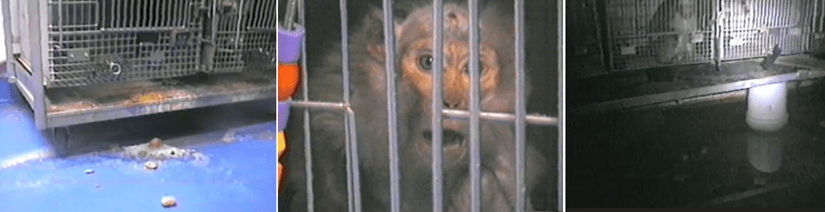
Last month, PETA released a whistleblower video showing monkeys at NIRC confined in accumulated waste with visible signs of stress and injury. Now, PETA has obtained public records involving NIRC and its pharmaceutical industry clients that raise serious concerns about the health of the monkeys it supplies, including evidence that at least one major drug company, Pfizer, accepted monkeys with known health problems, underscoring a willingness to use sick animals in experiments, which can taint data.
These records show that monkeys were selected for experiments based on age, weight, sex, and availability, not health. Even animals with infections, injuries, and active lesions were not excluded. Some were still sent to a contract laboratory for use in experiments. PETA is concerned this may reflect broader industry practices.
The whistleblower video shows the conditions behind those records, including monkeys stacked in barren cages in small, windowless rooms. Many have extensive hair loss, a well-documented indicator of chronic stress. The footage and records tell the same story: compromised animals are used in experiments.
“Sick monkeys don’t just suffer, they distort results and mislead decisions about what is safe and effective for patients,” says PETA Chief Science Advisor on Primate Experimentation Dr. Lisa Jones-Engel. “PETA strongly urges Lovelace Biomedical to examine its relationship with NIRC, where monkeys are confined in conditions that drive disease and distress and where even compromised animals can still end up in experiments.
In addition to its relationships with Lovelace Biomedical and Pfizer, NIRC sells monkeys to or receives funding to conduct monkey experiments from Charles River Laboratories; Crown Bioscience; CyanVac LLC; Elicio Therapeutics; Gates Foundation; Novavax; Ragon Institute—affiliated with Mass General Brigham, Massachusetts Institute of Technology and Harvard University—Sanofi; SeromYx Systems, Inc.; University of Nebraska Medical Center, among others.
Federal inspectors have cited NIRC for violating the Animal Welfare Act following the deaths of infant monkeys from dehydration, a monkey who was electrocuted, and for broken or dilapidated cages that contribute to repeated escapes. The U.S. Department of Agriculture recently cited the university when 19 monkeys died after being confined outside, unprotected, in sub-freezing weather. Authorities have imposed substantial fines of more than $158,000.
PETA—whose motto reads, in part, that “animals are not ours to experiment on”—points out that Every Animal Is Someone and offers free Empathy Kits for people who need a lesson in kindness. For more information, please visit PETA.org or follow PETA on X, Facebook, or Instagram.