20 Screws Driven Into Monkey’s Brain and Other Horrors at UMN, PETA Reveals
For Immediate Release:
April 11, 2026
Contact:
Tasgola Bruner 202-483-7382
In letters sent today, PETA calls for the University of Minnesota to ban experimenters Jan Zimmermann and Geoffrey Ghose from experimenting on animals, for the National Institutes of Health (NIH) to yank funding, and for the state veterinary board to investigate after whistleblowers supplied evidence the two—who aren’t physicians or veterinarians—repeatedly botched brain surgeries, leaving neurologically damaged monkeys with infection and painful side effects, often suffering long periods without adequate treatment.
PETA initially presented evidence of alleged violations to Minneapolis law enforcement. After that, Ghose was stripped of the privilege to run his own laboratory, but he is still allowed to experiment on monkeys in other laboratories. Ghose and Zimmermann receive NIH funding for monkey experiments.
Zimmermann, while implanting a metal post onto the skull of a monkey, drilled 20 screws so deep they pierced his brain tissue, a whistleblower said. Records show that after the surgery, the monkey was lethargic, vomited, and showed arm weakness, abnormal eye movements, and signs of severe headache. He suffered for months before he was killed.
Ghose operated on a monkey named Bilbo, whose brain was exposed for days after a device anchored to his skull fell off. Ghose was implanting an apparatus in Bilbo’s skull but failed to restrain him properly, allowing his head to slip free while a metal rod jammed into his eye. Bilbo then kept the injured eye closed for at least the next 40 hours. Later, after extensive infection developed in the tissue surrounding the implant, the recording chamber fell off entirely, leaving Bilbo’s brain exposed—yet nothing was done for days to cover or protect the exposed brain.
In addition to NIH grants, Zimmermann is paid by a San Francisco-based biotech company, NeuralThread, to experiment on monkeys. NeuralThread founders Chong Xie, Lan Luan, and Mattias Karlsson previously worked at Neuralink, the company owned by Elon Musk that came under fire for multiple animal welfare issues.
“Evidence shows these experimenters are butchers who should never be allowed near a monkey again,” says PETA Vice President Dr. Alka Chandna. “PETA calls on the University of Minnesota to close up their laboratories and send the surviving monkeys to a sanctuary.”
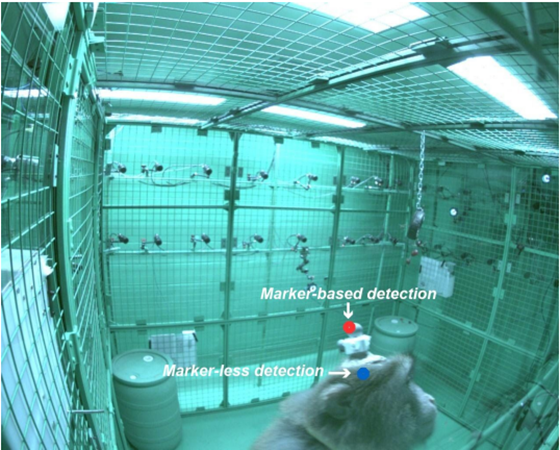
In Zimmermann’s laboratory, a monkey sits inside a cage while a holder attached to a surgically implanted headpost tracks the animal’s head position. These procedures can cause pain, infection, and chronic stress. Credit: Bala, P.C., Eisenreich, B.R., Yoo, S.B.M. et al. Automated markerless pose estimation in freely moving macaques with OpenMonkeyStudio. Nat Commun 11, 4560 (2020). Deed – Attribution 4.0 International – Creative Commons
The university has a long history of animal welfare violations. In 2023, it was ranked the nation’s fifth-worst violator of federal animal welfare laws among schools with taxpayer-funded laboratories, according to a study by PETA scientists.
In nature, macaques live in large, tight-knit groups, travel several miles each day exploring diverse habitats, and cuddle together in their favorite “sleeping trees” at night.
PETA—whose motto reads, in part, that “animals are not ours to experiment on”—points out that Every Animal Is Someone and offers free Empathy Kits for people who need a lesson in kindness. For more information, please visit PETA.org or follow PETA on X, Facebook, or Instagram.