UW Primate Center Name Change: A Rebranding or Real Reform? Grave Doubts Raised, Answers Sought
For Immediate Release:
February 18, 2026
Contact:
Tasgola Bruner 202-483-7382
Seven months ago, only days after staff at its Arizona primate breeding facility placed a still-living newborn primate inside a plastic biohazard bag and put the infant in a cooler, senior leadership at the Washington National Primate Research Center convened a meeting focused on public optics and funding vulnerability, and decided to accelerate efforts to remove the word “primate” from the center’s name.
In a letter sent today, PETA challenges UW’s Board of Regents to clarify whether its rebranding signals an end to monkey experimentation or merely a name change to attempt to dispel criticism of its failure to care for primates in its care. The USDA has cited the university’s primate facilities 10 times in just the past two years. Inspectors have found broken cages, unsafe housing, protocol breaches, overdoses, escapes, and a monkey who suffered radiation toxicity at the hands of an experimenter.
On June 30, 2025, staff at the university’s primate breeding facility in Mesa, Ariz., saw a limp infant macaque in a mother’s arms. The baby was taken, placed in a biohazard bag, and put in a cooler. As staff prepared for a necropsy nearly an hour later, they found the infant still alive and gasping for air. Staff euthanized the baby.
On January 12, 2026, the U.S. Department of Agriculture (USDA) cited the university for a critical violation of the federal Animal Welfare Act, noting failures in veterinary oversight and in basic procedures for confirming death. On February 11, 2026, UW sanitized the incident on its website by reducing it to a vague, one-line “self-reported” entry and omitting key details. On February 13, 2026, UW eliminated the word “primate” from the center’s name.
“A live newborn was treated as medical waste, and instead of fixing the system that allowed it, the center is changing its name,” says PETA Senior Science Advisor Dr. Lisa Jones-Engel. “The change the center should make is ending the use of monkeys entirely.”
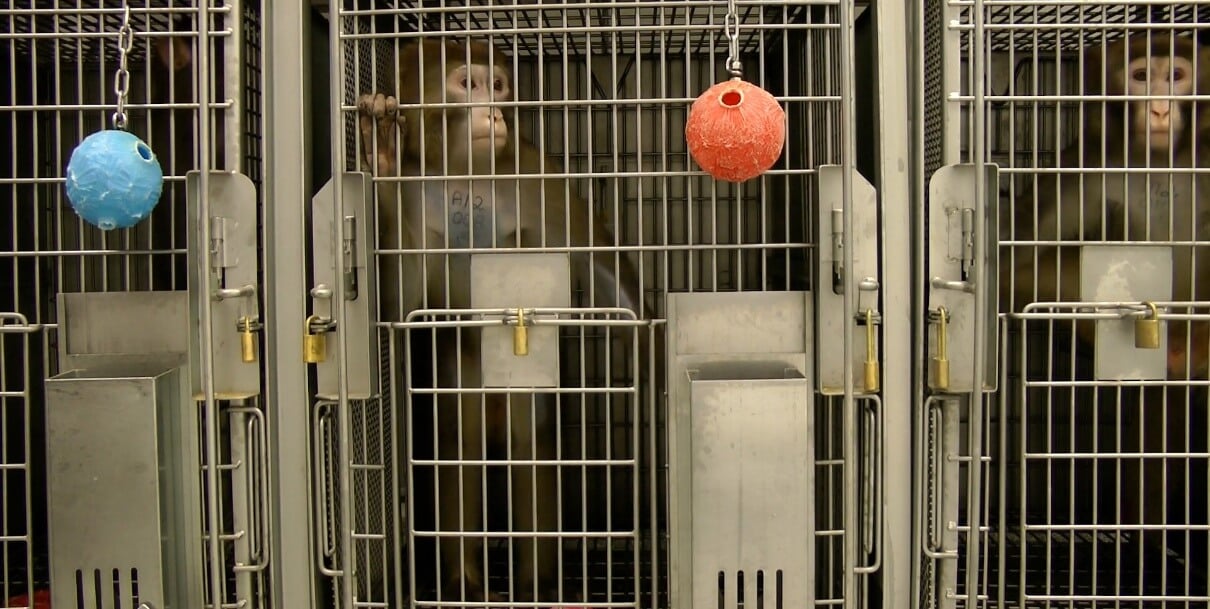
Monkeys caged at the WaNPRC. Image obtained through a public records request by PETA.
PETA obtained internal communications showing the name change was part of a coordinated, multi-center strategy among the remaining primate centers. Primate center senior leadership at UW agreed in a July 16, 2025, meeting that the name change should happen “sooner rather than later,” with the apparent goal of distancing the centers from the growing scrutiny of experiments on primates.
PETA—whose motto reads, in part, that “animals are not ours to experiment on”—points out that Every Animal Is Someone and offers free Empathy Kits for people who need a lesson in kindness. For more information, please visit PETA.org or follow PETA on X, Facebook, or Instagram.