
PETA: Let’s Liberate Language!
A Rat Isn’t Dirty, a Mother Bear Isn’t ‘It,’ and Thugs Aren’t ‘Behaving Like Animals’
When angry fans defaced a mural of ex-Liverpool defender Trent Alexander-Arnold with the word “rat,” PETA UK rushed to the defense – no, not of the soccer star, who doesn’t need our help, but of rats. Before Alexander-Arnold returned to Liverpool with his current team, PETA UK sent Anfield stadium bars of “Wash Your Mouth Out” soap to distribute to Liverpool fans.
Words matter. Research shows that the words we use affect how we think. They shape our ideas and reinforce beliefs. Take the name of any species and apply it to a human, and invariably the other animal comes off looking worse. Is someone complimenting you if they call you a rat, a pig, a chicken, or a snake? Exactly!
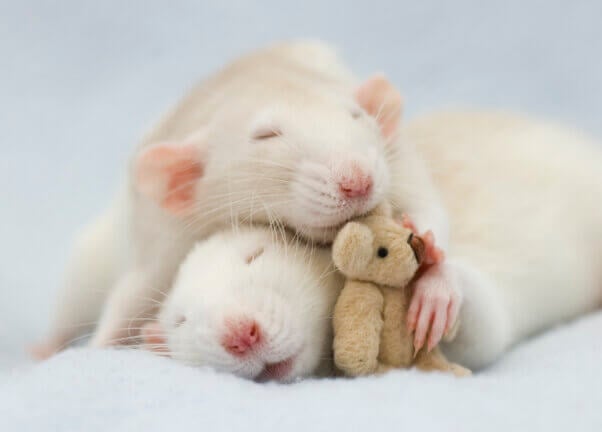
Never mind that rats are among the most empathetic of all animals and will save rats they don’t even know from drowning, even if that means they have to give up their food (making them far more empathetic than the humans who put them through such abusive experiments).
Rats love their families, and their enamored guardians love the beautiful scent of their fur. (One gushed, “My girls smell like the most fragrant flowers!”) People who have spent time around pigs know that they are smart, playful, and protective. Chickens, who are anything but cowardly, will fiercely protect their families from foxes, hawks, eagles, even bears. Garter snakes are social and form friendships. And so it goes.
But if language that devalues others, human or not, is used, it allows the speaker to discount exploitation, pain, and suffering. So PETA is proposing a linguistic revolution – and sparking discussion in the process. When we tweeted a list of animal-friendly phrases to replace idioms that evoke harming animals – try “feed two birds with one scone” rather than “kill two birds with one stone” and “take the flower by the thorns,” not “take the bull by the horns” – media outlets from The Guardian to CNN reported on the issue. The Daily Mail, MSN, and others ran articles about PETA UK’s request that the Cambridge Dictionary remove its denigrating entry for “rat,” which the dictionary inaccurately associates with deceit and disloyalty.
Thanks to speaking up about this issue, millions have gotten the message that calling animals “it,” calling a human coward a “chicken,” or using other slurs is harmful, inaccurate, discriminatory – and speciesist. Let’s keep moving the linguistic needle – and society’s attitude toward other animals – forward.